

Executive summary
Guinea has remained largely insulated from the militant violence affecting neighboring Mali. However, the security environment along the Mali-Guinea border has become increasingly fragile as the al-Qaeda-affiliated Jama’at Nusrat al-Islam wal-Muslimin (JNIM) has expanded and entrenched its presence across southern Mali. This expansion has brought militant activity closer to Guinea’s eastern border areas, where major industrial and artisanal mining sites are located. Although there is limited evidence of sustained militant operations inside Guinea, official warnings, suspected reconnaissance, militant recruitment, violent incidents, and counter-terrorism investigations point to an elevated risk of future spillover.
Looking ahead, the most likely trajectory is a gradual increase in cross-border militant activity rather than a sustained militant campaign inside Guinea. The main risk is not the direct targeting of mining sites, but the progressive infiltration of border communities, artisanal mining areas, transport corridors, and local commercial networks. If left unchecked, these activities are likely to create conditions similar to those that facilitated JNIM’s expansion elsewhere in the central Sahel.
JNIM infiltrates eastern Guinea’s main gold-producing region
Concerns over militant infiltration in Guinea’s mining regions predate the security deterioration along the Mali-Guinea border over the past year. In November 2023, the Kaloum court prosecutor publicly stated that suspected foreign militants had been identified in Kankan, Mandiana, and Guinea’s forested southeastern border areas. He described Guinea primarily as a transit area and said that the militants traveled to mining areas to generate income rather than to establish a permanent presence. This was one of the earliest official acknowledgments that militants had begun establishing a presence in Guinea’s eastern border areas through cross-border movement and mining-related activities, even if they did not yet pose an immediate threat at the time.
This approach is consistent with an early phase of militant infiltration marked by the gradual penetration of border communities, artisanal mining areas, transport corridors, and commercial networks. These environments provide access to local contacts, revenue, supplies, intelligence, and recruitment while allowing militants to establish a presence without immediately confronting the state. This broadly reflects JNIM’s expansionist playbook elsewhere in West Africa, where an initial infiltration phase involving cross-border movement, recruitment, economic activity, and the development of local networks often precedes more overt contestation with state forces and, where successful, the consolidation of territorial influence.
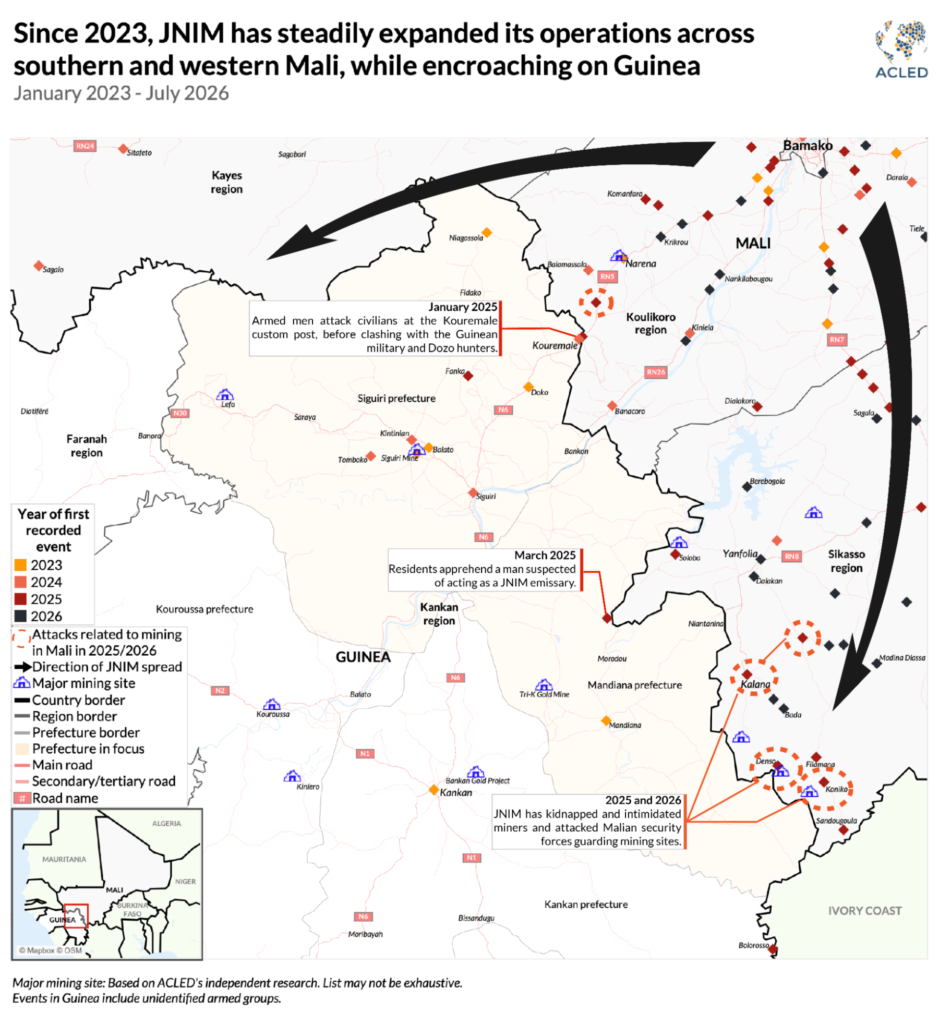
JNIM has steadily expanded its operations across southern and western Mali since 2023, indicating sustained entrenchment rather than sporadic activity. In 2025 and so far in 2026, the group has intensified attacks on mining operations along the Mali-Guinea border, where it has abducted foreign personnel, destroyed mining infrastructure and equipment, and attacked military positions protecting mining sites. This expansion has enabled JNIM to encroach on the artisanal and industrial gold-producing prefectures of Siguiri and Mandiana in Guinea’s main gold-producing eastern region (see map below).
Early indicators of a militant threat in Guinea emerge
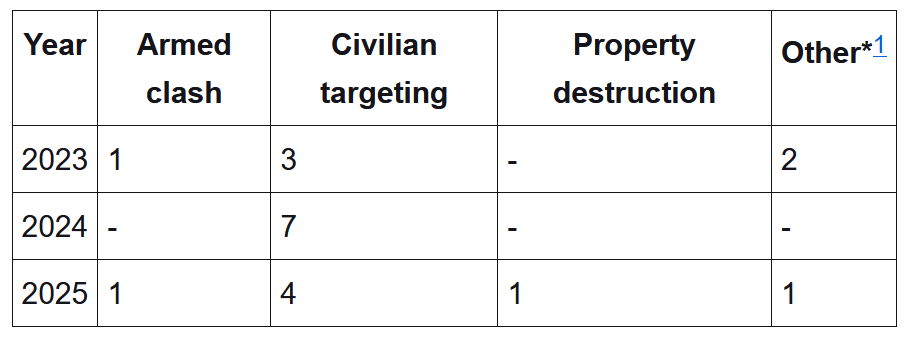
There is currently limited evidence of sustained militant activity inside Guinea, but several indicators point to a gradually evolving militant threat. These include cross-border movement and mining-related economic activity, suspected reconnaissance, recruitment, the establishment of local support networks, and a series of unattributed violent incidents in the same border and mining areas (see table below). During 2024 and 2025, unidentified armed groups attacked miners, mining communities, and border localities in eastern Guinea. In January 2025, armed men attacked civilians at the Kouremale customs post, the main border crossing between Mali and Guinea, before clashing with the Guinean military and Dozo hunters. Although none of these incidents can be conclusively attributed to JNIM, subsequent developments point more directly to concerns over militant infiltration.
Suspected JNIM activity in Guinea
For example, residents of Limbana in Mandiana prefecture, one of Guinea’s main artisanal gold-mining areas, apprehended a man suspected of acting as a JNIM emissary conducting reconnaissance on 25 March 2025. Two days later, Malian forces carried out clearing operations against suspected JNIM collaborators in several localities in the Yanfolila area near the Guinean border. In April 2025, Guinean authorities arrested 11 individuals in the prefectures of Siguiri, Mandiana, and Kankan. A statement issued by the Office of the Prosecutor General almost a year later said that these arrests concerned JNIM-linked networks. It also reported the arrest of a Malian national suspected of belonging to a dormant JNIM cell and said it had launched investigations into alleged financing, online radicalization, recruitment, and local support networks. While these allegations are subject to judicial proceedings, they show that authorities are investigating low-profile networks that can lay the groundwork for overt militant activity.
The presence of JNIM-linked networks in Siguiri and Mandiana is particularly concerning for industrial mining operations because militants do not need to attack a mine directly to disrupt operations. Local support networks can facilitate surveillance and provide intelligence needed to carry out kidnappings and extortion and to target employees, transport routes, and supply chains, as they have done in the Central Sahel.
Outlook: A mining-driven economic boom presents opportunities for militants but increases associated risks
Over the next 12 to 24 months, JNIM’s expansion in southern Mali is likely to increase pressure on Guinea’s eastern border areas, although sustained militant violence in Guinea remains unlikely in the next six months. The evidence points to a gradual shift from using Guinean territory for transit and revenue generation toward reconnaissance, recruitment, establishing local support networks, and potentially engaging in violence over the longer term.
Guinea’s strong economic performance presents a double-edged sword. Increasing mining revenues and investment are likely to strengthen the state’s capacity to improve border security, expand its presence in vulnerable regions, and invest in infrastructure and local development. At the same time, new industrial mining projects, increased foreign investment, and expanding transport and logistics networks create additional opportunities for militant infiltration while increasing the risk of extortion; kidnappings; and attacks targeting mining personnel, transport routes, and supply chains.
The gold-mining areas of Siguiri and Mandiana are particularly exposed because of their proximity to JNIM’s areas of operation in southern Mali. Any further escalation toward violent activity is likely to emerge first in these border and mining areas rather than deeper inside Guinea.
Key factors that indicate a growing risk for the Guinea mining sector
JNIM entrenchment in southern and western Mali: A more sustained JNIM presence along the Guinean border increases the risk of cross-border movement, recruitment, or engagement with local communities in Guinea, which would signal an intensifying phase of infiltration and elevate the risk of violent spillover.
Increasing militant activity in areas of artisanal mining: Key indicators of increased militant activity in areas of artisanal mining include extortion or taxation of miners and gold traders, regulation of access to mines, preaching and recruitment among local communities, procurement of fuel and other supplies, the establishment of relationships with local traders and transporters, and the provision of dispute resolution or security in mining areas, especially in Siguiri and Mandiana.
Gaps in border security efforts: Guinean and Malian military forces coordinate their respective border security efforts but conduct operations unilaterally on their respective sides of the border, potentially leaving gaps for cross-border militant movement. Recent arrests and counter-terrorism investigations point to increasing efforts from Guinea to mitigate the threat of militant movement, but there is limited evidence of strengthened border security, increased military deployments and patrols, or regular joint operations between the two countries.