
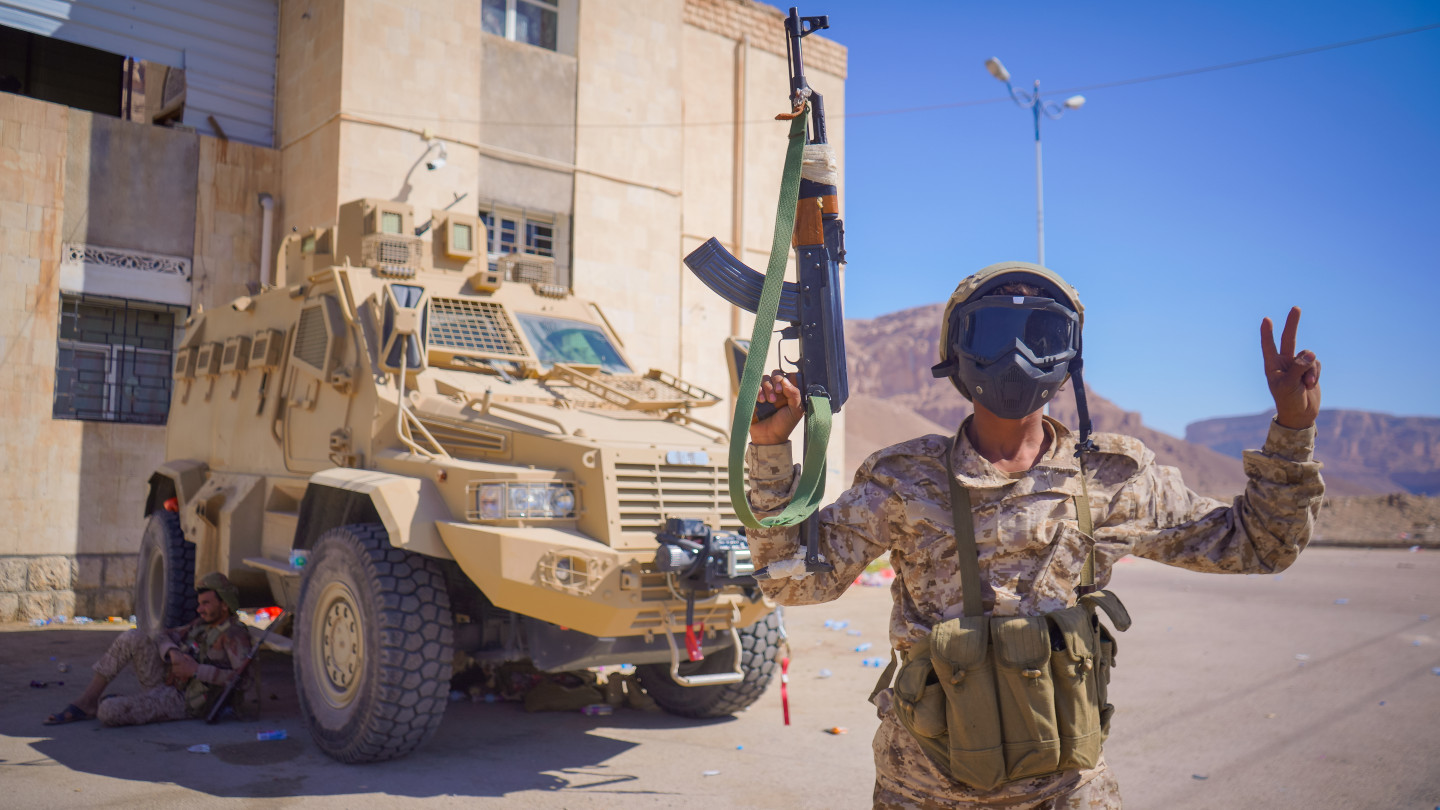
When the Houthis launched attacks along Yemen’s western coast on 3 September, internationally recognised government-aligned forces were unprepared for what was the largest offensive since the ceasefire signed in 2022.
Their response revealed a series of operational failures that allowed the Houthis to advance across 5,000 square kilometres, seizing the port city of Mocha, several coastal positions, and the islands of Mayyun and Hanish to gain control of the Bab al-Mandeb Strait.
Reported accounts of the initial Houthi offensive show that the fragmented government-aligned forces lacked military coordination and timely support from Saudi Arabia, which backs Yemen’s internationally recognised government.
The Houthis penetrated opposition communications, tracked troop movements, and cut off frontline units from command. They reportedly relied on Iranian advisers, who provided direct support for their blitzkrieg.
Over the following days, Saudi airstrikes and Yemeni government-aligned counterattacks sought to reclaim lost ground, including areas along the Taiz–Aden route.
Combat is currently concentrated in Taiz province, where the Houthis are attempting to consolidate control over captured territory.
“Their objective is to consolidate gains by securing the mountainous areas overlooking Bab al-Mandeb and blocking the road between Taiz and Lahej and Aden to cut off military support,” Yemeni political analyst and journalist Mohammed Al-Qadhi told The New Arab.
“By recapturing these zones lost in 2017, the Houthis shield themselves from government and Saudi counter-offensives, avoiding exposure in the flat coastal areas.”
Reports also suggest Houthi troop movements towards Saada province on the Saudi border.
The fault lines in Yemen’s anti-Houthi camp
Regional and Western officials told Reuters last week that Saudi Arabia was planning a large-scale offensive against the Houthis, including a possible coastal push to secure Red Sea shipping, or an assault on multiple fronts.
On Sunday, Yemen’s government then announced the ambitious goal of retaking all Houthi territory, with operations beginning at dawn.
So far, according to the Saudi-led coalition, the military has carried out over 1,000 airstrikes using 100 warplanes as part of Operation ‘Dawn of Yemen’.
The Houthis effectively encircled the city of Taiz the same day, cutting off the main supply route linking the city to Aden, the capital of the government.
As the war unfolds, the Houthi offensive could expose the limits of Yemen’s anti-Houthi coalition, with Saudi Arabia and the Yemeni government struggling to overcome fractured command structures and competing political agendas threatening to undermine their campaign.
Yemen’s anti-Houthi camp has never been a single bloc, with the Saudi-backed government, represented by the Presidential Leadership Council (PLC), an uneasy coalition of rival factions.
Among them is the Southern Transitional Council (STC), a UAE-backed separatist movement that had been represented on the council until January and seeks an independent southern Yemen.
Its offensive to expand control, launched in December 2025, was rapidly reversed by Saudi-backed forces in January, prompting the UAE to withdraw its remaining forces from Yemen.
Tareq Saleh, nephew of the late president Ali Abdullah Saleh, meanwhile, commands the National Resistance Forces (NRF), which favour a unified Yemen but were long backed by Abu Dhabi.
Islah, the Sunni Islamist party with historical ties to the Muslim Brotherhood – an association it denies – has long opposed the southern separatist project and supports a unified Yemen.
The UAE-backed Giants Brigades and National Resistance Forces (NRF) retain distinct command structures, even as Riyadh seeks to bring Yemen’s fragmented armed groups under a more unified state command through the Nation’s Shield and other security and military structures.
Operationally, the NRF, Giants Brigades, and National Shield Forces (operating under the PLC) maintain separate command structures and logistics rather than a unified field command, while the PLC itself has yet to establish an integrated military leadership.
Coordination is made even harder by lingering anger in the south after the STC’s contested dissolution in January, the rise of the southern region of Hadhramawt as an independent political force, and Islah’s mistrust of UAE-backed groups.
“On this basis, a unified front under a single command with a shared offensive objective appears unlikely in the coming months,” Ahmed Alshargabi, a research analyst at the Yemen Policy Centre, told The New Arab.
“The more probable outcome is defensive coordination aimed at blocking further Houthi advances toward Lahj, Aden, Bab al-Mandeb and Marib, without any real integration of forces.”
He added that a real alliance depends on an understanding between Riyadh and Abu Dhabi, unified funding, southern political guarantees, and an empowered field command.
Rival regional visions for Yemen
The Saudi-UAE rivalry plays a critical role in the anti-Houthi coalition’s internal fragmentation.
As Andreas Krieg, associate professor in Security Studies at King’s College London, explained to The New Arab, Saudi Arabia and the UAE have different interests and cultural approaches to Yemen.
Abu Dhabi does not see a unified Yemen as a necessity, while Riyadh favours a unified sovereign state. The result is a fragmented landscape in which few Yemeni forces have a stake in fighting beyond their own regions.
“It’s unrealistic to think that the southerners will fight in the north against the Houthis, which most southerners see as a problem for northerners,” he told The New Arab.
“Even if there is a reconciliation between the UAE and Saudi Arabia, it’s very unlikely the southerners will volunteer to take the war into northern Yemen. They have no stakes there. So ultimately what we end up with is a shifting stalemate.”
Last week, UAE Vice President Sheikh Mansour bin Zayed visited Crown Prince Mohammed bin Salman in Riyadh. It was the first visit by a senior Emirati official since a diplomatic rift erupted between the two Gulf states in January.
Alshargabi said the meeting reflects a tactical rapprochement driven by Houthi advances and Riyadh’s reliance on UAE-backed forces, but Abu Dhabi’s potential demands could fuel new instability and leave their rivalry unresolved.
Krieg added that potential UAE support is unlikely to alter the war’s trajectory, given the fragmented command structures and the limited reach of southern forces.
In early 2026, Yemen’s government attempted to consolidate southern forces by integrating former STC units into the Interior Ministry, reshuffling commanders, and tolerating hybrid arrangements. Some experts argue that a state monopoly on force is unlikely given Yemen’s tribal loyalties, whereas reducing the number of non-state armed actors is more realistic.
Forging military cooperation among anti-Houthi forces is far easier than achieving political unity, according to Anas Alqaed, director of programmes at the Gulf International Forum, because battlefield coordination requires no formal political agreement.
“The coalition lost ground mainly due to a breakdown in command and control, and fixing that could take anywhere from a few months to two years,” he told The New Arab.
“However, I do not believe the anti-Houthi coalition is ready to reverse the Houthi advance, and we will not see a joint Saudi-Emirati or global coalition form against them until they actively move to close the Bab al-Mandeb Strait.”
After the US declined Saudi Arabia’s request for military support, Riyadh turned to Pakistan and Turkey, signatories of the recent Mecca defence pact. Both have limited their commitments to technical support, while their defence and foreign ministers and military chiefs are due to meet in Riyadh this week.
Riccardo Gasco, foreign policy coordinator at InstanPol Institute, said expectations around the Mecca Pact are inflated, particularly over the prospect of automatic military support.
“Turkey has a clear interest in stopping the Houthis in relation to Bab al-Mandeb Strait as a trade corridor, but strictly automatic military support remains highly improbable,” he told The New Arab.
Among Saudi Arabia’s other allies, Britain offered air refuelling, while France announced the deployment of military personnel to the Red Sea port city of Yanbu.
Unconfirmed reports say Israeli Prime Minister Benjamin Netanyahu has offered to help Gulf states in a wider campaign against the Houthis. But Krieg argued that “the Israeli intelligence networks in Yemen are very poor”, with Riyadh and Abu Dhabi far better placed.
“That is not something the Israelis can deliver,” he said, adding that Israeli involvement could further fracture the anti-Houthi camp and fuel Houthi propaganda, while Tel Aviv may use its assistance as a card to play in its push for normalisation.
A new stalemate?
While the fragmentation of the anti-Houthi camp benefits the Houthis and Iran – exerting pressure on a second strategic chokepoint after Hormuz and handing Tehran greater leverage in US negotiations – it also strengthens the Houthis’ position against Riyadh.
As the trajectory of the Yemen war remains uncertain, experts lay out several scenarios. One is containment, with the Houthis consolidating gains as far as Bab al-Mandeb and front lines settling around Lahj, Taiz, and Marib.
This would leave Yemen de facto partitioned and Riyadh entering negotiations from a position of weakness.
Alternatively, a limited counter-offensive could see coalition forces retake ground around Dhubab and Mokha, though this would require unified command and Saudi–Emirati coordination.
Other possibilities include regional escalation via attacks on Saudi infrastructure or shipping, or a return to UN-led diplomacy.