
Key Takeaways:
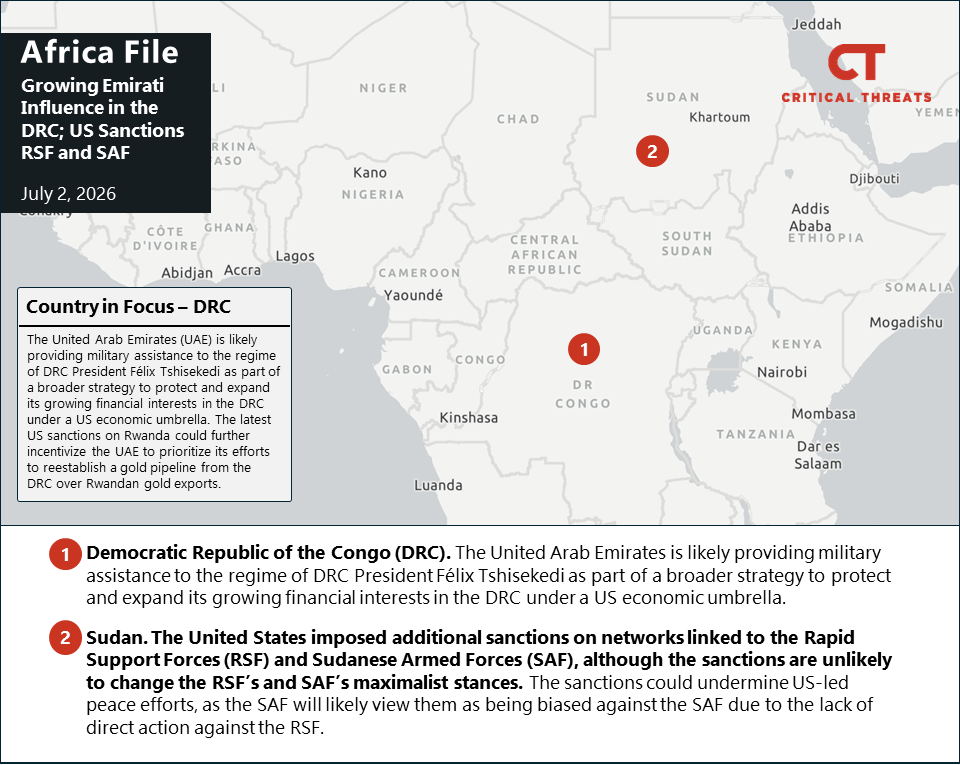
Democratic Republic of the Congo (DRC). The United Arab Emirates is likely providing military assistance to the regime of DRC President Félix Tshisekedi as part of a broader strategy to protect and expand its growing financial interests in the DRC under a US economic umbrella.
Sudan. The United States imposed additional sanctions on networks linked to the Rapid Support Forces (RSF) and Sudanese Armed Forces (SAF), although the sanctions are unlikely to change the RSF’s and SAF’s maximalist stances. The sanctions could undermine US-led peace efforts, as the SAF will likely view them as being biased against the SAF due to the lack of direct action against the RSF.
Assessments:
Figure 1. Africa File, July 2, 2026
Democratic Republic of the Congo
The United Arab Emirates (UAE) is likely providing military assistance to the regime of Democratic Republic of the Congo (DRC) President Félix Tshisekedi as part of a broader strategy to protect and expand its growing financial interests in the DRC under a US economic umbrella. Flight tracking data indicates that a cargo aircraft owned by a UAE-based company operating under a charter agreement with Invicta Air Cargo made two round trips between Al Reef Airbase in Abu Dhabi and Kinshasa, the Congolese capital, on June 25 and 26.[1] Invicta is a Central African Republic-based global freight company that holds contracts with the Emirati government and has been suspected of involvement in Emirati weapons shipments to the Rapid Support Forces in Sudan.[2] The UAE reportedly uses Al Reef frequently for its military logistics operations in Africa.[3]
The UAE has signed several mining deals with the DRC since the United States became involved in regional peace efforts in mid-2025. The UAE-based International Resources Holding (IRH) company, which has links to the UAE’s president, Mohammed bin Zayed al-Nahyan (MbZ), announced in June 2025 that it had acquired a majority stake in North Kivu province’s Bisie tin mine, the world’s third-largest tin mine, two months after the United States brokered M23’s withdrawal from the area.[4] Tshisekedi’s private adviser, Kahumbu Mandungu Bula, who is also known as Kao, reportedly facilitated the transfer of several industrial mining licenses in the southern DRC to companies linked to IRH after years of back-and-forth in late 2025.[5] Tshisekedi signed the Comprehensive Economic Partnership Agreement and several mining agreements with the UAE that expanded the UAE’s logistics presence along one of the DRC’s export corridors in early February 2026.[6] The DRC agreed to ship 50,000 tons of copper to Saudi Arabia and the UAE through a US-backed venture with a Swiss commodities trader in early February.[7] The Swiss mining giant Glencore then agreed to sell 40 percent of its Congolese assets to a critical mineral consortium backed by an Emirati sovereign fund, the US government, and a New York-based investment fund in a blockbuster deal in mid-February.[8]
Expanding Emirati military cooperation with the DRC over the last five years directly supports these financial interests. The UAE reportedly signed a bilateral defense deal and sent military equipment to the Congolese army (FARDC), including several batches of armored personnel carriers for use against M23 rebels in the eastern DRC and tens of thousands of small arms for the FARDC, between 2021 and 2023.[9] The UAE reportedly secured rights to Congolese gold exports during this period, in part through its donations of military equipment.[10] Tshisekedi dispatched his brother and Kao, who is orchestrating DRC-UAE ties due to his relationship with MbZ, to the UAE to discuss trading mining rights with IRH in exchange for increased military assistance after M23 and Rwanda’s offensive in the eastern DRC in early 2025.[11] An Emirati defense manufacturer delivered a batch of armored vehicles to Kinshasa’s port in May 2025, some of which Tshisekedi’s praetorian guard deployed in the mineral-rich southern DRC against secessionist militias.[12] The DRC announced in April 2026 that the UAE committed to help fund training for a paramilitary force of more than 20,000 that will purportedly protect mines in the southern DRC.[13]
Erik Prince, a partly UAE-based American private military contractor connected to DRC-UAE bilateral discussions in 2023, has expanded his involvement alongside the increased DRC-UAE cooperation. Several sources told the UN in July 2023 that a failed deal that Kao struck with Prince in 2023 to deploy 2,500 Latin American mercenaries to fight against M23 was linked to a DRC-UAE bilateral agreement.[14] The Congolese finance ministry hired Prince and his firm, Vectus Global, for a five-year, $700 million contract in late 2024 to help crack down on tax evasion in the DRC’s mining sector and provide covert military support to the FARDC.[15] The Wall Street Journal reported in August 2025 that Prince was also in discussions with the DRC about deploying Salvadoran mercenaries to help secure Tshisekedi’s presidential palace in Kinshasa.[16] The UN reported that the focus of the Vectus contract shifted to providing security for the Congolese government amid the escalating fighting in late 2025.[17] Vectus contractors then deployed to the front line alongside the FARDC against M23 in South Kivu province in January 2026, including to assist in operations with FARDC special forces that Israeli instructors reportedly advised.[18]
The latest US sanctions on Rwanda could further incentivize the UAE to prioritize its efforts to reestablish a gold pipeline from the DRC over Rwandan gold exports. The UAE tried to secure a steady supply of gold from the DRC in Tshisekedi’s first term. Kao negotiated a deal with MbZ to establish Primera Gold DRC, a public-private joint venture that began exporting artisanal gold from the DRC to a refinery controlled by members of MbZ’s family in Abu Dhabi in January 2023.[19] Primera benefited from a favorable tax regime, among other advantages, making it a de facto monopoly on official gold exports.[20] The Congolese government presented Primera as an effort to increase revenue from the informal gold sector and curb trafficking to neighboring countries, where gold is often exported to the UAE. Primera exported more than $300 million worth of gold to the UAE in 2023.[21] The UN reported in 2023 that Primera did not significantly curtail gold smuggling as exports from neighboring countries rose, however, and the initiative reportedly sourced conflict gold from Congolese militia groups, particularly in South Kivu.[22] Production began declining in October 2023, and the venture fell apart, which led the Emirati partner to sell its shares to the Congolese government and exit by August 2024.[23]
The UAE was simultaneously maintaining a gold export corridor through Rwanda, however. Rwandan gold exports purchased almost exclusively by the UAE steadily rose from $364 million in 2021 to $1.5 billion by 2024, as M23 expanded its territorial control and prices offered by gold traders in Rwanda—and Uganda and Burundi—remained higher than Primera’s.[24] The Global Initiative Against Transnational Organized Crime assessed in early 2026 that the UAE was likely “hedging its bets” by keeping open supply channels from Rwanda via the eastern DRC as it was also pursuing a gold-for-security deal with the DRC.[25] The UAE dispatched one of its top diplomats to meet with Rwandan President Paul Kagame and discuss strengthening bilateral cooperation a few days after M23 captured Goma with Rwandan military support in January 2025.[26]
The West has increased pressure on key exporters to disrupt the Rwandan mineral trade, however. The European Union sanctioned Rwanda’s main gold processing facility, the Gasabo Gold Refinery (GGR), in March 2025, after which Rwanda’s gold exports plunged about 65 percent from 2024 to $517 million in 2025.[27] The United States more recently sanctioned the GGR, two Rwandan individuals, and three other entities accused of working with M23 to smuggle gold to Rwanda in June 2026.[28] The US Treasury Department said that Rwandan and M23 troops transported gold worth about $7 million to the GGR in early 2026.[29] Joshua Walker, an associate fellow with the Chatham House Africa Program, said that the action will likely disrupt Rwandan gold exports, because most international gold trade is conducted in US dollars.[30]
The UAE will absorb and could benefit from these sanctions as it pivots back to sourcing gold in the DRC through “official” channels. Tshisekedi returned to Abu Dhabi in April 2026 and signed several more agreements with the UAE, including a major gold supply deal with a UAE-based company.[31] The terms of the gold deal were not disclosed, but it reportedly aims to establish an extensive long-term supply chain and keeps the UAE as the primary refining point.[32] DRC Gold Trading, the state-owned gold trading house that emerged from the original Emirati-backed venture in October 2024, said in early 2026 that it expanded gold purchases across several provinces and planned to increase exports to almost $2 billion in 2026.[33] These deals support the Washington Accords and the US-DRC Strategic Partnership Agreement signed in December 2025, which broadly seek to redirect Congolese minerals, including gold, away from both informal networks and Chinese-dominated supply chains into formal channels controlled by the United States and its partners. [34] The US Treasury Department said that the recent sanctions specifically supported the Washington Accords and US efforts to partner with the DRC and Rwanda to dismantle conflict mineral networks and build a licit cross-border economic architecture.[35]
Future Congolese efforts to regain control of Bukavu, the M23-controlled South Kivu provincial capital, through military action or the US-backed peace process would further strengthen the DRC-UAE economic partnership. Bukavu has been a trading and transport hub for high-value minerals for decades. Primera’s parent company had injected an additional $2 billion into a DRC state-owned mining company in a side deal to expand production of gold, tin, tantalum, and tungsten in South Kivu and neighboring Maniema province in July 2023.[36] Primera had used both airports in Bukavu and Goma, the North Kivu provincial capital also under M23 control, to export gold on Ethiopian Airlines flights or on private planes.[37] The fall of Bukavu to M23 in February 2025 significantly disrupted DRC Gold Trading’s supply routes and trade in South Kivu as it was restarting exports, including to the UAE.[38] M23 took control of several mining hotspots south of Bukavu throughout 2025, notably a Chinese-owned industrial gold mine in Walungu district in early May.[39] The UN reported in July 2025 that M23’s control of Bukavu awarded the group “strategic dominance” over regional mineral supply routes across several districts in South Kivu.[40] The Treasury Department, when it sanctioned the GGR, said that M23 and Rwandan troops used Bukavu to transfer gold to Rwanda in early 2026.[41]
Sudan
The United States imposed additional sanctions on networks linked to the Rapid Support Forces (RSF) and Sudanese Armed Forces (SAF). The United States announced two rounds of sanctions targeting the SAF-led Sudanese government and linked companies on June 26.[42] The US State Department said that the sanctions involve cutting off the Sudanese government from international financing due to SAF violations of US legislation outlawing chemical weapons.[43] The United States previously sanctioned the Sudanese government in June 2025 for using chemical weapons, which the French news outlet France 24 reported occurred in September 2024.[44] The US Treasury Department separately stated that it sanctioned two subsidiaries of the SAF-controlled Defense Industries System (DIS), which arms and equips the SAF, because they are “profiting” from the war at the expense of peace efforts.[45] The United States previously sanctioned the DIS in June 2023 for its role in the war.[46]
The United States also sanctioned an RSF mercenary network based in Central and South America. The Treasury Department sanctioned three individuals who manage a Panama-based company that has hired Colombian mercenaries to fight with the RSF.[47] The United States previously sanctioned the same RSF mercenary network in December 2025 and April 2026.[48] Several hundred Colombian mercenaries have served as trainers, drone operators, and in other combat roles for the RSF, including during the RSF’s capture of el Fasher in October 2025, in which the RSF committed constituent acts of genocide according to the United Nations.[49] The Central and South America-based network is part of the broader Emirati support chain to the RSF. An Emirati government-linked company has used the network to recruit mercenaries that it then employs, and Emirati-linked flights have helped transport the mercenaries from military bases in the United Arab Emirates (UAE) to Sudan.[50]
Figure 2. US Sanctions on RSF and SAF Networks.
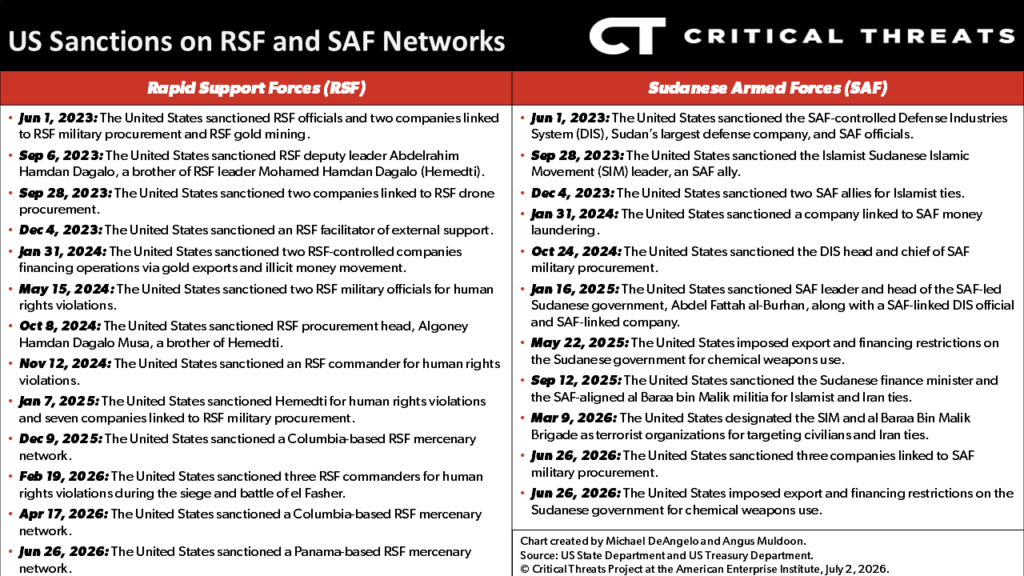
The sanctions are unlikely to change the RSF’s and SAF’s maximalist stances, which have hindered peace efforts and recently escalated the war. The RSF and SAF did not de-escalate in response to multiple rounds of US sanctions from 2023 to 2026, and they have not yet publicly engaged in peace talks with each other. The RSF has predicated peace on excluding SAF-linked Islamists and limiting the role of the SAF in Sudan’s postwar governance, while the SAF has ruled out negotiations barring an RSF demobilization and surrender.[51]
External support to both sides has allowed them to maintain these positions. The UAE remains the RSF’s indispensable backer, providing the group with equipment and weaponry, including drones, through supply lines via neighboring countries, particularly Chad, Ethiopia, and Libya.[52] Egypt and Turkey have increased their support to the SAF following the RSF’s consolidating control of western Sudan in late 2025. Egypt has conducted drone strikes on RSF supply lines and sent military advisers to Sudan, while Turkey has increased suspected weapons shipments, which include drones, and sent drone operators to Sudan.[53] External support for the warring parties has obstructed progress in the US-led Quad peace initiative, of which Egypt, Saudi Arabia, the UAE, and United States are members.[54]
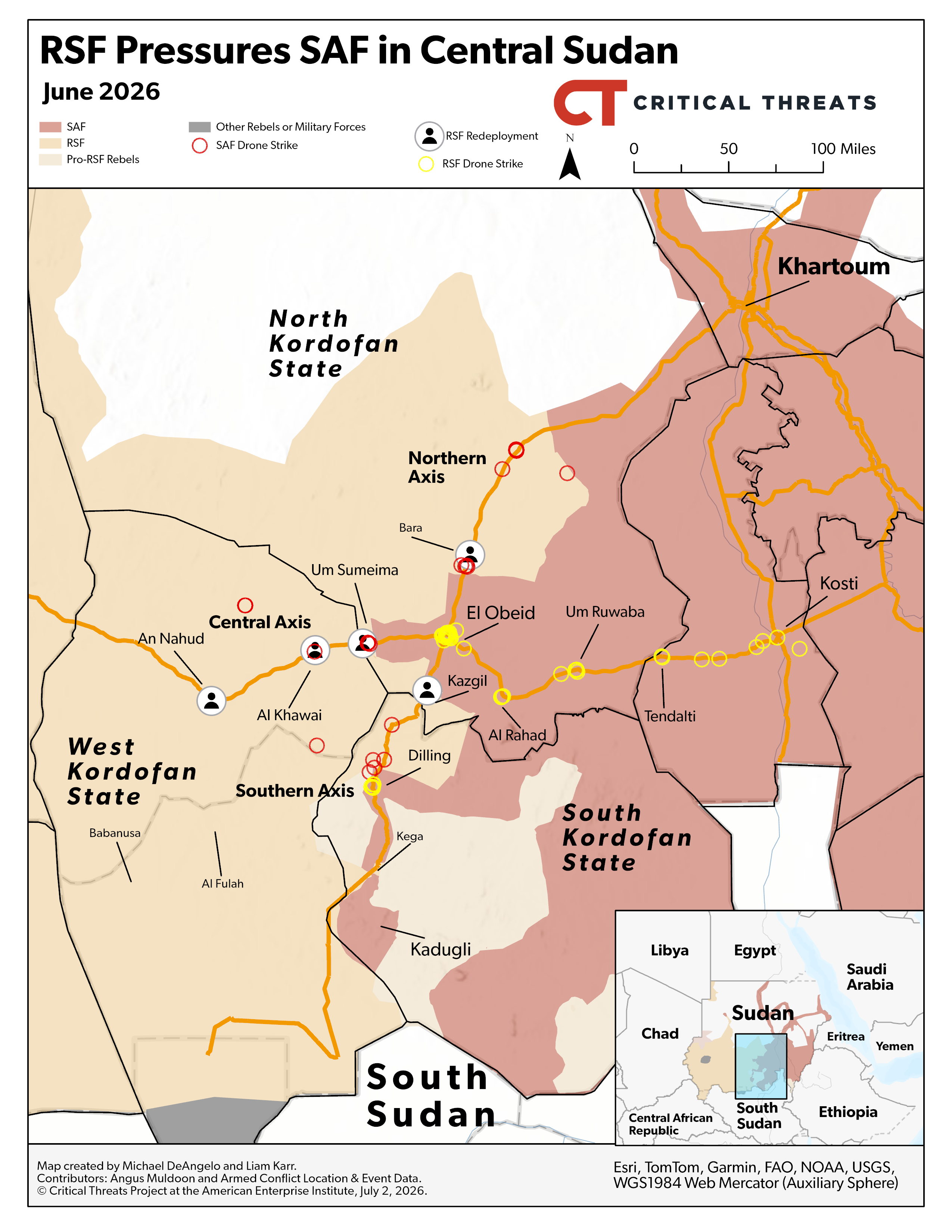
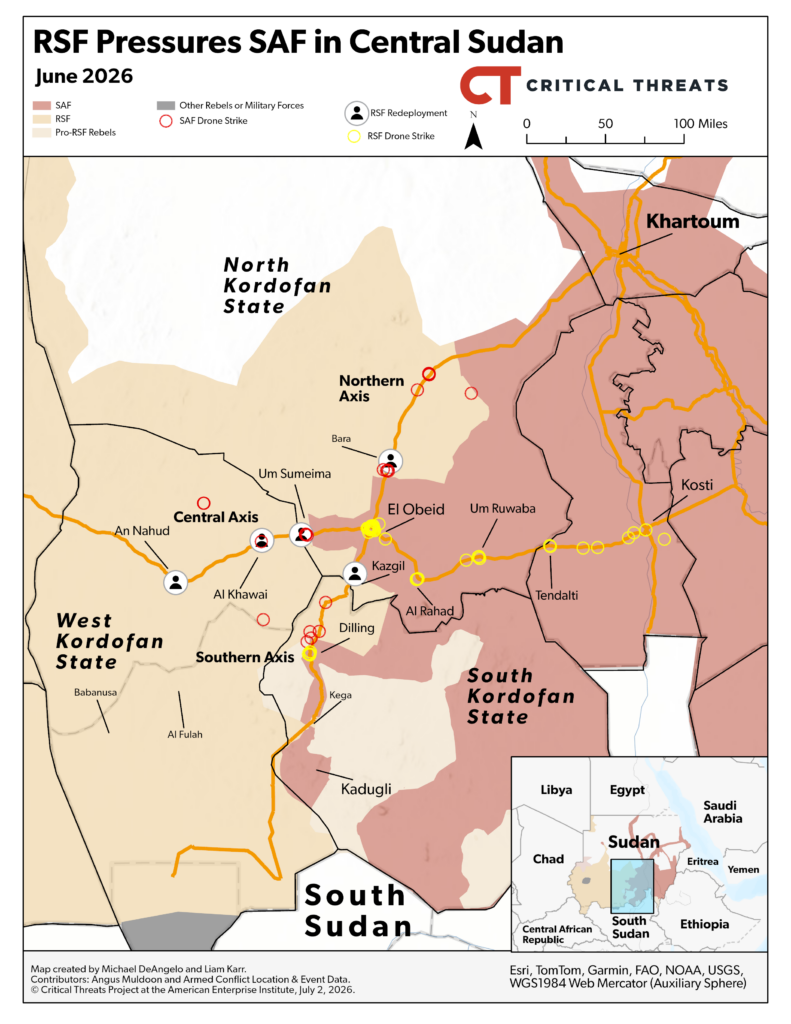
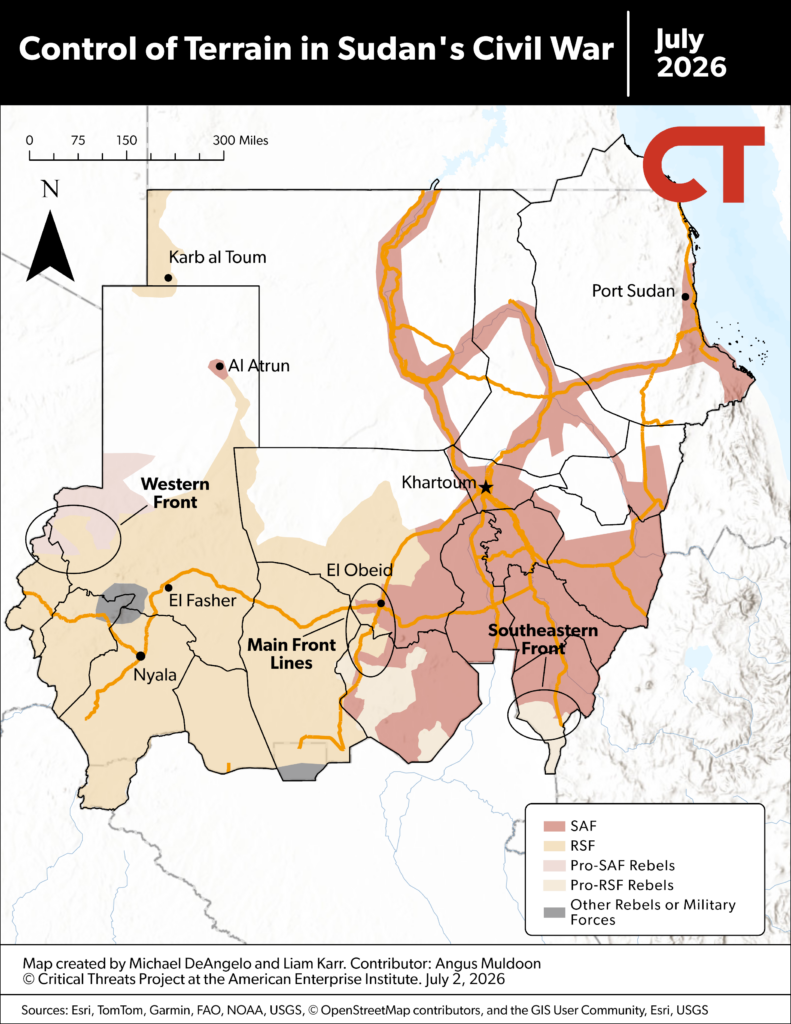
The war has recently escalated on the main front lines despite the latest sanctions. The RSF has begun setting conditions for an offensive on el Obeid, the SAF’s headquarters in central Sudan, since early June. The RSF has conducted daily drone strikes on key infrastructure in el Obeid and supply lines into the city while redeploying forces to positions surrounding the city, imposing a partial siege.[55] The SAF has responded by increasing its own drone strikes on RSF positions and constructing approximately 30 miles of berms and trenches surrounding el Obeid, according to Yale University’s Humanitarian Research Lab.[56]
Figure 3. Rapid Support Forces (RSF) Pressure Sudanese Armed Forces (SAF) in Central Sudan
Fighting has also intensified on other fronts. The RSF and SAF-aligned Joint Forces militia have repeatedly clashed over control of the final SAF-aligned pocket in western Sudan. The RSF assaulted um Baru, which is located 50 miles east of Tine, a town on the Chadian border in North Darfur state, on June 24.[57] The Joint Forces responded by retaking Abu Gomra—located 70 miles south of um Baru—to isolate the RSF and capturing Kulbus, a town located on the Chadian border approximately 75 miles north of el Geneina, the state capital of West Darfur.[58] The Joint Forces continued clashing with the RSF further east in West Darfur on June 30 and July 1, marking their first major advance in the state in over a year.[59] The RSF and SAF have separately clashed in southeastern Sudan’s Blue Nile state, with the RSF capturing a key SAF base at Sirkum, which is near Blue Nile’s main highway, approximately 75 miles south of Ad Damazin, the state capital, on June 21.[60] The SAF counterattacked to retake Sirkum and Magaja, an operationally significant crossroads town, on June 29.[61]
Figure 4. Control of Terrain in Sudan’s Civil War
The SAF will likely view the sanctions as being biased against the SAF, especially given the lack of direct action against the RSF, which could undermine US-led peace efforts. SAF head and leader of the Sudanese government Abdel Fattah al Burhan has already accused US Senior Advisor for African Affairs Massad Boulos, who is leading US peace efforts, of favoring the RSF and UAE.[62] Boulos denied rumors on June 26 that he is seeking to become the US ambassador to the UAE.[63] The Sudanese government has stated as recently as June 27 that the peace process unjustly legitimizes and benefits the RSF when explaining its hesitancy to support international mediation.[64]
The latest sanctions directly target only the SAF, rather than both the SAF and RSF.[65] The SAF-controlled DIS is the largest defense company in Sudan, and it is vital to the SAF’s war effort, with the Treasury Department stating that the DIS “has enabled the SAF to sustain combat operations against the RSF.”[66] The sanctions also obstruct Sudanese government efforts to obtain financing from institutions such as the International Monetary Fund and World Bank at a time when it is struggling to raise the extensive funds required to rebuild the country’s crippled infrastructure.[67] The sanctions on the RSF mercenary network meanwhile only target a select part of the RSF’s broader network and do not impact RSF or UAE-based assets and personnel.[68] A bipartisan US Senate bill currently under consideration also calls for similar financing sanctions against the Sudanese government but additionally directs the State Department to consider designating the RSF as a terrorist organization.[69]
The economic sanctions against the SAF come as the RSF has bolstered its unrecognized parallel state-building efforts, including in the economic domain. The French investigative outlet Africa Intelligence reported on June 29 that the RSF is planning to issue its own currency in RSF-controlled territory, with Reuters separately reporting that new currency is already circulating.[70] The RSF has also established banks and allowed the launch of Emirati-linked money transfer apps since early 2026, according to Africa Intelligence and the open-source investigative outlet EekadFacts.[71] The RSF has made political and military moves as well, establishing a Security and Defense Council in late May geared toward forming a “national army” and continuing to appoint cabinet-level officials and local administrators to its parallel government.[72]