
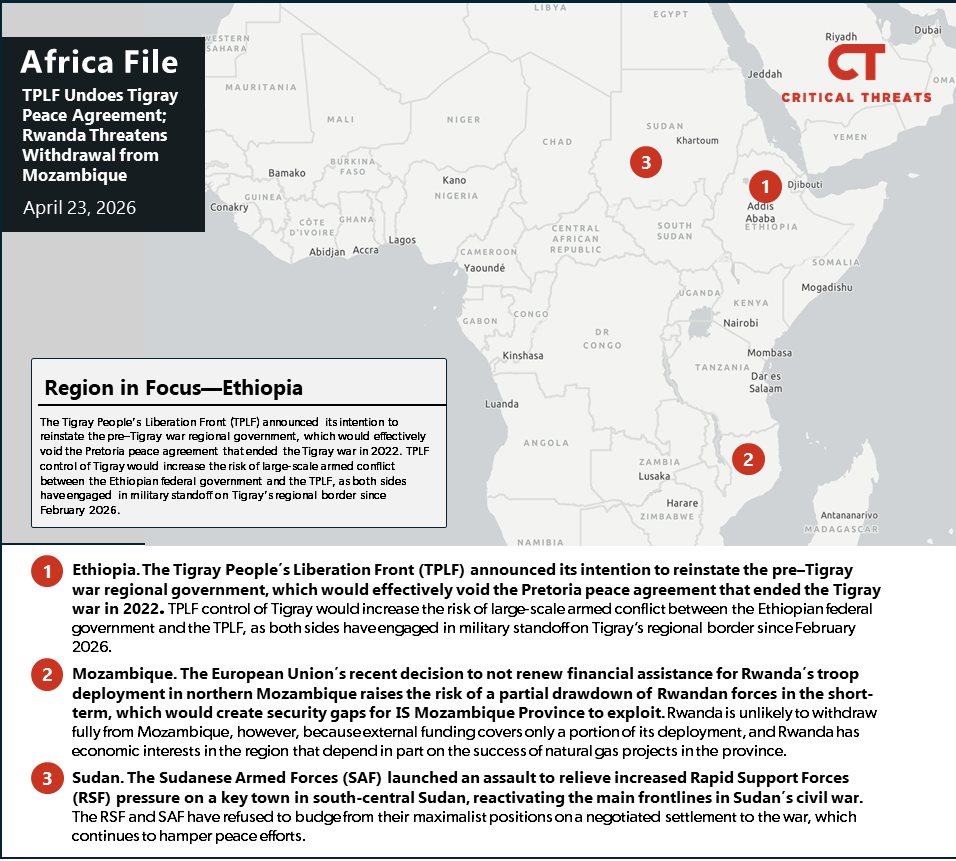
Key Takeaways:
Ethiopia. The Tigray People’s Liberation Front (TPLF) announced its intention to reinstate the pre-Tigray war regional government, which would effectively void the Pretoria peace agreement that ended the Tigray war in 2022. TPLF control of Tigray would increase the risk of large-scale armed conflict between the Ethiopian federal government and the TPLF, as both sides have engaged in military standoff on Tigray’s regional border since February 2026.
Mozambique. The European Union’s recent decision to not renew financial assistance for Rwanda’s troop deployment in northern Mozambique raises the risk of a partial drawdown of Rwandan forces in the short-term, which would create security gaps for IS Mozambique Province to exploit. Rwanda is unlikely to withdraw fully from Mozambique, however, because external funding covers only a portion of its deployment, and Rwanda has economic interests in the region that depend partly on the success of natural gas projects in the province.
Sudan. The Sudanese Armed Forces (SAF) launched an assault to relieve increased Rapid Support Forces (RSF) pressure on a key town in south-central Sudan, reactivating the main frontlines in Sudan’s civil war. The RSF and SAF have refused to budge from their maximalist positions on a negotiated settlement to the war, which continues to hamper peace efforts.
Figure 1. Africa File, April 23, 2026
Ethiopia
The Tigray People’s Liberation Front (TPLF) announced its intention to reinstate the pre-Tigray war regional government, which would effectively void the Pretoria peace agreement that ended the Tigray war in 2022. The TPLF stated on April 19 that Tigray’s regional executive and legislative bodies, which Tigrayans initially elected in 2020, would resume governing.[1] The Pretoria agreement enables the Tigray Interim Administration (TIA) to govern until the Ethiopian federal government holds regional elections, which remain unscheduled.[2] TIA head Tadesse Worede said on April 21 that the TPLF’s reinstatement of the prewar Tigray regional government would “nullify” the Pretoria agreement.[3]
The federal government’s extension of the TIA’s mandate triggered the TPLF’s announcement. The federal government granted the one-year extension on April 8—the mandate’s prior expiration date—after Tadesse met with Ethiopian Prime Minister Abiy Ahmed and other key federal officials.[4] The TPLF denounced the extension, but Tadesse rejected the TPLF’s stance and reaffirmed his intention to stay in office.[5] The TPLF leadership then held a summit, producing the April 19 announcement.[6] The TPLF claimed that the extension violates the Pretoria agreement because the federal government and TIA did not consult the TPLF, which is the most influential political entity in Tigray.[7]
The TPLF also accused the federal government and TIA of ongoing violations of the Pretoria agreement. The TPLF repeated long-standing grievances that the federal government has failed to enforce the withdrawal of Amhara ethnon-ationalist militias from disputed areas of Tigray and facilitate the return of displaced Tigrayans.[8] The TPLF also cited the federal government’s budget cuts to the TIA and fuel blockade of Tigray since late 2025.[9] The TPLF then stated that the federal government is preparing to launch a war against Tigray amid the Ethiopian military’s (ENDF’s) buildup on Tigray’s regional borders.[10]
The TPLF’s reinstatement of the prewar Tigray regional government would be the latest step in its campaign to regain military and political control of Tigray. The TPLF had dominated Tigray’s regional government before the Pretoria agreement, controlling Tigray’s executive and legislative bodies since a TPLF-led coalition overthrew the Ethiopian Derg regime in 1991.[11] A hardline TPLF faction aligned with TPLF head Debretsion Gebremichael launched a de facto coup against the TIA in March 2025, resulting in the replacement of former TIA head Getachew Reda with Tigray Defense Forces (TDF) head Tadesse, whom hardliners viewed as more aligned with themselves.[12] The TPLF then reinstated military command over the TDF, which is Tigray’s regional military force.[13] The French investigative outlet Africa Intelligence reported in June that the TPLF established a joint military committee, including the TDF and TIA, with Debretsion serving as the chairperson over Tadesse.[14]
The TPLF’s announcement signals a further fracturing of the Tigrayan leadership. The initial split came shortly after the signing of the Pretoria agreement in late 2022, as the hardline, Debretsion-led faction opposed the Getachew-brokered peace deal with the federal government.[15] Debretsion viewed Getachew’s subsequent actions as TIA head as being too aligned with the federal government despite Getachew’s role as a senior TPLF official.[16] The hardline faction began rallying other TPLF factions against the TIA and dismissed Getachew and his allies from the TPLF in April 2024.[17] TDF commanders then supported Debretsion in deposing the TIA in March 2025.[18] Getachew fled to Addis Ababa—the Ethiopian capital—and joined the federal government as an adviser to Abiy.[19] The TPLF has since accused Getachew of sponsoring the Tigray Peace Forces, which is an anti-TPLF rebel group consisting of former TDF and TPLF members that began clashing with the TPLF in mid-2025.[20]
The TPLF has now split with Tadesse, despite Tadesse largely aligning himself with Debretsion upon becoming the TIA head in April 2025. Tadesse tacitly supported the TPLF’s de facto coup against the TIA and has echoed the TPLF’s criticisms of the federal government, including on the implementation of the Pretoria agreement.[21] Tadesse also publicly denounced the federal government’s revocation of the TPLF’s legal status as a political party in May 2025.[22] Africa Intelligence reported that the TPLF grew dissatisfied with Tadesse’s leadership as his initial mandate neared completion, however.[23] The TIA has struggled to provide basic services to Tigrayans amid the federal government’s budget cuts and fuel blockade of Tigray.[24] The federal government also did not respond to Tadesse’s dialogue overtures following clashes between federal government and Tigrayan forces in January and a subsequent ENDF buildup on Tigray’s regional border.[25] A pro-TPLF news outlet reported that the TPLF has given Tadesse the option to work with the TPLF, resign, or face an internal revolt, although CTP cannot verify this claim.[26]
TPLF control of Tigray would increase the risk of large-scale armed conflict between the federal government and the TPLF. Tensions between the federal government and the Tigrayan leadership have turned violent in 2026. Federal government and Tigrayan forces engaged in large-scale clashes in January for the first time since the end of the Tigray war over the implementation of the Pretoria agreement.[27] The two sides have since been engaged in a military standoff on Tigray’s regional border.[28] CTP assessed in late February that the ENDF would likely launch an imminent offensive to neutralize the TPLF, although the Iran war has caused fuel shortages that may have disrupted plans for an offensive in the short term.[29] The TPLF’s rejection of the TIA’s mandate complicates the leadership of Tigray, however, reigniting a potential flashpoint for the imminent resumption of war.[30] Ethiopian news outlet Wazema Radio reported that “federal security officials” are considering actions to undo the TPLF’s move to reinstate the prewar Tigray regional government.[31] Getachew, Tadesse, and a Tigrayan opposition party have separately warned that the TPLF’s move could trigger a conflict.[32]
Figure 2. Military Buildup in Northern Ethiopia
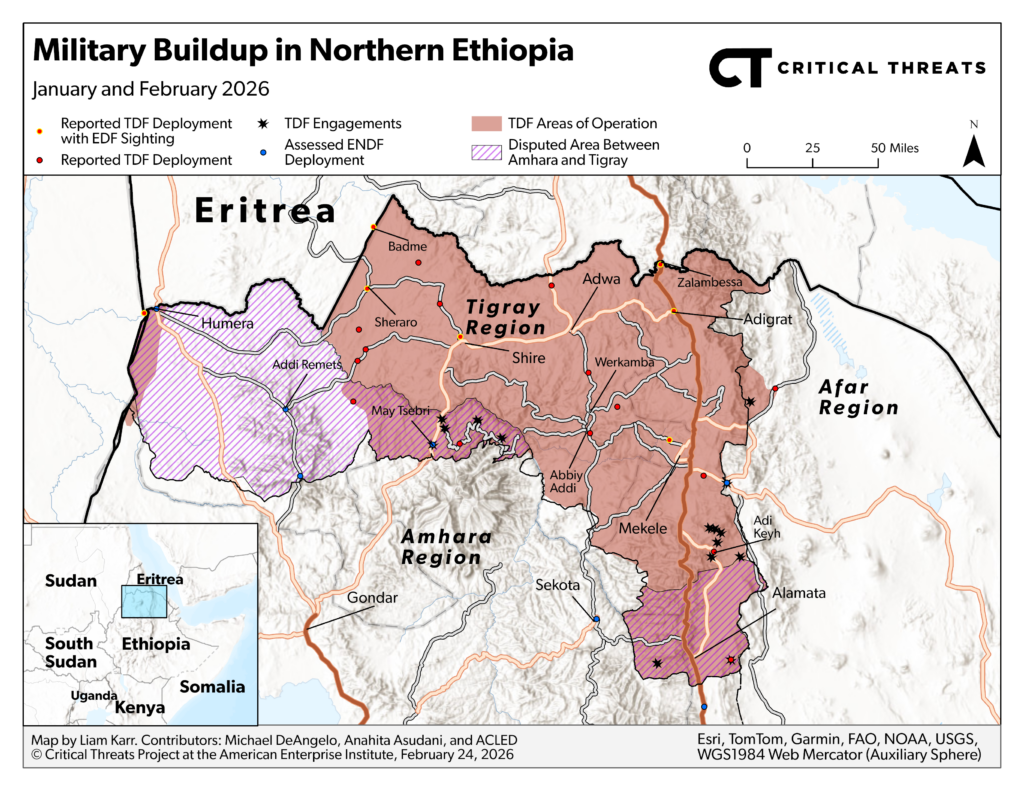
The issue of Tigray’s leadership sparked the Tigray war in 2020. The TPLF wanted to preserve its unrivaled control of the region after Abiy’s coalition decisively won 2018 federal elections, which ended the TPLF’s nearly three-decade control of the federal government.[33] Abiy sought to limit the TPLF’s influence, however, as the TPLF refused to join his coalition and opposed his efforts to shift governing authority from regional power brokers such as the TPLF to the federal government.[34] The TPLF decided to hold regional elections in September 2020 in response to the federal government delaying elections, which led to the outbreak of war in November 2020.[35] The federal government intended for the Pretoria agreement to prevent the TPLF from militarily or politically challenging the federal government’s authority over Tigray again.
Mozambique
The European Union’s recent decision to not renew financial assistance for Rwanda’s troop deployment in northern Mozambique raises the risk of a partial drawdown of Rwandan forces in the short-term, which would create security gaps for IS Mozambique Province (ISMP) to exploit. EU officials told several Western media outlets in March that the EU will not replenish funds for Rwanda’s mission in Cabo Delgado province under the European Peace Facility (EPF) program, meaning that the funding will expire in May 2026.[36] The EU had funded the mission in two tranches of about 23 million US dollars each in December 2022 and November 2024.[37] The funding covered personal equipment and logistics for the deployment.[38] Rwanda’s combined military and police contingent, operating as the Rwanda Security Forces (RSF), has been deployed to Cabo Delgado to combat ISMP in joint operations with the Mozambican government since July 2021.[39]
Rwandan officials have warned that Rwanda could start withdrawing troops if it does not receive requisite funding for its deployment. The Rwandan government said in March that it has 6,300 total forces deployed in Cabo Delgado.[40] Rwandan Government Spokesperson Yolande Makolo said on social media in mid-March that the RSF could withdraw and that its deployment depends on “adequate, predictable funding.”[41] Rwandan Foreign Minister Olivier Nduhungirehe then said that Rwanda will withdraw if it does not secure “sustainable funding.”[42] Rwandan President Paul Kagame echoed these statements in an interview with the French magazine Jeune Afrique in late March, saying that Rwanda could “pack our bags and go” if its security assistance was not needed.[43]
A partial RSF drawdown would create security gaps for ISMP, given that Rwanda has been the main force in weakening the insurgency. The RSF has secured key population centers, established a network of bases and outposts, and disrupted ISMP’s logistics and ability to conduct large-scale attacks.[44] Rwanda doubled its presence in Cabo Delgado in 2024 to help fill gaps left by the withdrawal of the 2,200-strong Southern African Development Community force, which was underfunded and unable to dislodge ISMP from its support zones in central Cabo Delgado.[45] Any new force that deploys or gradually replaces Rwandan troops would have to learn the terrain, build ties and trust with local communities, and adapt to an enemy that fights a guerrilla insurgency. The Mozambican army (FADM) receives training and support from the United States and the EU, but it suffers from numerous issues that limit its combat effectiveness.[46] Experts on the conflict have assessed that the FADM would likely be unable to assume full responsibility for security in northern Mozambique if Rwanda pulled back.[47]
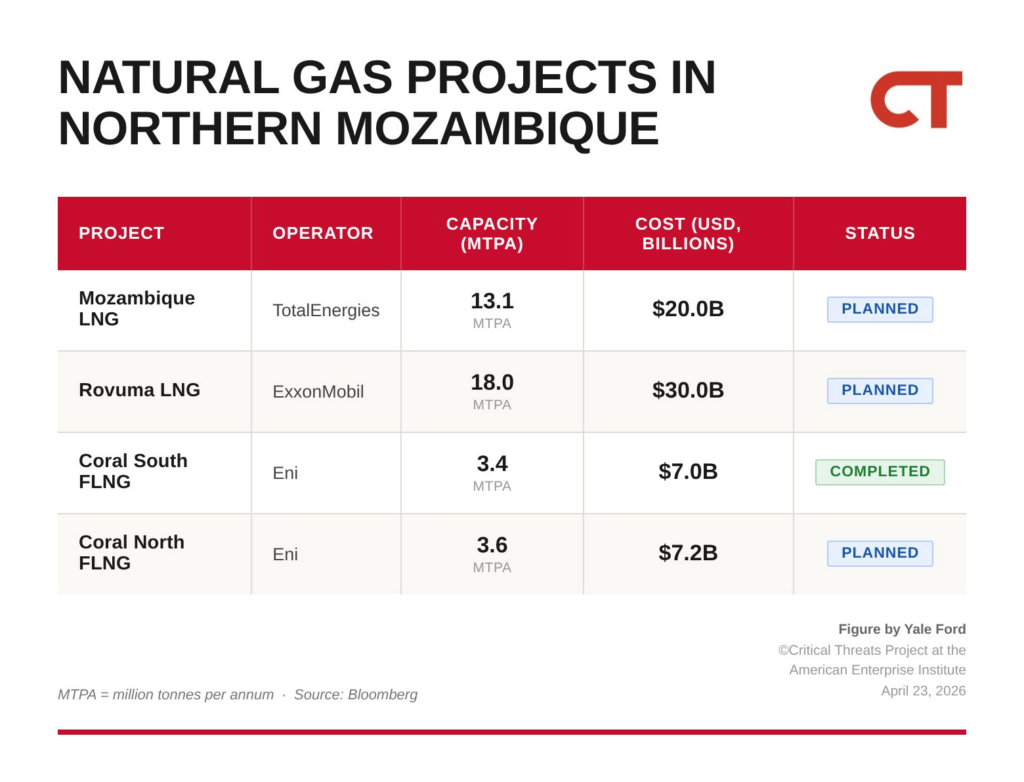
Increased insecurity linked to ISMP would threaten progress on multi-billion-dollar liquefied natural gas (LNG) projects in Cabo Delgado supported by Western governments. United States-based ExxonMobil and the French hydrocarbon company TotalEnergies are both financing LNG projects on the Afungi peninsula in Palma district in the Rovuma deepwater basin. Rwanda began its deployment a few months after the ISMP insurgency forced Total to declare force majeure on its 20 billion US dollar project in April 2021 and then shelve plans to restart the project in early 2024.[48] The counterinsurgency campaign has degraded ISMP and restored enough stability to Cabo Delgado for these projects to resume, but ISMP continues to conduct low-intensity attacks, maintain its support zones in rural areas, and develop new illicit revenue streams.[49] ISMP significantly expanded its area of operations in northern Mozambique and conducted a series of attacks in 2025, including near the N380 road—a vital supply and logistics corridor for both projects as the primary paved route in Cabo Delgado. This activity has forced Total to stop using the N380 and transport equipment to the project site exclusively using Afungi’s airstrip.[50] Total and ExxonMobil both sought security assurances and lobbied the Mozambican government to guarantee Rwanda’s long-term role as a security provider before lifting force majeure in late 2025.[51]
Figure 3. ISMP Area of Operations
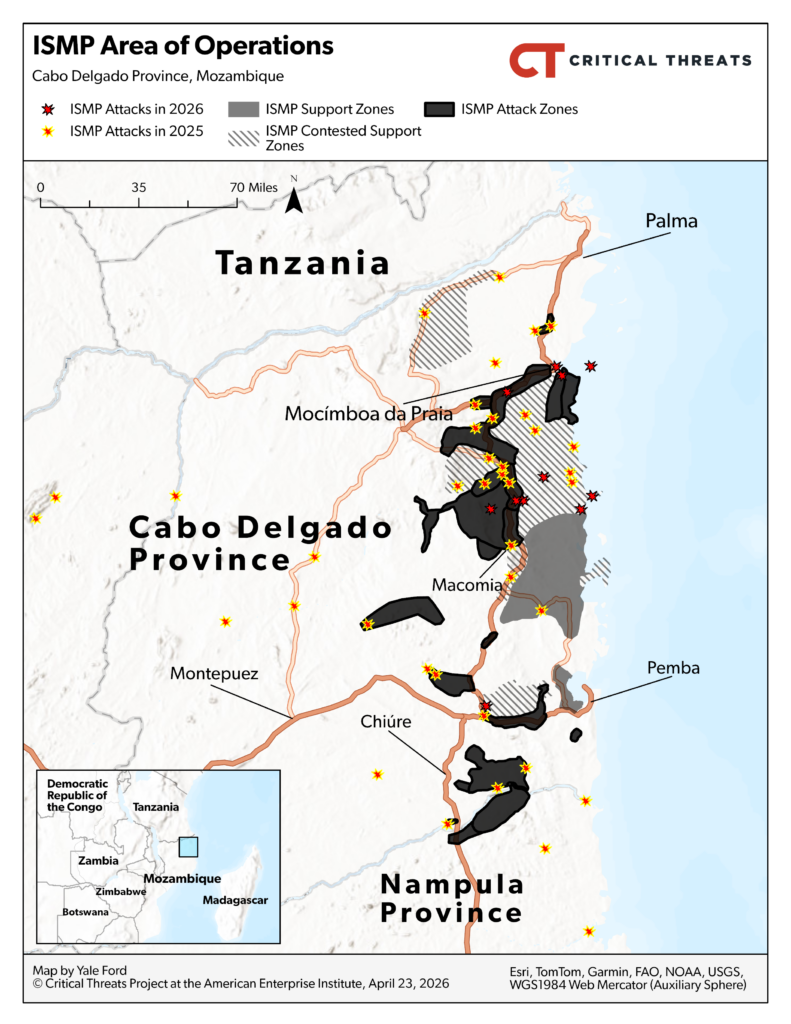
Rwanda is unlikely to withdraw fully from northern Mozambique, however, because external funding only covers a portion of the RSF’s deployment, and Rwanda has economic interests in the region that depend in part on the success of the LNG projects. Rwanda says that it bears most of the cost for its deployment, which it says costs $120–240 million per year.[52] EU funding for the mission has accounted for 15–25 percent of the mission’s total costs since 2022.[53] Makolo said that the EU’s final $23 million funding package covered only about 10 percent of the mission’s annual costs.[54] Mozambique has reportedly been paying Rwanda about $24 million per year for its mission—around 10–20 percent of the annual cost—but monthly payments have been inconsistent, with multiple interruptions since late 2024.[55] The French investigative outlet Africa Intelligence reported in mid-April 2026 that Mozambique has halted the payments again and owes Rwanda nearly a year of arrears, possibly due to reported divisions among decision makers in Mozambique’s ruling party over whether to allow the mission to continue.[56] Makolo told Jeune Afrique in mid-April that Rwanda has discussed the issue with Mozambican authorities but that the timetable of a Rwandan withdrawal “will depend on the implementation of a solution.”[57]
Rwanda has business interests in Cabo Delgado that are linked to the success of LNG projects, making a full withdrawal unlikely in the short-to-medium term. Rwanda and Mozambique signed a memorandum of understanding to expand investment and trade ties and a status of forces agreement in late 2025 that committed Rwanda to stay in Cabo Delagdo until both LNG projects are built in 2029 and 2030.[58] An investment fund affiliated with Rwanda’s ruling party has invested in multiple sectors in Cabo Delgado and supported private Rwandan companies that have secured contracts near the LNG sites.[59] These contracts have included security and logistics around Afungi and at graphite and ruby mines in southern Cabo Delgado.[60] Some observers believe that the French government, TotalEnergies, and ExxonMobil may be indirectly funding Rwandan forces to secure Afungi.[61] Economic opportunities and profits from Rwandan ventures in Cabo Delgado are expected to rise as the LNG projects come online over the next few years.[62] Makolo has pushed back on criticism that the Rwandan government and the RSF directly benefits from Rwandan business interests in northern Mozambique.[63]
Rwanda is likely using its role as a critical security partner in Cabo Delgado as leverage against growing Western diplomatic and political pressure on Rwanda for its involvement in the conflict in the eastern Democratic Republic of the Congo (DRC). The US Treasury Department and State Department imposed tough sanctions on the Rwandan army (RDF) and several senior Rwandan officials for continuing to back M23 rebels in the eastern DRC in violation of its commitments under the Washington Peace Accords in early March.[64] CTP assessed that the sanctions were the most severe actions the United States has taken against Rwanda for its involvement in the eastern DRC in over a decade.[65] The Treasury sanctions froze all assets and financial interests of the RDF and designated officials under US jurisdiction, and threaten to penalize any US civilians or entities that conduct business transactions with the RDF or designated officials. The designation also exposes third-party individuals or entities that conduct business with the RDF to secondary sanctions. US and Rwandan officials have said that the United States provided an exemption for the RDF’s deployment in Cabo Delgado, however.[66]
The US sanctions damaged Rwanda’s reputation and its ability to project influence with the RDF. The RDF plays a significant role in Rwandan society, and the RDF has portrayed itself as a positive force beyond its borders as one of Africa’s most disciplined armies and a key contributor to peace and security.[67] The US sanctions threaten to tarnish this image, however. The United States said it that imposed the wide-reaching sanctions on the RDF as an institution for “blatant violations” of the Washington Peace Accords and “fueling instability” in the Great Lakes region.[68] The RDF is now the second national army in Africa facing current US sanctions, after Eritrea. The Wall Street Journal cited several insider sources who claimed that senior RDF officials identified Mozambique as a “point of US vulnerability” to press after the United States levied the sweeping sanctions in early March.[69] Makolo and Nduhungirehe both alluded to sanctions on Rwanda in response to media reports about possible EU funding cuts, saying that Rwanda was ready to leave Cabo Delgado if its work was “not appreciated” and Rwanda is “blamed or sanctioned by the very countries that greatly benefit from our intervention in Mozambique.”[70]
The US sanctions could have swayed the EU’s political decision to cut funding for Rwanda’s deployment. Several EU countries, mainly Belgium, Germany, and Sweden, have been pushing for tougher sanctions on Rwanda and to suspend the EPF funding over its involvement in the DRC since 2024.[71] Other EU member states, including France, Italy, and Portugal, have been generally less willing to adopt a confrontational stance against Rwanda and wanted to continue EU support for Rwanda.[72] An EU spokesperson said in March 2026 that the funding suspension was not formally tied to a breach of Rwanda’s EPF obligations but that the bloc had “taken note” of the US sanctions and was assessing their implications for EU policy.[73] A European diplomatic source told Le Monde that the US sanctions did not directly prompt the EU’s decision, however.[74]
Rwanda’s deployment to Cabo Delgado is an important bargaining chip against US and EU pressure, because the LNG projects will likely grow in importance for Western countries. Mozambique’s gas reserves have the potential to place it among the world’s top 10 producers and contribute up to 20 percent of Africa’s output by 2040.[75] The US Export-Import Bank unfroze $4.7 billion in loans to fund Total’s project in March 2025.[76] The project is expected to support more than 16,000 domestic jobs in the United States.[77] The LNG facilities would produce significant quantities of natural gas—up to a combined total of 61 million metric tons annually, or about as much as six years of EU gas demand in total—that would alleviate the global gas squeeze that the Russian invasion of Ukraine and Europe’s efforts to shift away from Russian supply have exacerbated.[78] European demand for LNG is expected to increase by 40 percent between 2023 and 2030.[79] Qatari supply was expected to meet this demand in part, but the war in Iran forced Qatar to halt LNG production and declare force majeure on long-term contracts of up to five years for deliveries to Italy and Belgium.[80]
Figure 4. Natural Gas Projects in Northern Mozambique
The Sudanese Armed Forces (SAF) launched an assault to relieve Rapid Support Forces (RSF) pressure on a key town in south-central Sudan, marking the largest clashes in the region in at least two months. The SAF advanced on April 18 from positions outside of el Obeid—the SAF’s headquarters in central Sudan—to overrun RSF positions in Kazgil and al Hamadi, which are located approximately 30 and 50 miles south of el Obeid, respectively, along Kordofan region’s main north-south highway.[81] The open-source outlet Sudan War Monitor reported that the RSF repelled the SAF from al Dabibat—an RSF hub and crossroads town located just west of al Hamadi—and forced the SAF to withdraw toward al Hamadi.[82] Both the RSF and the Joint Forces militia allied with the SAF have claimed control of al Hamadi, although CTP cannot verify the claims.[83] The clashes caused mass casualties on both sides, with multiple reports stating that hundreds of fighters died.[84]
The SAF’s assault comes amid the RSF’s increased efforts to capture Dilling, a large town located approximately 100 miles south of el Obeid along the main highway. The RSF had besieged Dilling since early 2024, but the SAF foiled RSF attempts to capture the town and partially broke the RSF’s siege on from a secondary road in late January 2026.[85] Dilling could now serve as the launchpad for a secondary SAF line of advance through Kordofan toward the RSF’s center of gravity in western Sudan.[86] The RSF and the allied Sudan People’s Liberation Movement-North al Hilu militia still surround Dilling from multiple directions, however. The RSF has targeted Dilling through intensified shelling, drone strikes, and ground operations since mid-March.[87] The RSF advanced to Dilling’s outskirts in late March, but the SAF repelled the assault.[88] The SAF has conducted at least nine drone strikes on RSF positions around Dilling in March and April after conducting none in February, according to Armed Conflict Location & Event Data.[89] The SAF reportedly resumed airstrikes in the area on April 23 for the first time in several months.[90]
Figure 5. Control of Terrain in Sudan’s Kordofan Region
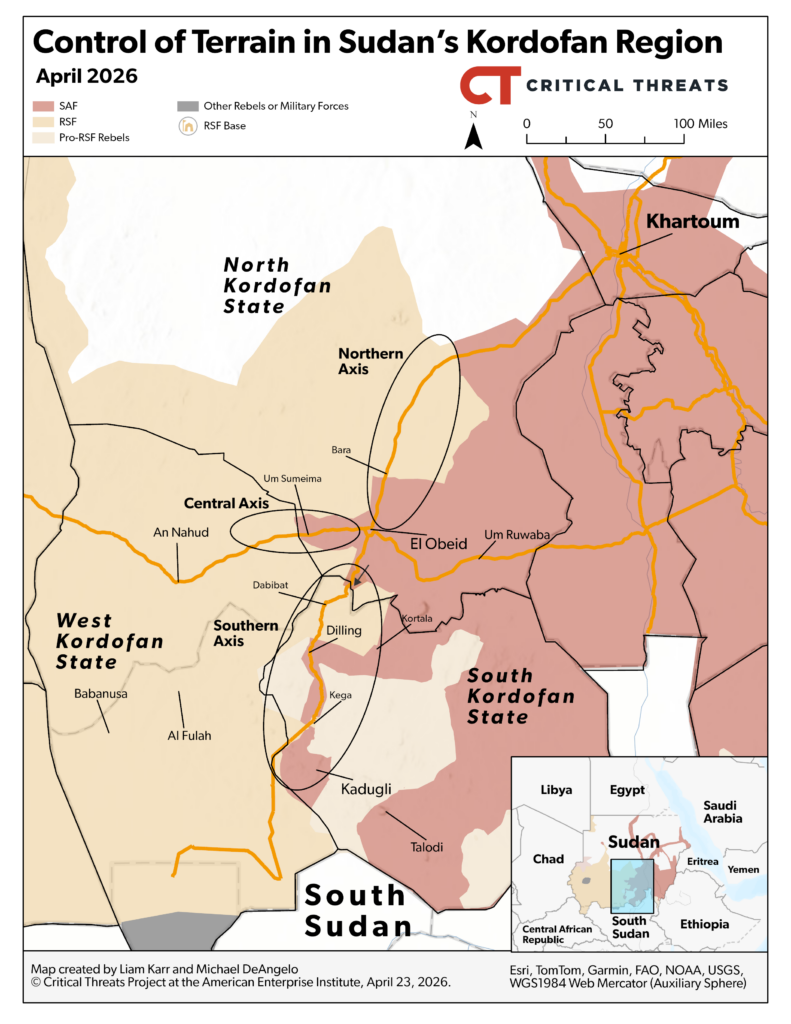
The clashes reactivated the main frontlines in Sudan’s civil war, as fighting had been concentrated mainly along a secondary front in southeastern Sudan since February 2026. The RSF launched an offensive in Blue Nile state to gain a foothold in the resource-rich Nile River Valley and tie up SAF resources from the main frontlines.[91] The RSF captured a key town on the Ethiopian border in late March, consolidating control of a key supply line linking its rear bases in western Ethiopia to Blue Nile.[92] The RSF has tried advancing further into Blue Nile in April, causing the SAF and allied militias to redeploy forces to the state.[93]
The RSF and SAF have refused to budge from their maximalist positions on a negotiated settlement to the civil war, which continues to hamper peace efforts. The United States and European and international partners sponsored a peace conference in Berlin on April 15 involving Sudanese civil society and political actors.[94] The sponsors did not invite the SAF-led Sudanese government, causing Sudanese Prime Minister Kamal Idris to state that the conference would be a “failure.”[95] Idris claimed that the SAF had won the war and would not compromise Sudan’s “sovereignty and integrity” by negotiating a political settlement with the RSF as an equal.[96] The conference sponsors did invite the RSF-led Sudan Founding Alliance (TASIS), which runs the RSF’s parallel government, but TASIS rejected the invitation due to the conference’s inclusion of Islamist and SAF-aligned political actors.[97] TASIS instead held a parallel conference in Berlin on April 16 to plan further cabinet and local administrative appointments to the RSF’s parallel government.[98]
Sudan