
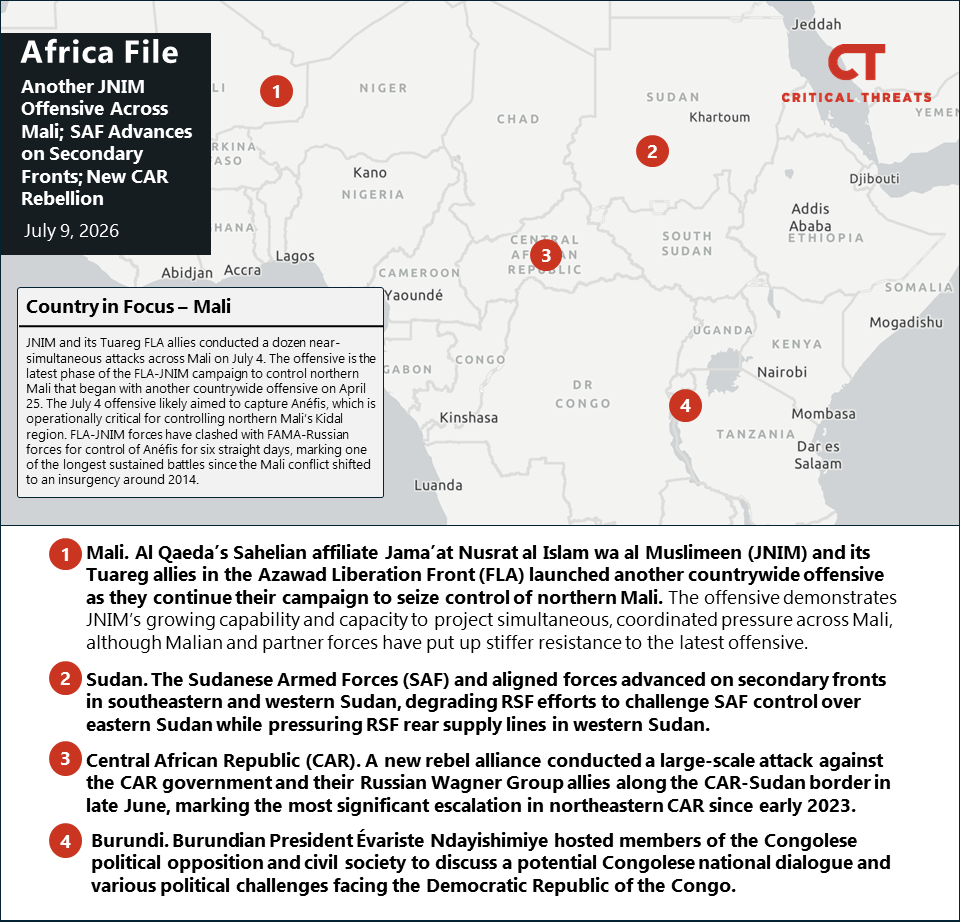
Key Takeaways:
Mali. Al Qaeda’s Sahelian affiliate Jama’at Nusrat al Islam wa al Muslimeen (JNIM) and its Tuareg allies in the Azawad Liberation Front (FLA) launched another countrywide offensive as they continue their campaign to seize control of northern Mali. The offensive demonstrates JNIM’s growing capability and capacity to project simultaneous, coordinated pressure across Mali, although Malian and partner forces have put up stiffer resistance to the latest offensive.
Sudan. The Sudanese Armed Forces (SAF) and aligned forces advanced on secondary fronts in southeastern and western Sudan, degrading RSF efforts to challenge SAF control over eastern Sudan while pressuring RSF rear supply lines in western Sudan. The gains hinder the RSF’s efforts to set conditions for an offensive on the main front in central Sudan by removing the need for the SAF to divert more forces to secure its rear areas in eastern Sudan while forcing the RSF to divert more forces to secure its rear areas in western Sudan.
Central African Republic (CAR). A new rebel alliance conducted a large-scale attack against the CAR government and their Russian Wagner Group allies along the CAR-Sudan border in late June, marking the most significant escalation in northeastern CAR since early 2023. The Sudanese paramilitary Rapid Support Forces (RSF) may have enabled the assault, which could complicate the CAR’s potential emerging role as a node in Emirati-RSF supply lines.
Burundi. Burundian President Évariste Ndayishimiye hosted members of the Congolese political opposition and civil society to discuss a potential Congolese national dialogue and various political challenges facing the Democratic Republic of the Congo (DRC). DRC President Félix Tshisekedi is continuing to use his regional allies as mediators to control a national dialogue and placate the opposition.
Figure 1. Africa File, July 9, 2026
Assessments:
Mali
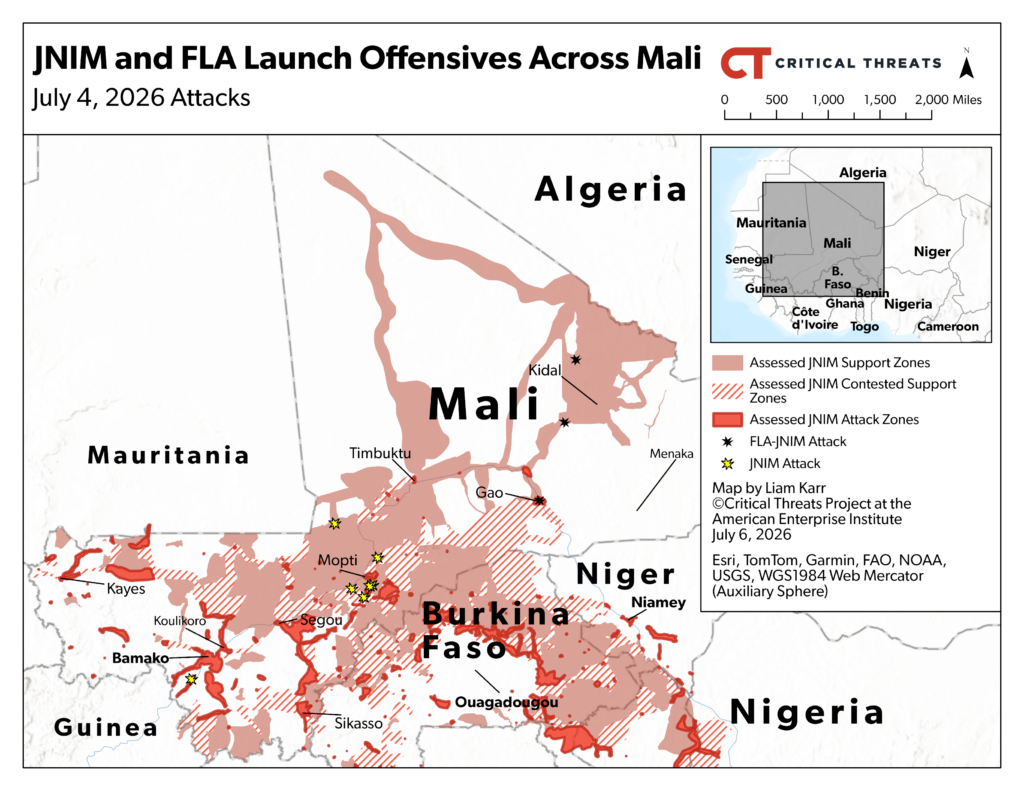
Al Qaeda’s Sahelian affiliate Jama’at Nusrat al Islam wa al Muslimeen (JNIM) and its Tuareg allies in the Azawad Liberation Front (FLA) launched another countrywide offensive. FLA-JNIM forces launched three attacks across northern Mali on July 4, targeting the military base in Gao city and bases in Aguelhok and Anéfis, the last two government-controlled towns in the Kidal region.[1] The Malian army (FAMA) and Russia’s Africa Corps forces repelled the attacks on Aguelhok and Gao, but the most intense fighting has concentrated on Anéfis, where FLA-JNIM forces have clashed with FAMA-Russian forces for six straight days.[2] The FLA and JNIM captured multiple positions around Anéfis in the initial attack and have continued to attack the besieged FAMA-Africa Corps soldiers in the encircled camp.[3] The Malian army claims to have killed over 300 insurgents after launching 54 airstrikes in Anéfis between July 6 and July 8.[4] Pro-government forces retook the town on July 8 following extensive airstrikes that forced JNIM-FLA elements to partially withdraw.[5] JNIM-FLA militants have remained in the area and shelled the Anéfis camp on July 9, however, and JNIM-FLA have prevented reinforcements from reaching the area.[6]
JNIM carried out eight more attacks across central Mali on July 4. The group attacked three Malian army positions in Kouakourou and Sofara in the Mopti Region and in Léré, Tombouctou region.[7] Malian authorities claim to have killed 20 insurgents at Sofara and 15 at Konna.[8] JNIM militants targeted government-aligned Dozo militias in five other localities in the Mopti and Segou regions.[9] JNIM claimed to kill 21 Dozo militiamen in Konna and 18 in Somadougou, in the Mopti region.[10]
Figure 2. JNIM and FLA Launch Offensives Across Mali: July 4, 2026 Attacks
Another set of JNIM militants simultaneously attacked the Kénieroba high-security prison in the Koulikoro region, 37 miles (60 kilometers) south of Bamako. JNIM set multiple vehicles on fire inside the compound, but it remains unclear whether the attackers freed any prisoners.[11] JNIM attacked the prison for the first time in May 2026.[12] The prison holds 2,500 prisoners, including JNIM and FLA fighters, and 72 “high value” prisoners.[13]
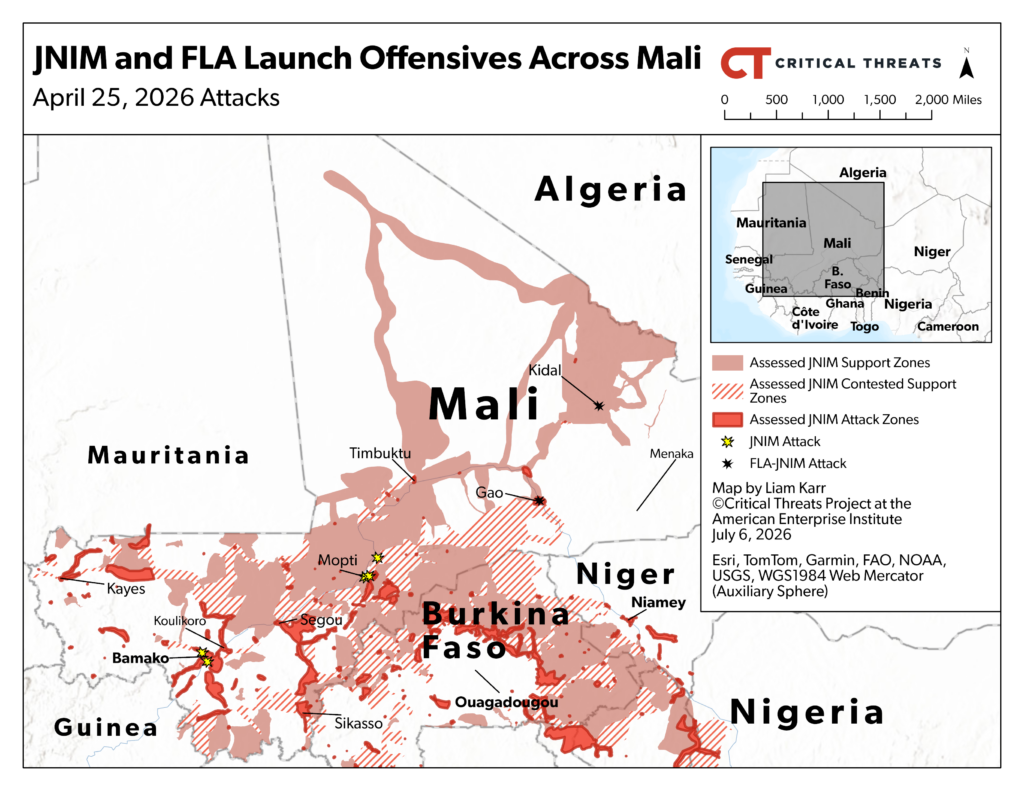
The attacks are the latest phase of the FLA-JNIM campaign to seize control of northern Mali, which began with another countrywide offensive on April 25. CTP assessed that the April 25 campaign aimed to seize Kidal city, cut Malian ground lines of communication between central and northern Mali, and degrade security forces’ ability to respond to the offensive.[14] The April 25 attacks resulted in the capture of Kidal city and Tessalit in the Kidal region and several other towns in the Gao region. JNIM seeks to govern northern Mali via the FLA as its local partner, and capturing northern Mali would also severely undermine the legitimacy of the Malian junta, which CTP has assessed that JNIM aims to topple so that the group can engage with new national authorities that it can heavily influence.[15]
Figure 3. JNIM and FLA Launch Offensives Across Mali: April 25, 2026 Attacks
The latest offensive likely aimed to capture Anéfis, which is operationally critical for controlling northern Mali’s Kidal region. The attack on Anéfis was the largest of the July 4 attacks, with FLA-JNIM forces employing at least one Russian BTR-80 armored personnel carrier, artillery, drones, armored vehicles, and pickup trucks.[16] The continued fighting and siege in the days since the initial attack is also one of the longest sustained engagements in the Mali conflict since the initial years of the 2012 rebellion. Militants have avoided conventional, multiday battles since the conflict shifted to an insurgency following the end of France’s initial Operation Serval in 2014 and the signing of the now-defunct 2015 Algiers Accords.
Anéfis is operationally significant for both sides, as it is key to Malian and Russian forces’ ability to exert pressure into Kidal region. Malian and Russian forces have used Anéfis as a makeshift base for their TB2 Bayraktar drones since capturing the town in November 2023.[17] Most major towns in Kidal region are within the TB2’s base range of 185 miles (300 kilometers) from Anéfis, including the FLA-JNIM–controlled Kidal city, FLA-JNIM–controlled Tessalit, and FAMA-Africa Corps–controlled Aguelhok. Anéfis is also the gateway to the Kidal region, as it is roughly 10 miles (16 kilometers) from the regional border and lies at the junction of the two major roads in the Kidal region that lead to Kidal city, Tessalit, and Aguelhok. The closest Malian forward operating base beside Aguelhok is nearly 100 miles south in Bourem, Gao region, which is unable to reliably send air support or reinforcements to Aguelhok.
Figure 4. Battle for Northern Mali
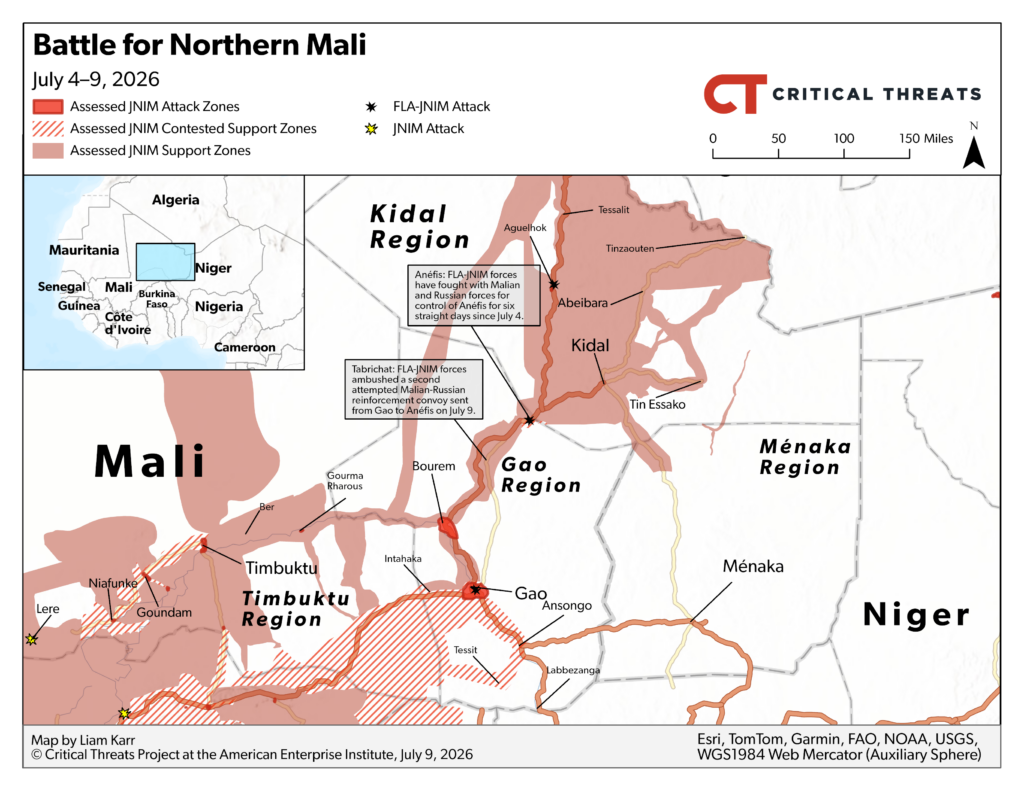
Malian forces and their partners have put up stiffer resistance to this offensive than the April 25 offensive. FAMA and Africa Corps elements successfully repelled the FLA-JNIM attacks except for that in Anéfis. Malian security sources told French outlet Jeune Afrique that FAMA-Africa Corps personnel received intelligence ahead of the attacks and had reinforced their positions in Gao and Sévaré accordingly.[18] FAMA and Africa Corps forces have also used Shahed-style Geran drones for the first recorded time in Mali in the battle for Anéfis.[19] Russia first shipped Geran drones to Mali in May 2026.[20]
Russian forces have also publicly disavowed any negotiated withdrawals and sought to reinforce besieged units in Anéfis. Africa Corps has denied that it is seeking a negotiated withdrawal from Anéfis as it did in Kidal, Tessalit, and other bases following the FLA-JNIM April 25 attacks.[21] The FLA has claimed that it rejected Russian requests for conditional withdrawals, however, after Russian forces failed to adhere to the terms of agreements struck after the April 25 offensive.[22] FAMA, Africa Corps, and pro-government Tuareg militia dispatched a reinforcement convoy to Anéfis from Gao on July 5.[23] FLA and JNIM militants forced the convoy to return to Gao, however, after launching a complex ambush that destroyed military vehicles, a Russian Mi-24 helicopter, and killed several FAMA and Africa Corps soldiers.[24]
Another stymied resupply effort reportedly has support from Mali’s neighbor and Alliance of Sahel States ally Niger. Two Il-76 transport planes arrived in Gao from Bamako on July 7, carrying matériel and troop reinforcements.[25] The pro-government coalition then sent another even larger convoy to Anéfis from Gao later on July 7, including around 67 armored fighting vehicles, fuel trucks, and motorcycles with drone support, including from the Nigerien Air Forces, and additional Russian helicopter and fighter-jet air support on standby in Gao.[26] FLA-JNIM detonated multiple improvised explosive devices targeting the convoy and ambushed the convoy near Tabrichat, Gao region, 31 miles (50 kilometers) south of Anéfis on July 9.[27] Each side claimed to kill multiple fighters and destroy various vehicles, while FLA-JNIM claimed to down Russian reconnaissance drones.[28] The current status of the convoy is unclear at the time of writing.
The offensive demonstrates JNIM’s growing capability and capacity to project simultaneous, coordinated pressure across Mali. JNIM has demonstrated growing capability to conduct near-simultaneous attacks across different areas of Mali since 2025. JNIM began orchestrating such attacks across multiple regions within the same area of the country in 2019 and 2020.[29] The group conducted one of its most sophisticated operations ever in July 2025, when it simultaneously attacked seven positions across central and southern Mali.[30] JNIM then demonstrated the capability to simultaneously exert pressure across the entire country with the April 25 offensive, which involved near-simultaneous attacks across all three areas of Mali—the north, central, and south—for the first time.
JNIM’s new alliance with the FLA has further bolstered its capacity to sustain coordinated, countrywide pressure. The FLA and JNIM openly coordinated operations for the first time in the April 25 offensive, which followed yearslong negotiations on political issues, such as compromises on the implementation on sharia law in areas under the groups’ control.[31] The alliance has been a force multiplier for JNIM in northern Mali, where the FLA is based and has been leading joint operations with JNIM. The July 4 offensive signals that the April 25 offensive was not isolated and that the partners have the capacity to support regular countrywide activity.
Sudan
The Sudanese Armed Forces (SAF) retook an operationally significant district capital on the Ethiopian border in southeastern Sudan, degrading Rapid Support Forces (RSF) efforts to threaten the SAF’s control over eastern Sudan. The SAF recaptured Kurmuk, which is located approximately 100 miles south of the Blue Nile state capital of Ad Damazin, on July 8.[32] The SAF had consolidated control of key areas surrounding Kurmuk since late April 2026. The SAF recaptured al Keili, which is located approximately 30 miles north of Kurmuk adjacent to the main highway, on May 9.[33] The SAF then retook Sirkum and Magaja—a base located 10 miles north of Kurmuk adjacent to the highway and an operationally significant crossroads town, respectively—on June 29.[34] The SAF supplemented its ground efforts with increased drone strikes in Kurmuk district in June, conducting the same number of strikes as it did in April and May combined.[35]
Figure 5. Sudanese Armed Forces (SAF) Counteroffensive in Blue Nile State
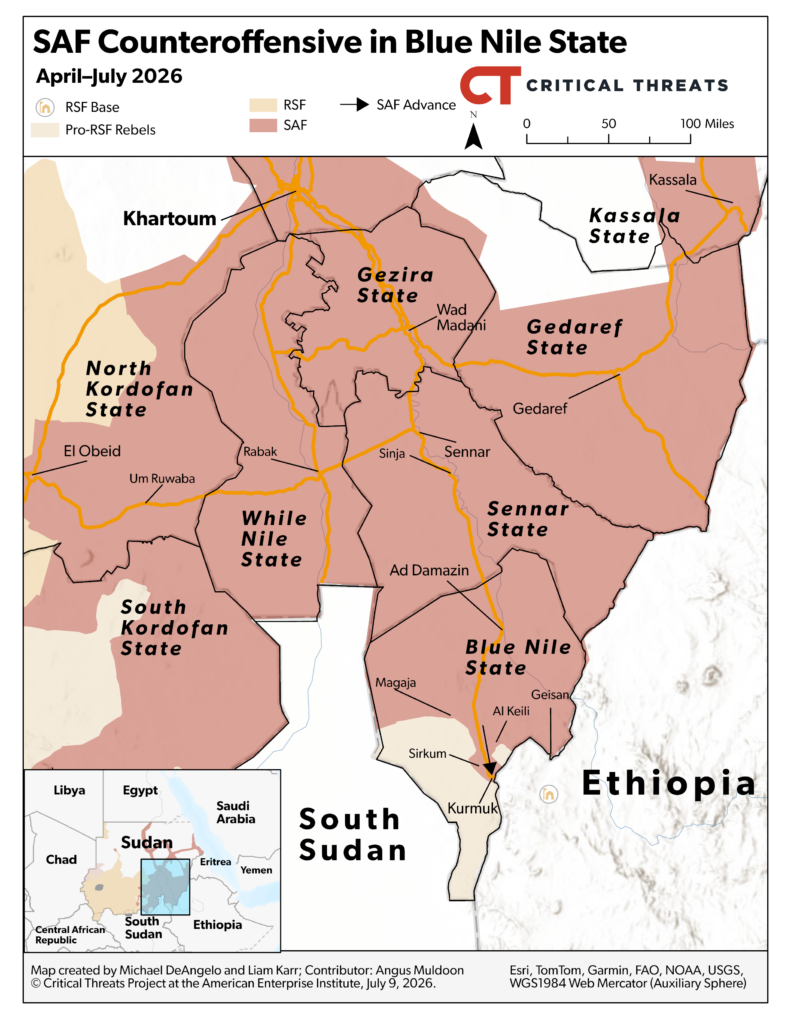
Kurmuk was a key operational and supply hub for the RSF’s Blue Nile offensive, which the group launched in early 2026 to divert SAF forces from central Sudan by threatening SAF control over the Nile River Valley and potentially Khartoum. Kurmuk is the main border-crossing point between Ethiopia and Blue Nile state and is on Blue Nile’s main highway, which runs from western Ethiopia through the Nile River Valley up to Khartoum, the Sudanese capital. The RSF captured Kurmuk in late March 2026, which strengthened RSF supply lines connecting its rear base in western Ethiopia’s Benishangul-Gumuz region with Blue Nile.[36] The RSF had established a military camp in Benishangul-Gumuz in late 2025 to support the Blue Nile offensive, and the United Arab Emirates significantly increased suspected weapons shipments to the RSF via western Ethiopia in late 2025 throughout early 2026.[37] The SAF’s capture of Kurmuk does not give the SAF full control of Blue Nile yet, as the RSF and allied militia still have bases and supply lines in Ethiopia and hold positions south and west of Kurmuk in Blue Nile.[38]
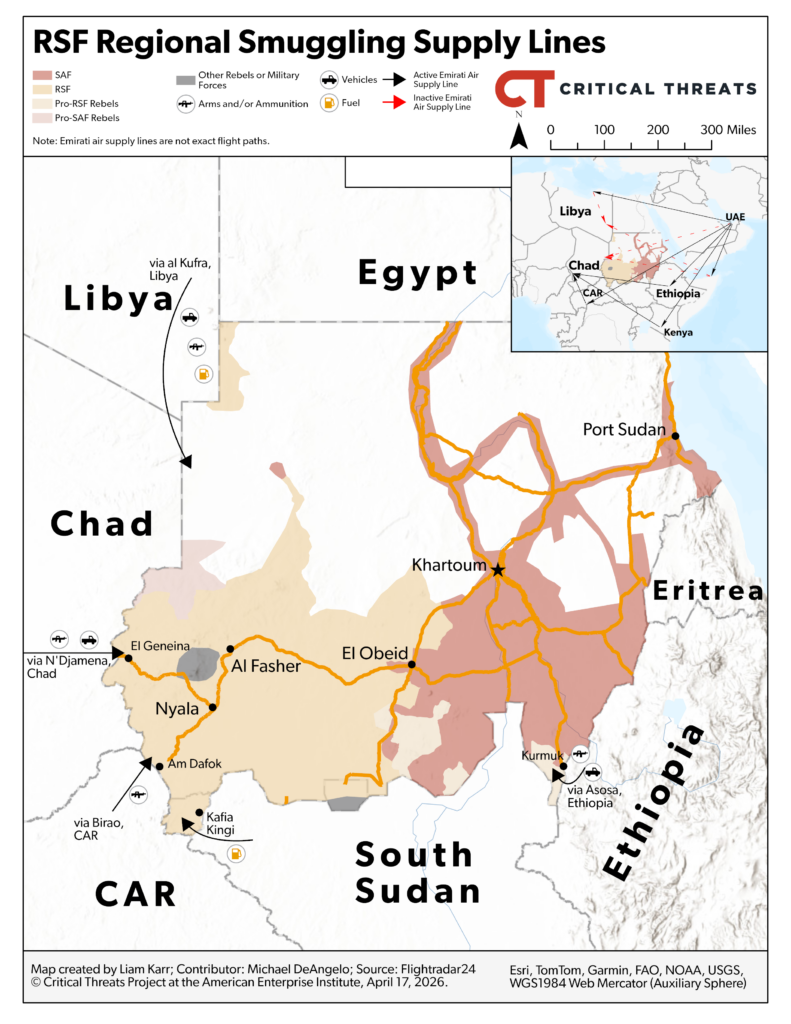
SAF-aligned forces separately captured another town near the Chadian border in western Sudan, pressuring the RSF’s rear support zones and supply lines. The SAF-aligned Joint Forces militia reportedly captured Abu Saruj—located 35 miles north of el Geneina, the state capital of West Darfur—on July 8.[39] The Joint Forces have advanced south along the Chadian border toward el Genina as part of its recent offensive, which began when the Joint Forces captured Kulbus—located approximately 75 miles north of el Geneina—in late June.[40] The offensive threatens to disrupt the RSF’s supply lines, as the RSF transports ammunition, fuel, vehicles, and weapons from Emirati shipments and regional smuggling networks via Chad at various points along the Chadian border with western Sudan.[41]
Figure 6. Control of Terrain in Western Sudan
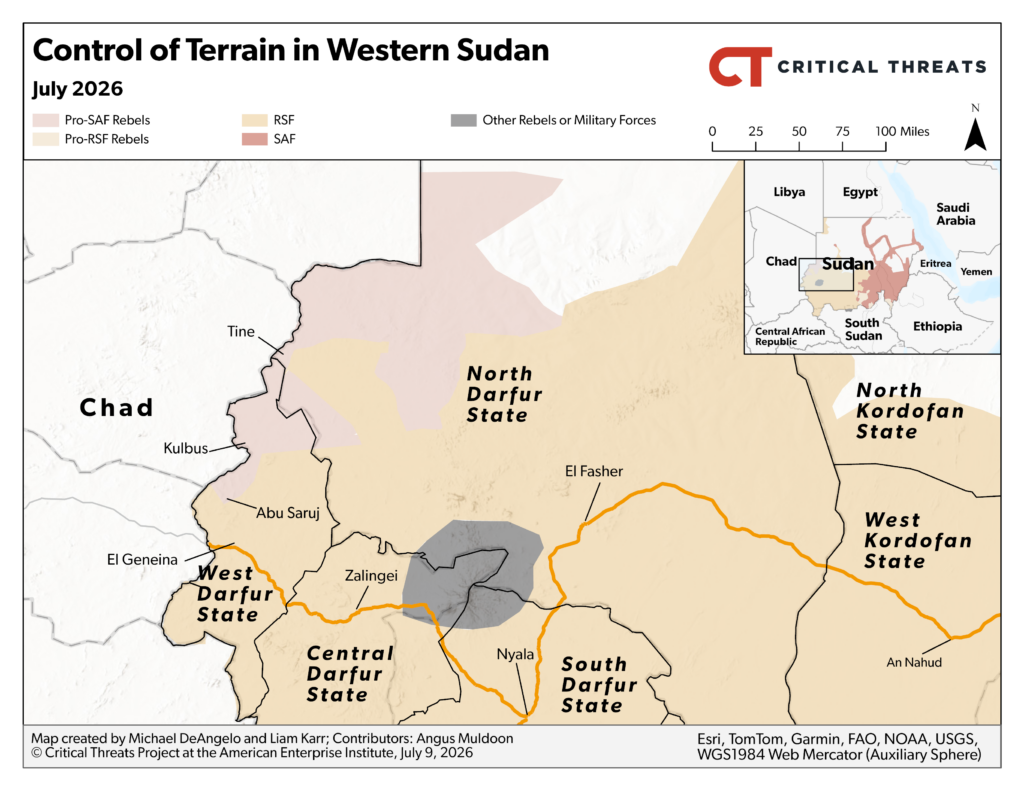
The SAF’s gains hinder the RSF’s efforts to set favorable conditions for an offensive on the main front in central Sudan. CTP and numerous international authorities have previously assessed that the RSF has been preparing to launch an offensive to capture el Obeid, the SAF’s headquarters in central Sudan.[42] The SAF had already redeployed an unspecified number of forces from central Sudan to secure Blue Nile state in April and May 2026, but its containment of the RSF will likely remove the need for further reinforcements in the short-term.[43] The RSF increased drone strikes around el Obeid and reinforced front line positions surrounding the city starting in early June, but it has since redeployed some forces from central Sudan back to western Sudan in response to the Joint Forces offensive.[44]
Figure 7. Rapid Support Forces (RSF) Regional Smuggling Supply Lines
Central African Republic
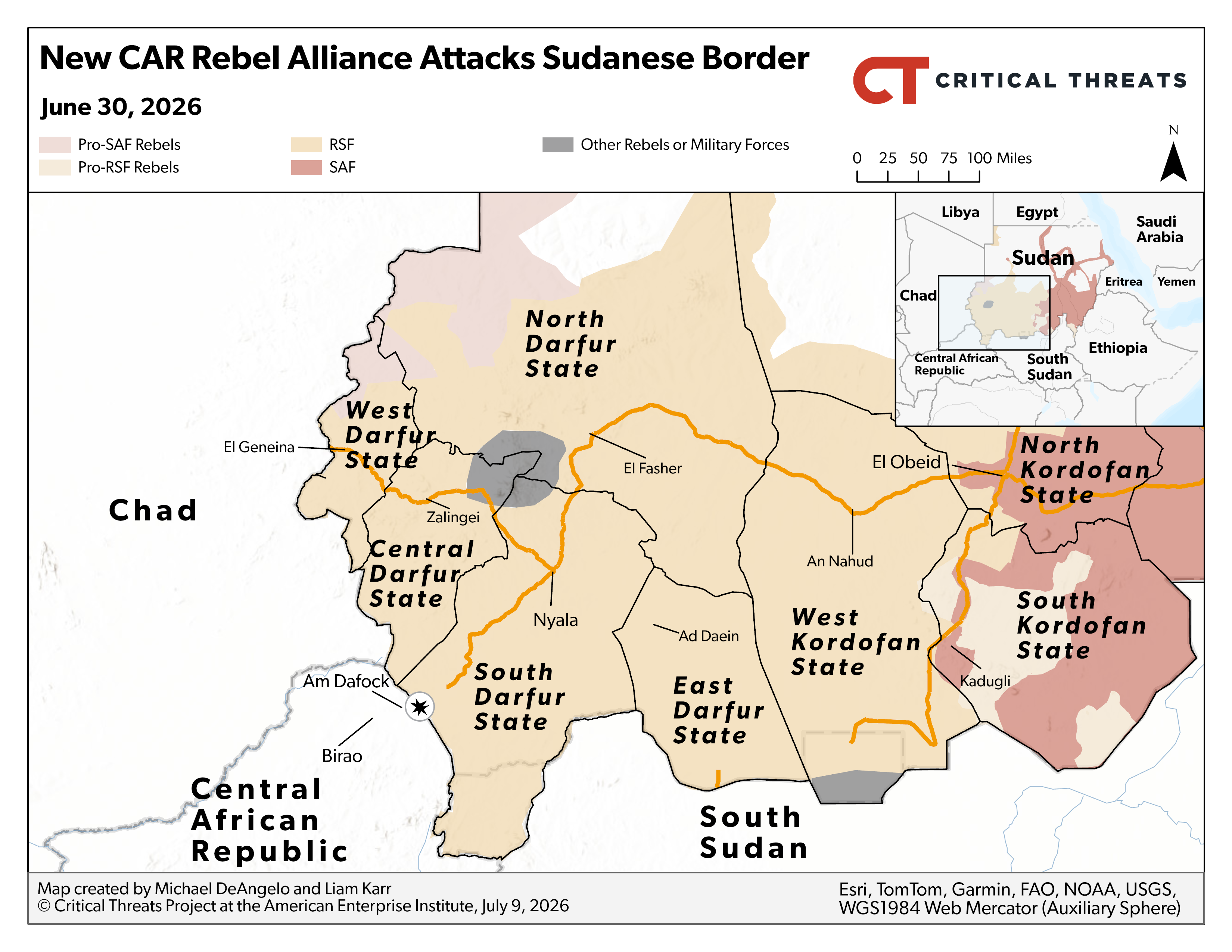
A new rebel alliance conducted a large-scale attack against the Central African Armed Forces (FACA) and their Russian Wagner Group allies along the Central African Republic (CAR)-Sudan border in late June, marking the most significant escalation in northeastern CAR since early 2023. More than 700 militants fighting under the banner of the Patriotic Awakening Alliance (Alliance du Sursaut Patriotique, ASP) attacked positions held by the FACA and Wagner in Am Dafock, a town in northeastern CAR’s Vakaga prefecture on the border with Sudan, on June 30.[45] ASP fighters reportedly overran FACA and Wagner positions and wounded three UN peacekeepers in the assault despite Wagner resistance.[46] ASP controlled the town for roughly five days before FACA-Wagner forces regained control of the town on July 5 after a counteroffensive.[47] The last major Central African rebel attack on government-held positions in Vakaga was in early 2023.[48]
Figure 8. New Central African Republic (CAR) Rebel Alliance Attacks Sudanese Border
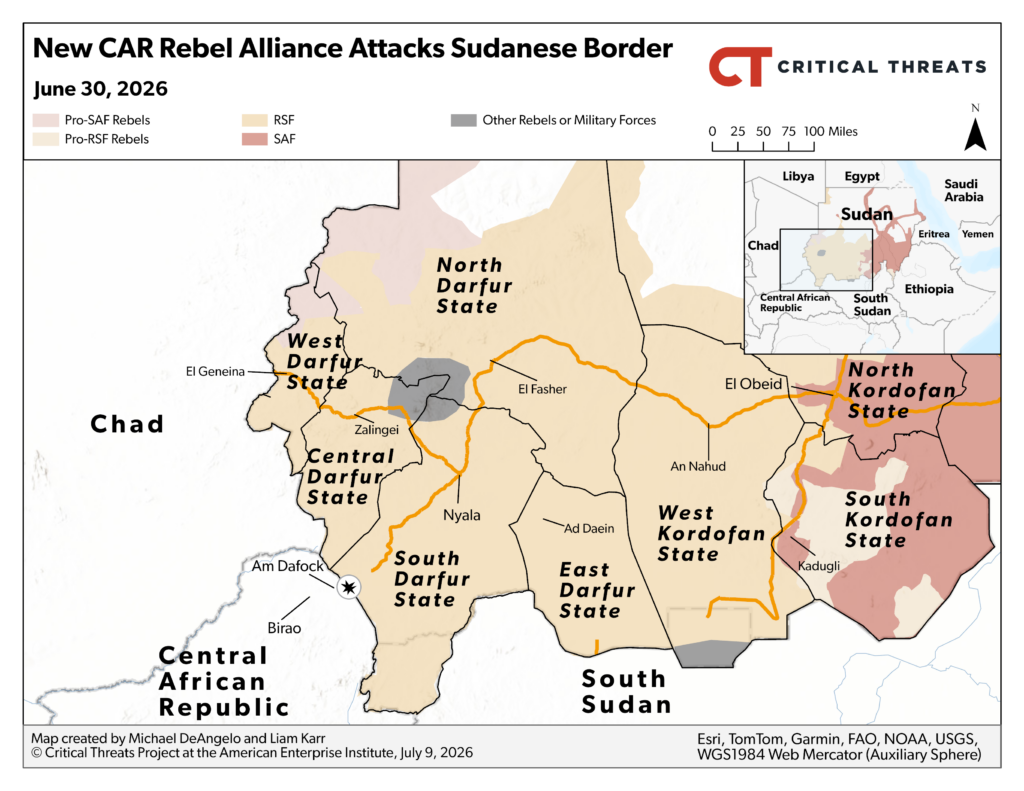
Note: “RSF” stands for the Sudanese paramilitary Rapid Support Forces, and “SAF” stands for the Sudanese Armed Forces.
The ASP alliance, which formed in mid-May 2026, claims to be a new coalition of Central African rebel groups. Noureddine Adam, a longtime Central African warlord and head of the Popular Front for the Renaissance of the Central African Republic (Front Populaire pour la Renaissance de la Centrafrique, FPRC), is reportedly recruiting and mobilizing fighters for the ASP.[49] Haroun Gaye, a close associate of Adam who helped form a splinter coalition from the Coalition of Patriots for Change (CPC) in mid-2024, is reportedly in charge of military operations.[50] The CPC was a loose coalition of six armed groups that formed in 2020 to overthrow the CAR government. The Africa Report reported that the ASP is modeling itself on the CPC.[51] Former fighters from Séléka, a coalition of predominantly Muslim armed groups that toppled the CAR government in 2013 and later split into factions that joined the CPC, reportedly participated in the Am Dafock attack.[52] The ASP also includes an ethnic Azande militia that Wagner forces initially helped train in early 2024 to fight other rebels in southeastern CAR but then mutinied against their chain of command later that year.[53] The ASP also claims the support of fighters loyal to a warlord based in western CAR who was a former leader of a coalition of mostly Christian and animist militias that formed to counter in Séléka in 2013.[54]
The emergence of the ASP increases the security challenges facing CAR President Faustin-Archange Touadéra. The French investigative outlet Africa Intelligence reported on July 1 that the Am Dafock offensive “took the government by surprise” and led to “unease” among the security services in Bangui, the Central African capital.[55] ASP said that it aims to capture Birao, which is the capital of Vakaga and a key logistics hub in the region about 40 miles from the CAR-Sudan border at Am Dafock.[56] The rebels also declared their intention to march on Bangui, although Bangui is almost 700 miles away from Birao on poor roads.[57] The French news outlet The Africa Report cited an unnamed insider source on July 3 who said that Gaye planned the attack on Am Dafock to test how quickly FACA and its allies could respond, potentially foreshadowing future military operations.[58]
UN forces, which have played a key role in providing security, have scaled back their presence in the CAR’s hinterland. The UN mission in the CAR (MINUSCA) alongside FACA and its bilateral allies—including Wagner and Rwandan troops—have helped improve security in urban areas, pushed rebel groups into remote regions, and degraded rebels’ fighting capacity since 2020.[59] MINUSCA announced in March 2026 that it withdrew from two military bases in the central CAR, however, as part of a wider scaling back of its operations, driven in part by political and financial pressure from the United States.[60] MINUSCA then withdrew or closed at least two dozen additional bases across the CAR in early June, except in Vakaga, where many armed groups and bandits remain active.[61] The International Crisis Group assessed in early 2026 that MINUSCA plays a critical military and political role in addressing security challenges across the CAR and that reductions in its budget and staff will undermine its operational effectiveness.[62]
Touadéra may be concentrating more personnel in Bangui to protect against coup threats. Touadéra won a third term in elections in December 2025 and largely preserved the political and ethnic balance of his previous administration, including in the security services, in the new government he appointed in May 2026.[63] Rumors of a coup orchestrated by the FACA chief circulated in Bangui when Touadéra reshuffled the government, leading the Central African defense minister to redeploy a significant number of FACA elements to Bangui to bolster Touadéra’s security.[64] The FACA general staff and several close advisers to Touadéra denied publicly in mid-June the rumors of their involvement in a coup plot.[65]
These challenges come as Touadéra’s relationship with the Kremlin is in limbo over the stalled transition from Wagner to Africa Corps. CTP assessed in early 2026 that Touadéra’s reelection preserved Russian interests in the CAR, even amid turmoil in his relationship with the Kremlin amid the switch from the Wagner to Africa Corps.[66] The CAR is the last Wagner bastion in Africa, as the Russian Ministry of Defense–controlled Africa Corps has subsumed Wagner operations in other African countries, such as Mali and Libya, in the aftermath of the Wagner mutiny and death of Wagner founder Yevgeny Prigozhin in 2023. Touadéra had been more resistant to the Kremlin’s overtures because of his close ties with Wagner’s commanders in the CAR, but French media reported in April 2026 that Touadéra had accepted the transition in late 2025.[67] The transition has not occurred, however, and the issue reportedly remains a point of contention within the Kremlin.[68] Africa Intelligence reported that Wagner took advantage of the coup rumors in Bangui in late May to deploy more troops and consolidate its presence in Bangui.[69]
The Sudanese paramilitary Rapid Support Forces (RSF) may have enabled the assault, which could complicate the CAR’s role in Emirati-RSF supply lines. The RSF and ASP have preexisting ties. The RSF has reportedly recruited fighters from Adam’s FPRC since August 2023 to fight in the Sudanese civil war.[70] The Africa Report also reported that an ASP-aligned former speaker of the CAR’s national assembly has a long-standing relationship with RSF head Mohamed Hamdan Dagalo (Hemedti) and serves as conduit between the two groups.[71] The ASP launched the recent assault from RSF-controlled territory in Sudan’s South Darfur state, with The Africa Report alleging that most of the ASP fighters involved were Sudanese.[72]
RSF-Wagner ties have weakened since 2024 amid Russia’s realignment with the SAF and Wagner incursions into RSF territory. Russia initially supplied the RSF with surface-to-air missiles and other weaponry in Sudan’s civil war, largely due to prewar Wagner ties with Hemedti and gold mining in RSF-controlled western Sudan.[73] Russia switched to supporting the SAF in early 2024, however, and offered military aid to the SAF in exchange for SAF following through on a 2020 agreement with the previous regime to give Russia a naval base on Sudan’s Red Sea coast.[74] The shift was another part of the Kremlin’s broader effort in the aftermath of the Wagner mutiny in 2023 to assert control over Russian military activities in Africa and pursue state-to-state relationships that better align with Russian strategic objectives.[75] Russia has since provided the SAF with crucial fuel and weapons shipments, while Wagner reportedly closed an RSF supply line from the CAR in mid-2026, according to the United Kingdom-based news outlet The Arab Weekly.[76] CAR and Sudanese news outlets have also reported since early 2025 that there have been multiple Wagner incursions into RSF-controlled South Darfur in which Wagner forces looted villages and killed civilians, along with recent RSF and Wagner buildups along the CAR-Sudan border.[77]
RSF support for the ASP could strain ties between the RSF and CAR government. FACA and Wagner warned in the aftermath of the assault on Am Dafock that they would target the attackers in Sudan if necessary, and the CAR and RSF have reportedly since closed their respective sides of the shared border, according to Sudanese news outlet Darfur24.[78] Africa Intelligence reported in January 2023 that the RSF had reached an agreement with the CAR government in which the group would fight armed groups in the northern CAR in collaboration with FACA and Wagner, potentially in exchange for access to gold mines in the area.[79] The CAR government has allowed Emirati weapons shipments, which are the RSF’s main source of external support, to transit to the RSF via CAR since at least 2025, according to Le Monde.[80] Touadéra has tried balance his ties with the RSF by also maintaining ties with the Sudanese Armed Forces (SAF), which he initially supported in the civil war, however.[81]
The RSF’s relationship with the ASP could also reduce the CAR’s willingness to serve as a key node in Emirati-RSF supply lines, although the United Arab Emirates (UAE) is a key economic partner for the CAR. The CAR and UAE signed an economic agreement in March 2025, reducing tariffs and calling for an increase in annual bilateral trade from approximately $250 million in 2024 to $1 billion by 2031.[82] Le Monde reported that the CAR has announced several Emirati-funded infrastructure projects in Bangui since signing the deal, including a new airport.[83] The UAE has coupled its economic initiatives with efforts to improve its supply lines to the RSF, as it has with several other countries that border Sudan. Africa Intelligence reported in late 2025 that the CAR and UAE were discussing the UAE funding Russian paramilitaries in the CAR in exchange for bolstering Emirati supply lines to the RSF via northern CAR, and the UAE reportedly later offered to develop the Birao airport.[84]
The SAF also has preexisting ties with the ASP, however, which may cause this latest iteration of the CAR conflict to not neatly align with the sides in the Sudanese civil war. The SAF has reportedly provided unspecified support to Adam for several years to counter ties between Hemedti and Touadéra, according to Africa Intelligence.[85] The Africa Report separately cited an anonymous source alleging that an Adam associate who resides in Port Sudan—the de facto capital of the SAF-led Sudanese government since the start of Sudan’s civil war—planned the assault on Am Dafock.[86]
Burundi
Burundian President Évariste Ndayishimiye hosted members of the Congolese political opposition and civil society to discuss a potential Congolese national dialogue and various political challenges facing the Democratic Republic of the Congo (DRC). Ndayishimiye hosted representatives from evangelical churches in the DRC, the DRC’s two largest church associations, and several members of the Congolese political opposition who are part of the C64 coalition for consultations in Bujumbura, Burundi’s economic capital, on July 6.[87] Former DRC President Joseph Kabila, who leads a separate opposition platform in exile, reportedly declined an invitation to join the talks.[88] The political opposition launched the C64 platform in mid-May 2026 to oppose DRC President Félix Tshisekedi’s bid to change the Congolese constitution, which CTP assessed previously would allow him to remain in power beyond the end of his constitutionally limited second term.[89] The church associations also oppose constitutional revision, whereas the evangelical churches, which are popular in urban areas, support it.[90]
The discussions focused on a potential national dialogue and the political challenges in the DRC. The opposition called for Tshisekedi to stop his efforts to change the constitution and asked Ndayishimiye to convince Tshisekedi to prioritize governance issues and commit to an inclusive national dialogue led by the church associations.[91] A national dialogue is a state-convened forum that brings together political actors, armed belligerents, and civil society members to negotiate solutions to various crises. Congolese government sources told the French state media outlet Radio France Internationale (RFI) that Burundi wanted to first hold consultations before getting more involved in any dialogue.[92]
The opposition wants Tshisekedi to commit to a series of measures aimed at building trust for any future dialogue. This included the release political prisoners, the annulment of politically motivated convictions, and the suspension of travel restrictions on the regime’s political opponents.[93] The opposition specifically asked Ndayishimiye for the release of a Congolese aid worker and blogger critical of Tshisekedi whom Burundian intelligence services arrested for “illegal parking” in Bujumbura in late May.[94] Congolese immigration authorities confiscated the passport of Delly Sesanga, one of the opposition leaders, in Kinshasa in late June before he went to Burundi.[95] The French investigative outlet Africa Intelligence reported that Ndayishimiye personally asked Tshisekedi to return Sesanga’s passport so that he could travel to Bujumbura.[96] Several conference participants told RFI that they doubted Tshisekedi’s good faith and want “concrete guarantees” before engaging in dialogue.[97]
Tshisekedi is continuing to use his regional allies as mediators to control a national dialogue and placate the political opposition. Angolan President João Lourenço has tried to organize a national dialogue at Tshisekedi’s request since January 2026.[98] Lourenço hosted Tshisekedi and Togolese President Faure Gnassingbé, who is the African Union (AU) mediator for the Great Lakes region, for a summit in Luanda, the Angolan capital, where they agreed Lourenço would start preparing for a dialogue in early February.[99] Lourenço and his aides consulted with a range of Congolese stakeholders and produced a detailed roadmap, referred to as the Luanda Pact, which Lourenço then submitted to Tshisekedi in early March.[100] The French magazine Jeune Afrique reported that the Luanda Pact calls for a dialogue held ceremonially under Lourenço’s auspices in Luanda but facilitated in practice by Gnassingbé and the AU facilitators.[101] Angola suggested that the Congolese government implement a series of confidence-building measures for the dialogue, including the release of political prisoners, and proposed including an equal number of participants from the majority and state institutions, civil society, and the political and military opposition, including M23.[102]
Tshisekedi effectively blocked the Luanda Pact, however, as he seeks to heavily control the format and outcome of any potential dialogue. Tshisekedi did not respond to the proposal until a senior aide delivered a counterproposal to Lourenço in mid-May that rejected most key aspects of the Luanda Pact.[103] Jeune Afrique reported that the DRC refused to include M23 or Kabila in the dialogue, called for greater accountability for Rwanda and Uganda, and stipulated that Tshisekedi have the authority to select the participants, convene and lead the dialogue in Kinshasa, and have sway over its conclusions.[104]
Tshisekedi’s obstinance has killed opposition buy-in to the Luanda Pact and alienated Angola, although Angola is likely to stay involved because of its common interests with the DRC. The political opposition has repeatedly rejected the idea of government-led dialogue as laid out in Tshisekedi’s counterproposal. The counterproposal explicitly left open the possibility of constitutional revision at the end of the process, which CTP and others have said would aim to keep Tshisekedi in power.[105] Jeune Afrique reported that Angola saw the DRC’s slow response time to the Luanda Pact and the counterproposal as a “lack of good faith.”[106] Lourenço sent an emissary to Kinshasa in late May and remains officially engaged in the dialogue initiative, but the process has stalled, with unverified reports suggesting that Angola may reduce its involvement due to various disagreements with the Congolese government.[107] CTP assessed when Lourenço received the original mandate from Tshisekedi to explore a dialogue in January that excluding M23 and Kabila and holding the dialogue in Kinshasa under Tshisekedi’s purview would impede a dialogue or prevent it from occurring altogether and limit its effectiveness.[108]
Tshisekedi is likely taking advantage of his ties with Ndayishimiye as he sidelines Angola to set conditions for a dialogue favorable to his terms. Burundi has thousands of troops deployed alongside pro-Congolese government forces against M23 in the eastern DRC and regularly supports political positions that the DRC defends in various regional forums, but Ndayishimiye is framing his engagement with the opposition and civil society as an extension of his role as the rotating AU president.[109] Jeune Afrique reported that Tshisekedi’s aides planned to present their counterproposal to “other mediators” after Angola rejected it, including Togo and possibly also Burundi.[110] RFI reported that Tshisekedi discussed with Ndayishimiye the possibility of hosting opposition figures and civil society members during Ndayishimiye’s state visit to Kinshasa in late June.[111] Ndayishimiye’s main request in the July 6 discussions was reportedly that the opposition and civil society accept the principle of a dialogue without specifying its format or agenda.[112] Ndayishimiye reportedly told the opposition that he would brief Tshisekedi on the talks and that future discussions would depend on the outcome of discussions between him and Tshisekedi.[113]
The new dialogue efforts may also aim to placate the opposition’s demands against constitutional change. The C64 coalition organized a general strike in several of the DRC’s major cities to protest constitutional change in early June.[114] The strike yielded mixed results but sent a “strong message” that the coalition could cause problems for Tshisekedi’s coalition, according to French journalist Christophe Rigaud.[115] Security services and militias linked to Tshisekedi then forcibly cracked down on opposition protests in Kinshasa against the government’s push to change the constitution in mid-June.[116] The C64 coalition planned another protest opposing constitutional change for early July but pushed back the march to late July after Ndayishimiye invited them to Bujumbura.[117]