
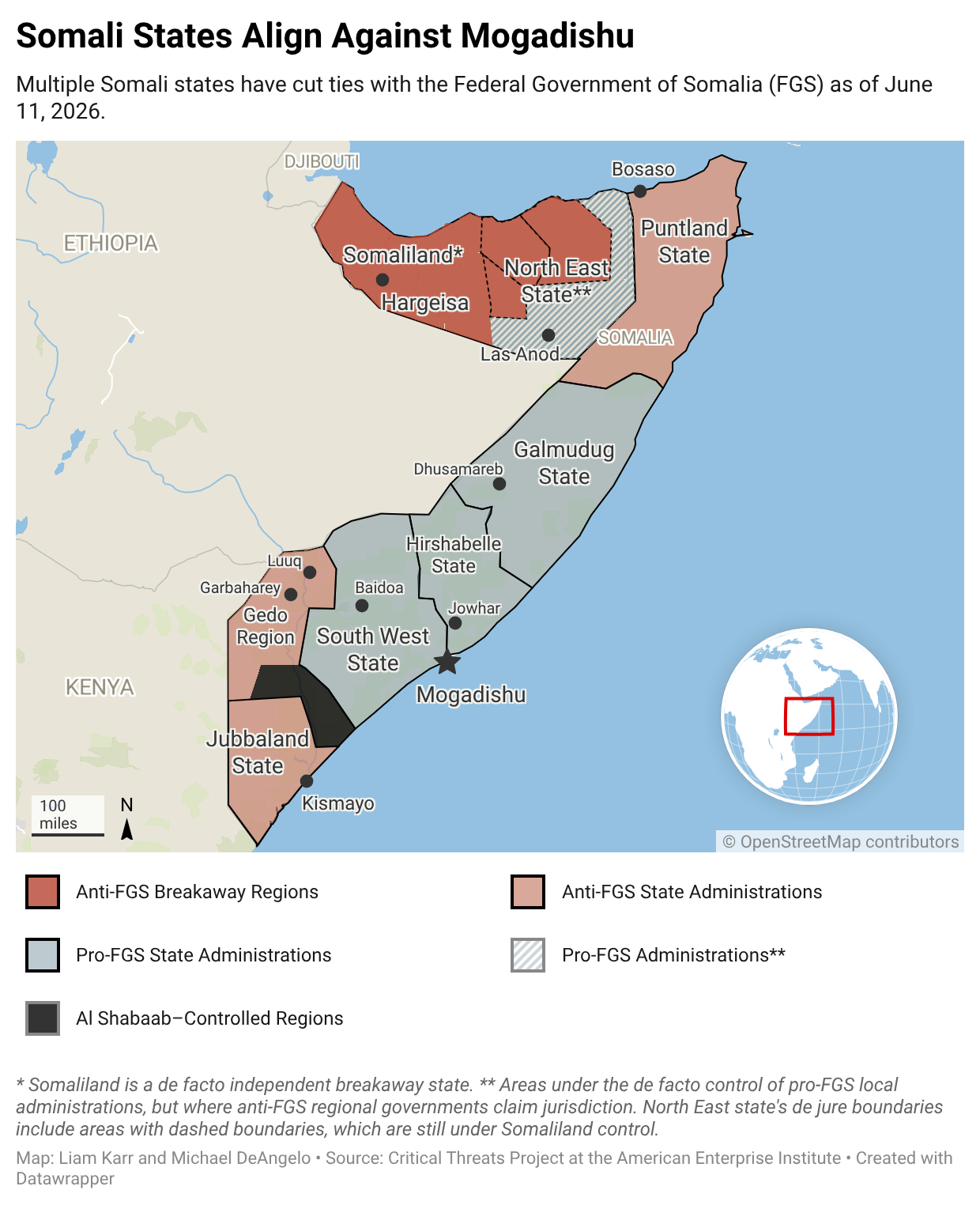
Key Takeaways:
Somalia. Federal Government of Somalia forces clashed with opposition forces in Mogadishu, the Somali capital, marking an escalation in their constitutional and electoral dispute. Clashes between the two parties in Mogadishu will likely continue to intensify in the immediate term, although there is growing international pressure on both sides to compromise on their maximalist political positions.
Tanzania. Tanzanian President Samia Hassan traveled to Russia on her first state visit outside Africa since Tanzania’s controversial elections in October 2025, as she continues her recent efforts to court the Kremlin. Russia is likely capitalizing on Tanzania’s growing pariah status in the West to draw it closer into Russia’s orbit and advance its strategic objectives, as it has done with many other African states.
Sudan. Sudanese political groups produced a roadmap for settling the civil war, although key factions did not endorse the roadmap due to the inclusion of certain groups, highlighting divisions that are stalling peace talks.
Figure 1. Africa File, June 11, 2026
Assessments:
Somalia
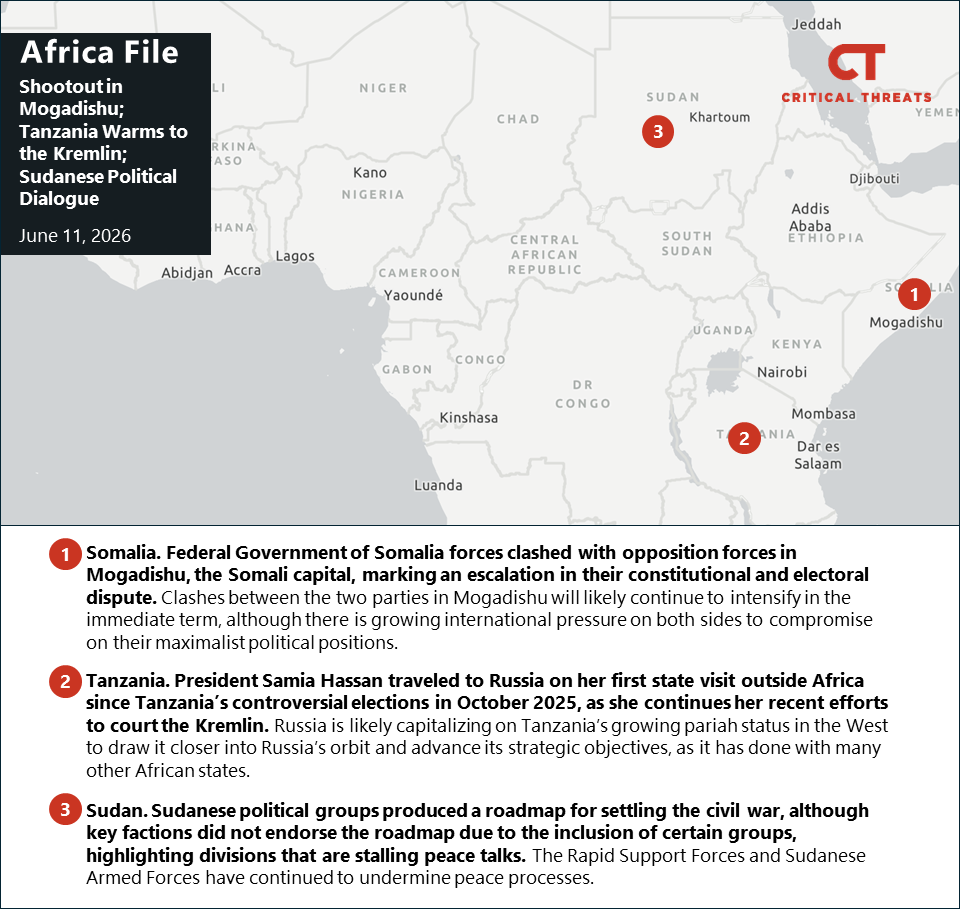
Federal Government of Somalia (FGS) forces clashed with opposition forces in Mogadishu, the Somali capital, marking an escalation in their constitutional and electoral dispute. The FGS deployed forces to neighborhoods where Somali Future Council (SFC) opposition coalition leaders were gathering to prevent an SFC protest against the FGS’s constitutional and electoral revisions. FGS forces surrounded the temporary headquarters of Hassan Ali Khaire and Sharif Sheikh Ahmed, SFC leaders and a former Somali prime minister and president, respectively.[1] Opposition forces had previously established positions around the headquarters in the central Mogadishu neighborhoods.[2] Clashes then broke out on June 3, persisting into the next day before both sides withdrew from the affected neighborhoods.[3] Somalia’s Ministry of Health and Human Services stated that the clashes killed one person and injured 55 others, although a United Nations document reported at least nine dead.[4]
Figure 2. The Federal Government of Somalia (FGS) and Somali Future Council (SFC) Clash in Mogadishu
The FGS similarly deployed forces to prevent a planned protest near the presidential palace on June 5 after efforts to convince the SFC to hold the rally in a less sensitive location failed, leading to the recent clashes.[5] The FGS’s pressure contributed to Ahmed and Khaire abandoning their temporary headquarters, and the protest plans subsequently fell apart.[6] The international community, particularly Turkey and the United States, reportedly helped convince the SFC to stand down in exchange for guaranteed dialogue with Somali President Hassan Sheikh Mohamud.[7]
The fighting comes months into a political standoff over the FGS’s controversial constitutional and electoral revisions. The FGS approved a new constitution in March 2026 that extended Mohamud’s term by one year, delayed federal elections, and mandated direct federal parliamentary elections going forward.[8] The SFC rejected the new constitution as a power grab by the FGS and has organized a broad coalition across Mogadishu, holding events and planning protests.[9] The FGS had responded by deploying security forces to disrupt SFC activity, including by obstructing roads to prevent a protest from taking place right before Mohamud’s term extension took effect on May 15.[10]
Clashes between the two parties in Mogadishu will likely continue to intensify in the immediate term, although there is growing international pressure on both sides to compromise on their maximalist political positions. Dialogue throughout 2025 and the first part of 2026 has failed to reduce tensions, with the most recent internationally sponsored talks in advance of the May 15 term extension collapsing over the extension and direct elections.[11] The FGS has proceeded with its plan despite SFC threats of parallel elections.[12] The United States, along with the European Union, over a dozen European countries, and the United Nations mission in Somalia, issued statements on June 1 calling for further talks to avoid violence.[13] Turkey has been mediating between the FGS and SFC, although this effort has reportedly stalled due to internal SFC disputes.[14]
The FGS has continued its crackdown on the SFC since the recent clashes, setting the stage for further violence. FGS forces temporarily obstructed Ahmed’s convoy at a roadblock in Mogadishu on June 5, despite Ahmed’s withdrawal from his temporary headquarters.[15] FGS forces then raided an opposition-owned hotel on June 6.[16] The FGS claimed to seize weapons, including drones, which hotel owner and Ahmed-allied parliamentarian Abdullahi Mohamed Nur denied.[17] The FGS has also deployed forces to areas where pro-SFC forces and leaders, including a former Somali military head, are located.[18]
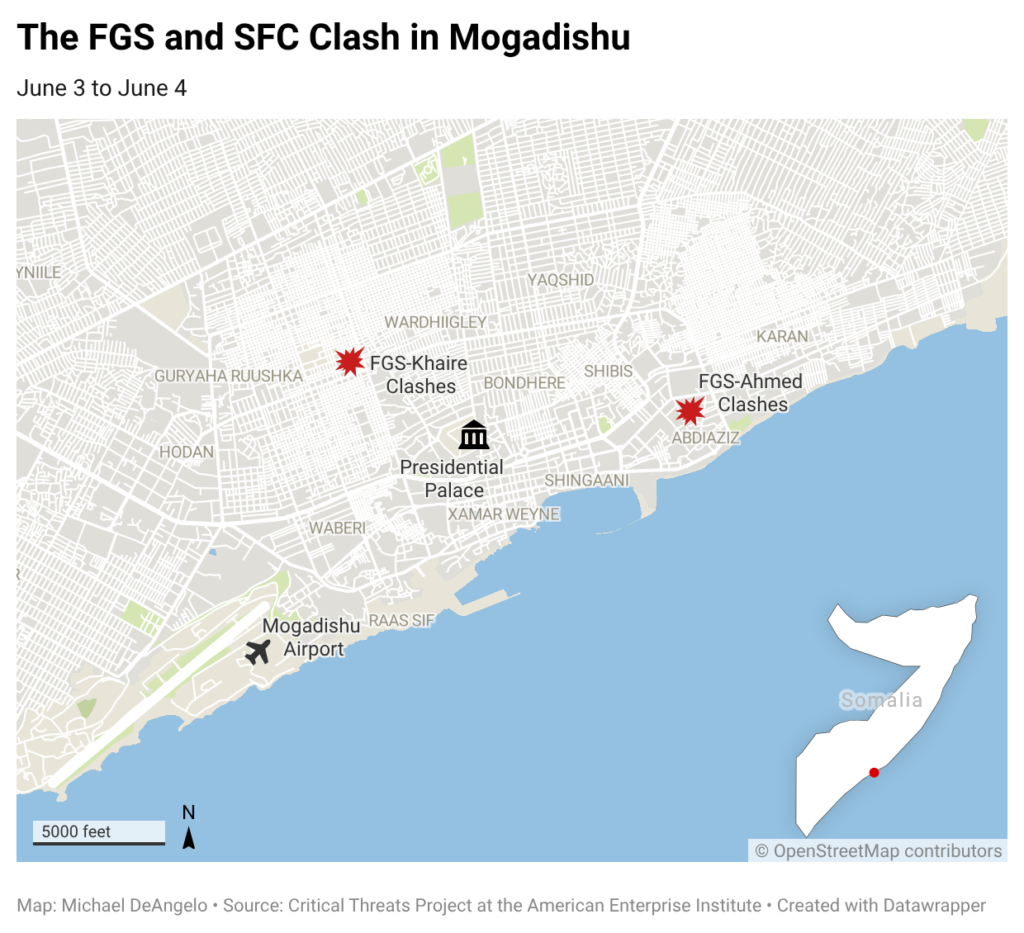
Violence could extend beyond Mogadishu, as the FGS is trying to consolidate control of pro-FGS Federal Member States. The FGS deposed the formerly allied South West state president in March 2026 due to an emerging power struggle and has established a puppet government to run the state.[19] The FGS’s handpicked candidate for South West state president almost unanimously won the state’s June 10 election, which rival figures denounced as rigged.[20] The FGS’s takeover has sparked clashes between its forces and those loyal to the former state president, with the latter briefly advancing into Baidoa—the de facto state capital—in both mid and late May.[21] The anti-FGS Somali outlet Baidoa Online reported on June 6 that the opposition forces remain mobilized around Baidoa.[22]
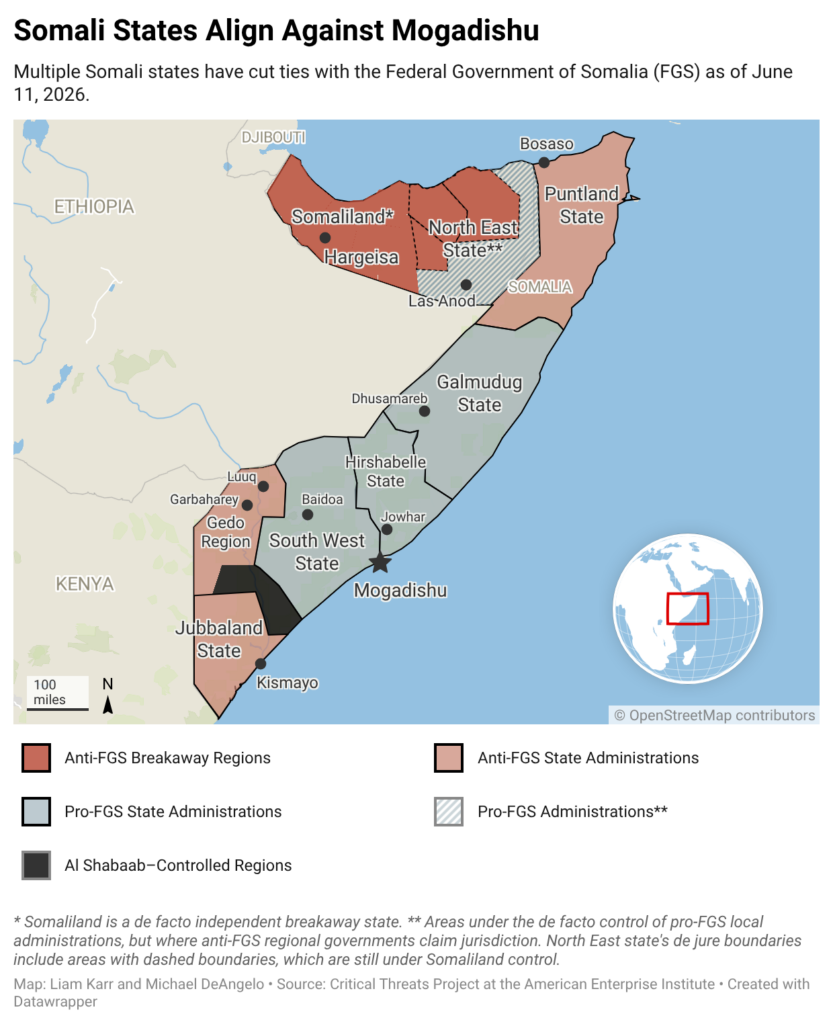
Figure 3. Somali States Align Against Mogadishu
The FGS has separately increased pressure on Galmudug and Hirshabelle states to install more pro-FGS leaders, despite both state presidents’ prior support for the FGS. The FGS began redeploying forces from the front lines with al Shabaab to Dhusmareb, the Galmadug state capital, after Galmudug state President Ahmed Abdi Karie (Qoor-Qoor) rejected the FGS’s replacement of state officials in early May 2026.[23] The FGS has continued sending forces to Dhusmareb due to Qoor-Qoor’s refusal to step aside in favor of the FGS’s handpicked candidate in the upcoming election.[24] The FGS has also redeployed forces to Jowhar, the Hirshabelle state capital, to prevent Hirshabelle state President Ali Gudlawe Hussein from contesting the upcoming election, according to freelance journalist Hussein Mohamed.[25] Mohamed reported on June 6 that FGS forces have attempted to enter Hussein’s residence, but Hussein’s guards stopped them.[26]
Tanzania
Tanzanian President Samia Hassan traveled to Russia on her first state visit outside Africa since Tanzania’s controversial elections in October 2025, as she continues her recent efforts to court the Kremlin. Hassan visited Russia from June 3 to 5, meeting with Russian President Vladimir Putin in Moscow before attending the St. Petersburg International Economic Forum (SPIEF).[27] The visit included the signing of several new economic cooperation agreements.[28] An accompanying Tanzanian business delegation negotiated deals in trade, minerals, and tourism.[29] Tanzanian officials highlighted several flagship projects in the country to Russian investors and announced that Tanzania expects more than $2 billion in new Russian investment over the next three to five years.[30] Tanzania’s mining minister said that the two countries recommitted to advance the $1 billion Mkuju River uranium mining project, which is led by Russia’s state nuclear corporation, Rosatom, and would position Tanzania as one of Africa’s top uranium producers.[31] Hassan also announced the launch of direct flights from Dar es Salaam, Tanzania’s most populous city and economic capital, to Moscow in early July.[32]
Hassan was elected president in sham elections marred by violence in late October 2025. Tanzania’s electoral commission gave Hassan a landslide win for her first elected mandate with almost 98 percent of total votes.[33] Large-scale protests and low voter turnout overshadowed the election after Hassan’s ruling party disqualified her two main opposition candidates and repressed its political opponents in the run-up to the election.[34] Even the African Union criticized the election as undemocratic.[35] Protests erupted in Dar es Salaam and across the country for several days, before the Tanzanian government imposed an internet blackout and used force to crack down brutally on protesters, killing at least an estimated 700 people, according to a UN estimate in November.[36] Hassan blamed “foreigners” for the instigating the protests and has called protesters and political activists “disrespectful children” who deserve to be “beaten with canes.”[37] Hassan handpicked members for a government commission that confirmed over 500 election-related deaths in late April, but the report did not attribute responsibility to the state, and Hassan used it to reassure investors in the country.[38]
Tanzania has long-standing ties with Russia but has initiated closer relations since the postelection crackdown. The two countries have had diplomatic relations since the Soviet Union became one of the first nations to recognize Tanzania’s independence in 1961. Hassan’s visit to Russia was the first state visit by a Tanzanian president to Russia since 1969, however. Russia and Tanzania strengthened their economic ties and established a joint business council in January 2026, shortly before Hassan sent her foreign minister to meet with his Russian counterpart in Moscow to lay the groundwork for expanded relations in February.[39] A senior Tanzanian legislative official told The Africa Report in early June that Tanzania purposely served Rosatom with a default notice on the Mkuju River uranium project to draw Russia’s attention, which reportedly moved the Kremlin to invite Hassan for the state visit.[40]
Tanzania’s increased engagement with Russia is likely at least partially in response to heightened diplomatic and political pressure from United States and the European Union (EU) over Tanzania’s last election and the government’s repressive tactics. The US State Department said in early December 2025 that it would conduct a comprehensive review of bilateral relations over Tanzania’s repression of religious freedom, barriers to US investment, and violence against civilians before and after the October elections.[41] US President Donald Trump’s nominee for ambassador to Tanzania said that the elections raised concerns about Tanzania’s viability as a long-term “reliable partner” in his April confirmation hearing.[42] Two US senators introduced a bipartisan bill in late May to reassess US-Tanzania ties, amid concerns over “democratic backsliding, political repression, human rights abuses,” along with growing Chinese influence in the country.[43] The US State Department then imposed visa restrictions on the head of Tanzania’s police force based on “credible information” of his involvement in “gross violations of human rights” committed in May 2025.[44]
The EU has also taken a tough stance on Hassan’s government. The EU’s high representative said that the EU was “very concerned” about the election-related violence at the time and the “lack of a level playing field” in the run-up to elections.[45] The EU condemned the election killings and targeting of the opposition and voted to freeze about $180 million in annual funding to Tanzania in late November 2025.[46] EU officials criticized the Tanzanian government’s move to deny the entry of an EU delegation tasked with investigating allegations of electoral violence and auditing EU funds in early May 2026 and voted against repealing the November 2025 annual funding decision in early June.[47]
Ties with Russia also fit Hassan’s “non-alignment” foreign policy, which seeks to expand and balance broad international partnerships. Hassan has worked to rebuild Tanzania’s regional and global standing and court external investment under its Vision 2050 development strategy after a period of isolationism under her predecessor.[48] Tanzania has the second-largest economy in East Africa behind Kenya, and the Dar es Salaam port serves as a major gateway for international trade and regional logistics. The Tanzanian market is competitive and diverse, as the country’s major trading and investment partners include China, Egypt, India, Kenya, South Africa, Turkey, and the United Arab Emirates.[49] Bilateral trade between Russia and Tanzania was only about $300 million, compared to nearly $9 billion with China—its largest trading partner—in 2024.[50] The EU is also an important trading and development partner for Tanzania, and Tanzania has aligned itself with several EU global priorities.[51] Tanzania is likely to remain engaged with a range of external partners to maintain access to Western markets, multilateral finance, foreign direct investment, and regional trade opportunities.
Russia is likely capitalizing on Tanzania’s growing pariah status in the West to draw it closer into Russia’s orbit and advance its strategic objectives, as it has done with many other African states. The Kremlin’s engagement with Tanzania supports its objective to gain political allies on the continent, which helps mitigate Western isolation in international forums and advance Russian narratives. The Kremlin is attempting to gain more authoritarian and pro-Russian African partners to strengthen its position in the international system. These partners bolster antidemocratic and anti-Western Russian narratives that attempt to undermine the existing international order and promote a more pro-Russian worldview. The Kremlin uses these various partnerships to advance these aims within international bodies. Russia is also attempting to strengthen economic engagement with Africa in various sectors to mitigate the impact of tensions and sanctions with the West by exploiting new revenue streams and export markets.
The Kremlin is using this playbook with Tanzania. Sergei Kiriyenko, a top Kremlin official, delivered a personal message to Hassan from Putin, who was one of the first foreign leaders to publicly salute her election victory, in November, and Putin affirmed Russia’s commitment to what he said is a “mutually beneficial” partnership.[52] Kiriyenko has been linked to Kremlin influence operations and was recently appointed to oversee relations with several African countries.[53] Putin hailed Hassan’s trip to Moscow as a sign of stronger relations and said that the two countries align on many international issues and would continue to cooperate in achieving a “more balanced” world order.[54] Russia uses the SPIEF to project economic influence and showcase non-Western partnerships. A senior Tanzanian economic official said in early June that the two countries are finalizing negotiations to establish a new payment system for trade.[55] The Tanzanian legislative official who spoke to The Africa Report said that Russia likely wants to use the Mkuju River project as a symbolic move to bolster ties with Tanzania and show the EU that Russia can “beat them at their own game,” as the project will not produce a significant quantity of supply to the global market.[56]
Sudan
Sudanese political groups produced a roadmap for settling the civil war, although key factions did not endorse the roadmap due to the inclusion of certain groups, highlighting divisions that are stalling peace talks. The groups gathered in the Ethiopian capital, Addis Ababa, from June 3 to June 5 for talks sponsored by the Quintet, a body consisting of the African Union, Arab League, European Union, United Nations, and Intergovernmental Authority on Development, which is the East African economic bloc.[57] Participants included factions of the Sudanese Armed Forces (SAF)-aligned Democratic Bloc, the Rapid Support Forces’ (RSF’s) political body Tasis, and Somoud, an unaligned coalition that former Prime Minister Abdalla Hamdok leads.[58] Somoud, factions of the Democratic Bloc, and several other groups agreed to a roadmap that calls for a ceasefire and the establishment of a committee to initiate a political settlement dialogue.[59] The Quintet, the United States, and several European countries released a statement on June 8 supporting the political track, referencing a timeline of six months to complete dialogue.[60]