
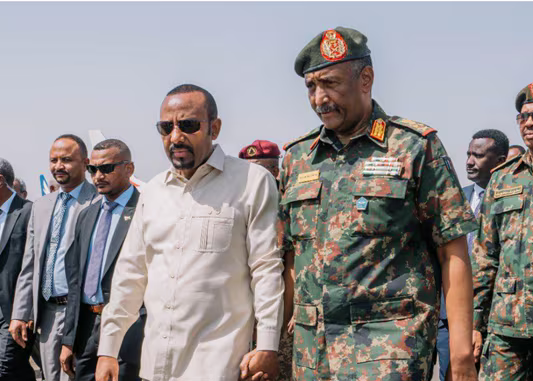
As Sudan enters its fourth year of civil war, the Ethiopia-based think tank Horn Review recently published a policy brief, titled “Sudan’s War and the Imperative of Ethiopia’s Re-engagement,” arguing that Ethiopia should reassert itself as the principal African mediator in the conflict. The paper contends that Sudan’s future is too important to Ethiopian security to leave the field to Egypt, Eritrea, and other external actors, warning that continued Ethiopian disengagement risks undermining Addis Ababa’s interests in border security, regional stability, refugee management, and the security environment surrounding the Grand Ethiopian Renaissance Dam (GERD). It therefore calls for a more active Ethiopian diplomatic role, centered on renewed leadership within African institutions and support for a civilian-led political settlement in Sudan.
The policy paper has been authored by Horn Review’s executive director, Blen Mamo, and Horn Review’s Researcher, Mahder Nesibu.[1]
Executive Summary
Sudan’s civil war, now in its fourth year, has produced the world’s largest displacement crisis and drawn in a constellation of regional powers whose competing interests have transformed the conflict into a sustained proxy contest. For Ethiopia, this is a national security challenge unfolding on a shared border, with direct implications for the Grand Ethiopian Renaissance Dam, cross-border stability, and the regional balance of power in the Horn of Africa.
Ethiopia’s diplomatic record in Sudan is unmatched among the conflict’s potential mediators. From the Addis Ababa Agreement of 1972 to the brokerage of the 2019 power-sharing arrangement, Addis Ababa has consistently demonstrated the capacity to operate as an effective mediator while holding its own declared interests in the outcome. That combination of proximity, institutional knowledge, and diplomatic credibility constitutes a strategic asset that no other actor in the current process can replicate. It is not being deployed.
Since April 2023, Ethiopia’s engagement has retreated to the humanitarian perimeter. The bilateral channel with the SAF leadership has been effectively severed. Egypt and Eritrea, both adversarial toward Addis Ababa, are now embedded on the SAF side as active partners. The diplomatic vacuum Ethiopia has left is being filled by actors whose regional objectives are structurally opposed to Ethiopian interests.
A structured re-engagement is both necessary and achievable. At the multilateral level, Ethiopia must invest substantive diplomatic resources in IGAD and the African Union and position itself as the leading African voice for a civilian-led transitional outcome. A working relationship with Washington, built on the precedent of coordinated engagement during the 2005 peace process, would complement the Quad’s external leverage with Ethiopian regional depth. An African diplomatic coalition comprising impartial continental partners, convened and anchored by Addis Ababa, would provide the credible African consensus-building architecture that existing processes lack. A dedicated Special Envoy for Sudan, carrying a Prime Ministerial mandate, is the essential instrument for operationalizing all three tracks.
The cost of continued absence is compounding. Sudan’s political future is not separable from Ethiopia’s strategic environment, and the window for meaningful Ethiopian influence on its trajectory is narrowing.
- Ethiopia’s Prior Engagement: History and Mechanisms
Ethiopia carries a long and substantive diplomatic history in the Sudanese political space, one that has developed in parallel to Sudan’s almost unbroken experience of internal armed conflict since
independence. In fact, Sudan’s conflict history predates its formal statehood. The First Sudanese Civil War, fought between the Khartoum-based northern government and southern armed movements, is dated from 1955, a year before independence in 1956, and lasted until 1972.
Ethiopia’s mediation legacy runs alongside this trajectory.
A. The First Sudanese Civil War (1955–1972)
The First Sudanese Civil War ended primarily through an Ethiopian-led diplomatic initiative. The Addis Ababa Agreement of 1972, brokered under Emperor Haile Selassie, brought the conflict to a close and has been designated “Africa’s Beacon of Hope” for its significance as an early resolution of an identity based, post-colonial civil conflict of the kind that defined much of the continent’s post-independence era.
The agreement is instructive for the case this brief advances. The Ethio-Sudanese relationship at the time was deeply complicated by Cold War alignment dynamics: Ethiopia was situated within the Western aligned bloc, while Sudan operated under a Soviet-aligned government until 1971.
Proxy conflict was a structuring feature of the bilateral relationship. Khartoum backed and hosted Ethiopian rebel movements, principally the Eritrean People’s Liberation Front (EPLF) and the Tigray People’s Liberation Front (TPLF), while Addis Ababa, alongside the United States and Israel, extended support to southern Sudanese armed factions.
Despite these underlying fissures, two conditions enabled the agreement: a demonstrated willingness on the part of both the Government of Sudan and the southern armed movements to negotiate, and Ethiopia’s diplomatic weight and institutional appetite for mediation. Ethiopia’s role was that of facilitator rather than principal mediator. The substantive mediation was conducted by two non-partisan multilateral religious bodies, the All Africa Council of Churches (AACC) and the World Council of Churches (WCC), with Ethiopia represented at the negotiations by Nebiyelul Kifle, a legal scholar serving as the Emperor’s personal envoy. Ethiopia’s most consequential contribution was persuading the South Sudan Liberation Movement (SSLM) to enter negotiations, and applying diplomatic pressure on contested issues such as the composition of security forces in southern territories.
B. The Second Sudanese Civil War (1983–2005) and the Path to South Sudan’s Independence
Ethiopia again assumed a central mediation role during the Second Sudanese Civil War, operating within the Intergovernmental Authority on Development (IGAD) framework, the primary institutional vehicle for the peace process, alongside the IGAD Partners Forum Quartet, comprising the United States, the United Kingdom, Norway, and Italy. Prime Minister Meles Zenawi exercised particular influence over the process by virtue of established working relationships with both President Omar al-Bashir and Sudan People’s Liberation Movement (SPLM) Chairman Dr. John Garang, giving Addis Ababa access to both principal parties in a way few external actors could claim.
C. The 2019 Revolution and the Lead-up to the Current War
Ethiopia’s most recent and most direct engagement in the Sudanese political process came in the period following the April 2019 removal of President Omar al-Bashir, during which Addis Ababa assumed a leading role in shaping Sudan’s transitional political architecture.
Prime Minister Abiy Ahmed was the most actively engaged foreign head of state in the initial post-Bashir mediation effort. Ethiopia’s principal instrument in this process was Ambassador Mohammed Dardir, then serving as Special Envoy to Sudan, who, alongside African Union Special Envoy Mohammed Hassan, served as a principal broker of the July 2019 power-sharing agreement between Sudan’s civilian opposition and its military establishment. The agreement, reached following sustained popular pressure that forced Bashir’s removal, was designed to chart a pathway toward a civilian-led democratic transition. Ethiopia was thus a foundational architect of the transitional blueprint.
The blueprint, however, did not hold. A military coup in October 2021 dismantled the transitional framework. The partnership between the Sudanese Armed Forces (SAF) and the Rapid Support Forces (RSF), the two coup principals, subsequently collapsed, and the breakdown between them escalated into the full-scale civil war that erupted in April 2023 and continues to the present.
- The Logic of Withdrawal
The underlying tensions in the Ethio-Sudanese relationship, long managed beneath the surface of diplomatic engagement, moved to the foreground as the Sudanese Armed Forces (SAF) consolidated its influence over Sudanese political life following the 2019 revolution. The SAF’s institutional character, its external alignments, and its posture toward Ethiopia collectively transformed what had been a workable bilateral framework into a relationship defined by competing interests and mutual suspicion.
The SAF’s divergence from both the Forces for Freedom and Change (FFC), the civilian coalition that led the 2019 uprising, and the Rapid Support Forces (RSF) was apparent from the early days of the transitional period. Several structural features of the SAF shaped this trajectory. The institution carries decades of established ties with the Egyptian Armed Forces (EAF), a relationship that mirrors the broader Egyptian-Sudanese state dynamic, both countries governed in practice by their respective military establishments. The SAF also retained significant internal influence from the Islamist networks embedded during the Bashir era under the National Islamic Front (NIF), which persisted within its ranks well beyond Bashir’s removal. Compounding this, the SAF maintained longstanding institutional relationships with officers from the EPRDF era in Ethiopia, a significant portion of whom went on to serve within the Tigrayan Defence Forces (TDF), the armed wing of the Tigray People’s Liberation Front (TPLF) during the 2020–2022 Tigray conflict.
These alignments had direct operational consequences for Ethiopia. During the conflict, the SAF facilitated arms flows to the TPLF, with the strategically positioned Humera corridor serving as the principal supply route into Tigray. The Sudanese side of the Al-Fashaga border zone, historically home to refugee populations from Ethiopia, was converted into a staging and mobilization ground for TDF forces operating along the disputed frontier territories. Elements of TPLF-aligned forces present in the area have since been reported to have engaged alongside the SAF in active combat, including in the Blue Nile region and further into Sudan’s interior.
The SAF’s seizure of the disputed Al-Fashaga territory in late 2020 compounded the deterioration. The move was widely read as a deliberate exploitation of Ethiopia’s institutional preoccupation with the Tigray conflict, a calculated encroachment on contested borderlands at a moment when Addis Ababa’s military and political bandwidth was fully absorbed internally. Sudan’s position on the Grand Ethiopian Renaissance Dam (GERD) shifted in parallel. Through the Bashir period and into the transitional government under Prime Minister Abdalla Hamdok, Khartoum had maintained a broadly constructive posture on the GERD. Under SAF dominance, that position realigned toward Cairo’s, a shift attributable to the depth of the EAF-SAF institutional relationship, their shared preference for military-led governance models, and Egypt’s active cultivation of the SAF as a strategic partner on Nile waters policy.
With the outbreak of the Tigray conflict in November 2020, Ethiopia’s diplomatic attention turned decisively inward. Addis Ababa’s engagement with Sudanese political developments during this period was limited. The SAF-led coup of October 2021 and the subsequent friction between the military establishment and the civilian transitional government unfolded largely without substantive Ethiopian involvement. The Framework Agreement of December 5, 2022, which sought to restore the path toward civilian administration, was principally the product of AU and IGAD multilateral pressure, supported by Western diplomatic engagement, rather than direct Ethiopian initiative.
Following the outbreak of armed conflict between the SAF and the RSF in April 2023, Ethiopia made concentrated efforts to re-engage. These efforts did not produce results. The bilateral relationship continued to deteriorate, and the record of Prime Minister Abiy Ahmed’s visits to Sudan across this period charts the arc of that decline.
On August 17, 2019, Abiy attended the signing of the Constitutional Declaration, the concluding instrument of the power-sharing agreement Ethiopia had helped broker, and was received warmly by Sudanese counterparts. An August 2020 visit to Prime Minister Hamdok focused primarily on GERD related discussions. A January 26, 2023 visits to Khartoum, conducted months before the outbreak of fighting, was the most consequential of the series as it came against the backdrop of unresolved tensions over the GERD, the Al-Fashaga territorial dispute, and the SAF’s conduct during the Tigray conflict, and signaled Ethiopia’s attempt to stabilize the relationship as its own internal conflict had ended following the November 2022 Cessation of Hostilities Agreement. In July 2024, Abiy made a further visit, this time to Port Sudan, the SAF’s de facto wartime seat of government at that time. The visit failed to produce a diplomatic opening.
By that stage, SAF commander General Abdel Fattah al-Burhan had repositioned himself in explicit alignment with Egypt and Eritrea, both of which maintain adversarial postures toward Addis Ababa. Internal reporting indicates that Egyptian influence played a direct role in undermining the July 2024 engagement. Cairo’s cultivation of al-Burhan appears to have effectively severed high-level contact between the Ethiopian government and the SAF leadership, foreclosing the bilateral channel through which Ethiopia had historically exercised its most direct influence over the Sudan file.
This was made more visible in 2025, when the Ethiopian Prime Minister dispatched the Ethiopian Spy Chief Redwan Hussein and the advisor minister For East Africa Getachew Reda to Port Sudan. The meeting laid visible the growing rift between the Army and Ethiopia.
- Ethiopia’s Current Posture and the Stakes of Continued Disengagement
Ethiopia’s present position on the Sudanese civil war was most formally articulated by State Minister Hadera Abera at the Third International Conference on Sudan, held in Berlin in April this year. The statement reflected a posture of principled distance rather than active engagement. High-level political commitment to mediation has receded markedly, driven in part by the withdrawal of Prime Ministerial attention from the Sudan file and in part by the structural character of the conflict itself.
The nature of the current war distinguishes it from Sudan’s prior conflicts, in which a recognized state apparatus confronted an insurgent or secessionist armed movement. The present confrontation is an intramilitary rupture. The Rapid Support Forces (RSF), a paramilitary formation elevated from irregular militia status under Omar al-Bashir and subsequently institutionalized as a parallel security structure, is now in direct armed conflict with the Sudanese Armed Forces (SAF), the recognized national military. This configuration complicates Ethiopia’s established mediation toolkit, which was built around state-to-insurgency frameworks.
The SAF’s repeated accusations that Ethiopia is covertly backing the RSF have further constrained Addis Ababa’s room for maneuver. The accusations are without evidentiary foundation and are best understood as a function of the SAF’s alignment with Egypt, which has its own strategic incentives to isolate Ethiopia diplomatically. Nevertheless, the accusations have served their purpose; they have driven a wedge between Ethiopia and the broader SAF bloc and have complicated Ethiopia’s positioning within multilateral peace processes.
Ethiopia’s current engagement can be characterized across two tracks. On the political-military dimension, Addis Ababa has adopted a posture of deliberate non-recognition, declining to confer legitimacy on either the SAF, the RSF, or the civilian bodies that have variously claimed governmental authority over the Sudanese state. Ethiopia remains formally committed to the transitional framework established following the 2019 revolution and to the principle of civilian-led democratic governance as the legitimate endpoint for Sudan’s political process.
On the humanitarian dimension, Ethiopia has maintained a more active role, reflecting both its geographic exposure as a major host country for Sudanese refugees and its institutional interest in managing crossborder displacement. Addis Ababa hosted the First High-Level Humanitarian Conference for the People of Sudan in 2025 and has sustained participation in the high-level humanitarian conferences that have followed, including the Berlin conference of April 2026.
A. The Stakes of Disengagement
This posture of managed distance carries compounding strategic costs that warrant direct assessment. The SAF’s increasingly adversarial orientation toward Ethiopia, reinforced by its alignment with Cairo and Asmara, means that Ethiopia’s diplomatic standing is being actively degraded within the Sudanese political space. Both Egypt and Eritrea maintain adversarial postures toward Addis Ababa and have embedded themselves in the war as active stakeholders. Eritrea provides military training, serves as a transit corridor for arms supplies to the SAF, and has been reported to have deployed personnel in a direct combat capacity at various stages of the conflict. Egypt is the SAF’s primary external patron, providing military, political, and diplomatic backing, and has worked systematically within the African Union to advance the SAF’s legitimacy claims.
Allowing these two states to operate without a countervailing Ethiopian presence in the Sudan process means ceding strategic terrain to actors whose regional objectives are structurally opposed to Ethiopian interests. Eritrea in particular has built an extensive network of proxy relationships across the region, including inside Ethiopia, that directly threatens Addis Ababa’s national security calculus.
Sudan’s geographic position amplifies the risk calculus. The country sits at the intersection of the Sahel, the Horn of Africa, and the Great Lakes region. The war’s spillover effects are already evident, and the prospect of a governance vacuum enabling the entrenchment of non-state armed actors and transnational militant networks in Sudanese territory presents a direct long-term security risk to Ethiopia and to regional stability more broadly. South Sudan, itself fragile, represents one of the more immediate vectors of spillover concern.
Ethiopia’s strategic interest in a civilian-led Sudan extends beyond normative commitment. The relationship between the Ethiopian state and the Sudanese population is being actively eroded by systematic war propaganda emanating from the SAF-aligned information environment. Rebuilding that relationship requires visible Ethiopian engagement in the peace process, not merely a humanitarian presence.
The economic dimension adds further urgency. The SAF’s continued antagonism poses potential security risks to the Grand Ethiopian Renaissance Dam (GERD), whose operational integrity is a core national interest. Cross-border infrastructure and trade corridors are similarly exposed to the consequences of prolonged instability.
B. Scenario Analysis
Five plausible trajectories for the Sudanese conflict each, to varying degrees, underscore the case for Ethiopian re-engagement.
Continued fighting represents the trajectory of deepening cost: an escalating humanitarian catastrophe, further entrenchment of Egypt and Eritrea within the conflict architecture, growing fragmentation among external actors, and the progressive consolidation of Sudan as a corridor for armed movements and weapons flows into Ethiopia.
Deadlock or negotiated ceasefire without political settlement would likely produce a de facto partition of Sudan along SAF-RSF lines of control, fracturing the Sudanese state and institutionalizing a dormant but structurally destabilizing division.
A negotiated peace deal, even one constructed primarily around the military blocs with limited civilian participation, remains the most constructive scenario, though it risks reproducing the structural deficits that have defined Sudan’s post-2019 political arrangements.
A decisive SAF military victory, assessed as unlikely, would formalize an Egypt-Eritrea-Sudan axis directly hostile to Ethiopian interests and would likely trigger internal SAF fragmentation as the coalition of forces currently united against the RSF loses its common organizing threat.
A decisive RSF victory, equally unlikely, would generate acute instability of a different character, given the RSF’s own internal heterogeneity and the absence of the institutional infrastructure required to consolidate territorial control at a national scale.
C. The External Actor Landscape
Any Ethiopian re-engagement strategy must account for the configuration of external actors already present in the conflict. Egypt is the SAF’s primary patron, holding Quad membership and working within the African Union to advance SAF legitimacy claims. Eritrea operates as Egypt’s partner in the SAF aligned bloc, providing military training, arms transit, and reported direct personnel involvement. The United Arab Emirates is broadly assessed as the principal external backer of the RSF, though Abu Dhabi maintains an official posture of neutrality, and also holds Quad membership. Saudi Arabia is diplomatically aligned with the SAF and holds Quad membership, with its support understood in part as an expression of its broader regional competition with the UAE. Turkiye backs the SAF through arms transfers, with Turkish-manufactured unmanned aerial vehicles constituting a significant component of the SAF’s air capability. The United States leads the Quad and has taken punitive measures against both parties to the conflict. The European Union and the United Kingdom engage primarily through the Quintet and maintain a presence within IGAD and AU-led processes.
- The Current Peace Effort: Mechanisms, Actors, and Gaps
The international effort to resolve the Sudanese civil war is conducted across three principal diplomatic tracks, each operating with a distinct membership, mandate, and theory of engagement. They operate in parallel rather than in coordination, and the absence of a unified architecture is itself a structural impediment to progress.
A. The Quad
The most operationally significant initiative is the Quad, an informal grouping comprising the United States, Saudi Arabia, the United Arab Emirates, and Egypt. The Quad emerged as an improvised response in mid-2024, after Washington recognized that sanctions and debt relief alone could not move a military elite that viewed civilian rule as a direct threat to its survival.
It gained renewed momentum when, on November 19, 2025, President Trump announced in the presence of Crown Prince Mohammed bin Salman of Saudi Arabia that he was committing to work for a resolution to the conflict in Sudan.
The Quad operates on what its is described as an “outside-in” logic. Rather than engaging the warring parties directly at the outset, it seeks first to align the external actors whose support sustains the conflict, and then to translate that external consensus into pressure on the SAF and RSF. The mechanism is led on the American side by Massad Boulos, who serves as Senior Advisor to the President of the United States on Arab and Middle Eastern Affairs. The remaining Quad members are represented at the level of their respective foreign ministers.
On September 12, 2025, the Quad issued a joint roadmap prescribing a tightly sequenced exit from the war: an initial three-month humanitarian truce to enable relief delivery, followed by a permanent ceasefire, and then a nine-month inclusive political transition leading to an independent, civilian-led government. The roadmap also explicitly excluded extremist forces linked to the Muslim Brotherhood from Sudan’s future political dispensation.
The roadmap’s initial reception exposed the limits of the US diplomact. SAF commander General Abdel Fattah al-Burhan initially rejected the Quad’s roadmap outright, while the RSF continued its military campaign to secure El Fasher, the capital of North Darfur. In February, Boulos reported that a peace document had been developed that both parties had tentatively accepted, though the military situation on the ground had continued to deteriorate in the intervening months.
The Quad’s internal coherence is its central liability. Although the roadmap speaks the language of civilian transition and unified political settlement, its sponsors continue to pursue divergent endgames. The UAE cannot afford a settlement that strips the RSF of its territorial gains; Egypt cannot accept an RSF victory that would leave a powerful paramilitary authority on its southern frontier. The SAF has also consistently objected to the UAE’s participation in the grouping, citing Abu Dhabi’s documented material support for the RSF as disqualifying it from a mediating role.
B. The Quintet
The second track is the Quintet, a multilateral grouping that encompasses the African Union, the Intergovernmental Authority on Development (IGAD), the League of Arab States, the European Union, and the United Nations. Where the Quad represents the concentrated leverage of states with direct stakes in the conflict’s outcome, the Quintet represents the institutional weight of the broader international community and its normative frameworks.
The Quintet operates with a comparatively impartial mandate, and its principles give it ongoing significance. They include recognition that there is no viable military solution to the conflict, support for a humanitarian truce followed by a permanent ceasefire, and commitment to an inclusive Sudanese transition toward civilian-led governance. Following the Berlin Conference of April, the grouping signaled a closer alignment with Sudan’s civilian political landscape, a meaningful shift in emphasis given the extent to which prior international engagement had focused almost exclusively on the warring military factions.
The Quintet’s limitation is the inverse of the Quad’s: it carries institutional legitimacy but limited coercive leverage. Its member bodies are themselves internally divided and move slowly. For any Quintet-supported process to be effective, it needs to coordinate with the Quad, the Troika, and other mediating stakeholders under one coherent umbrella, a coordination architecture that has yet to materialize.
C. The Troika
Operating alongside both groupings is the Troika, a longstanding diplomatic formation comprising the United States, the United Kingdom, and Norway. The Troika’s engagement with Sudan and South Sudan spans more than two decades, predating both the current conflict and the Quad mechanism. Its institutional memory of Sudan’s peace processes, including the Comprehensive Peace Agreement of 2005 and the subsequent transitional arrangements, gives it a depth of contextual understanding that the Quad lacks. Its current role in the Sudan file is more limited than in prior conflict cycles, focused primarily on diplomatic statements, coordination with multilateral bodies, and support for civilian-led transition processes.
D. The Civilian Political Landscape
The dimension most consistently marginalized across all three tracks is the Sudanese civilian political sphere. Sudan’s civilian forces, which led the 2019 revolution and constituted the civilian half of the transitional partnership dismantled by the 2021 coup, remain fragmented across multiple groupings with competing visions for the war’s end and the country’s political future. Leaders from these groups have been encouraged to form a united front capable of participating in a post-war government, drawing on recommendations that emerged from the July 2024 meeting of key political figures organized by the AU’s parallel consultations with Sudanese political groups in Addis Ababa. Neither process produced durable unity. The civilians remain, for the moment, an underutilized constituency in a peace process that nominally aims to restore civilian governance.
- The Blueprint for Re-engagement: How Ethiopia Can Shift Its Approach
A. The Precedent of Interested Mediation
Ethiopia’s diplomatic history in Sudan establishes a precedent that the current moment demands revisiting: the capacity to hold a direct geopolitical stake in a conflict while simultaneously functioning as a credible and effective mediator. This is not a contradiction in the foreign policy record; it is a defining feature of it.
From the Addis Ababa Agreement of 1972 through to the brokerage of the 2019 power-sharing arrangement, Ethiopia operated in the Sudan file as a party with real and declared interests, and those interests did not disqualify it from the mediating role. They informed it. Ethiopia understood the conflict’s internal architecture, maintained relationships with competing parties, and carried the institutional credibility to bring them to the table. The geopolitical interest and the mediating function reinforced one another.
The present configuration is more complex, but the underlying logic holds. The SAF leadership’s demonstrated reluctance to engage Addis Ababa in good-faith diplomacy, shaped as it is by Egyptian influence and the internal dynamics of the SAF-aligned bloc, is a genuine constraint. It is not, however, a sufficient justification for strategic withdrawal. Sudan’s political trajectory is consequential to Ethiopian national security across multiple dimensions, as the preceding sections of this brief have established. Limiting Ethiopia’s role to formal participation in multilateral processes, attending conferences and issuing statements without a structured re-engagement strategy, would represent a strategic miscalculation proportional to the stakes involved. The novelty of this conflict’s dynamics, an intramilitary rupture rather than a state-insurgency confrontation, and the changed regional configuration, with Egypt and Eritrea now embedded as active stakeholders on the SAF side, present genuine challenges that require ingenuity. They are arguments for a more sophisticated Ethiopian approach, not for continued disengagement.
B. Regional and Continental Leadership
Ethiopia brings to this file assets that no other external actor can replicate in combination. It is Sudan’s most significant immediate neighbor. It carries deep institutional knowledge of Sudanese political culture, accumulated across decades of direct engagement with successive governments, transitional authorities, and armed movements. And it retains, among significant segments of the Sudanese civilian population, a reservoir of goodwill that reflects its role in the 2019 transition. The reception accorded to Prime Minister Abiy Ahmed at the signing of the Constitutional Declaration in August 2019 was a measure of that standing.
That standing is under active pressure. The SAF’s information campaign, which attributes RSF support to Addis Ababa without evidentiary foundation, is designed precisely to erode Ethiopia’s legitimacy in the eyes of the Sudanese public and the international community. It is a strategic instrument of the SAF aligned bloc, and it is working in the absence of a countervailing Ethiopian presence. Re-engagement is itself a form of rebuttal.
C. The Recommended Architecture
Ethiopia’s re-engagement should operate across three mutually reinforcing tracks: multilateral positioning, a new African coalition mechanism, and a reinvigorated bilateral channel anchored by a dedicated Special Envoy.
Track One: Multilateral Positioning Within Igad And The African Union
Ethiopia’s most immediate multilateral obligation is to exert substantive diplomatic weight within IGAD and the African Union on the Sudan file. This means active and coordinated advocacy for impartial processes, and an equally active posture against initiatives that confer premature legitimacy on either warring faction. Egypt’s systematic effort to use its influence within the African Union to advance the SAF’s legitimacy claims has proceeded, to a significant degree, in the absence of a coherent Ethiopian counterweight. That absence has a cost, and correcting it requires deliberate investment of diplomatic resources at the institutional level, not merely attendance at scheduled meetings.
Within the Quintet framework, Ethiopia’s natural home is as an active supporter and, where possible, a shaper of the civilian-oriented process that the grouping signaled at the Berlin Conference. The Quintet’s institutional weight, if mobilized behind a well-structured civilian political process, represents the most credible multilateral pathway toward the kind of outcome Ethiopia’s stated policy position supports: a civilian-led democratic Sudan. Ethiopia should position itself as a leading African voice for that outcome within the Quintet’s deliberations.
The Quad is a different matter. Its membership reflects the configuration of external actors with the most direct material stakes in the conflict’s outcome, and Ethiopia’s entry into that formation is neither realistic nor, given the presence of Egypt, strategically advisable. The relevant question is not membership but relationship. The institutional precedent here is instructive: during the negotiations leading to the 2005 Comprehensive Peace Agreement, Ethiopia operated within the IGAD framework in a role closely coordinated with the United States and the IGAD Partners Forum Quartet. A similar logic applies now. Addis Ababa should pursue a structured working relationship with Washington on the Sudan file, establishing a channel through which Ethiopian analytical capacity and regional relationships can complement the Quad’s external leverage. Given the United States’ own stated commitment to a civilian led transitional outcome, the interests are sufficiently aligned to make this a productive bilateral investment.
Track Two: An African Coalition Mechanism
The most consequential and innovative element of Ethiopia’s re-engagement strategy would be the construction of a new African-led diplomatic coalition on Sudan, operating with impartiality and continental credibility that neither the Quad nor the Quintet’s institutional members can claim independently.
IGAD made an early attempt in this direction, organizing a quartet-level mechanism that included Kenya, Ethiopia, and Somalia. The initiative did not translate into meaningful diplomatic action. The model, however, is sound, and the failure was one of execution and political will rather than concept.
Ethiopia is positioned to revive and substantially expand this logic. A coalition anchored by Addis Ababa and comprising states with no visible partiality in the Sudan conflict and with significant continental weight, including Kenya, Uganda, Nigeria, and South Africa, would constitute a credible African diplomatic bloc capable of operating with the independence that the AU’s institutional constraints and Egypt’s internal influence currently prevent. These states bring collective leverage at the level of the African Union (and its Peace and Security Council), the United Nations Security Council, and in bilateral relationships with the warring parties and their external backers. Coordinated, they could provide the African diplomatic architecture that the Sudan process has lacked: a mechanism that speaks to and for the continent without being captured by the regional proxy interests that have distorted prior initiatives.
This coalition would not displace IGAD or the African Union. It would operate as a complement to both, providing political momentum and African consensus-building capacity that feeds into the larger multilateral frameworks. Its convening authority would rest with Ethiopia, reflecting Addis Ababa’s historical role and institutional depth on the Sudan file.
Track Three: The Bilateral Channel And The Special Envoy
Ethiopia’s bilateral relationship with Sudan, whatever its current state of strain, remains a strategic asset that cannot be abandoned to Egyptian and Eritrean influence by default. The diplomatic channel must be maintained and, where possible, actively developed.
The essential instrument for this is the appointment of a dedicated Special Envoy for Sudan, carrying a clear mandate from the Prime Minister and operating in close coordination with the Ministry of Foreign Affairs. The precedent for this role is established: Ambassador Mohammed Dardir’s tenure as Special Envoy during the 2019 transition demonstrated the difference that a high-caliber, mandated envoy with genuine access to both the government and relevant external actors can make in a critical period. The current moment is no less critical.
The Special Envoy’s mandate should be structured across three functions. The first is direct bilateral engagement: maintaining active contact with relevant Sudanese actors, including civilian political forces, through Ethiopian embassies and diplomatic channels, independent of the current freeze in high-level SAF contacts. The second is multilateral coordination: representing Ethiopia’s position across the IGAD, African Union, and Quintet processes, and pursuing the working relationship with the American side recommended above. The third is coalition development: providing the diplomatic leadership required to build and sustain the African coalition mechanism described in Track Two.
The appointment should reflect the seniority and expertise the role demands. An envoy operating below that standard would signal to all parties that Ethiopia’s re-engagement is performative rather than substantive, and would confirm rather than challenge the narrative that Addis Ababa has effectively withdrawn from the Sudan file.
[1] Hornreview.org/member/
[2] Hornreview.org/2026/05/21/sudans-war-and-the-imperative-of-ethiopias-re-engagement/, May 21, 2026.