
Key Takeaways:
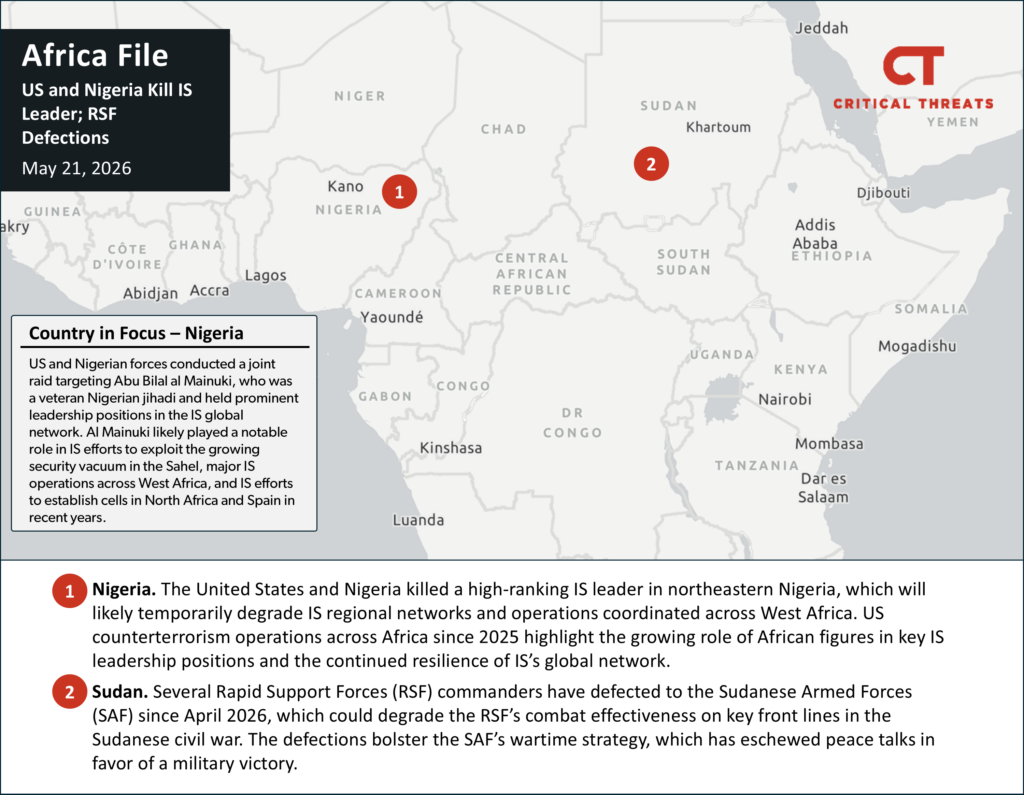
Nigeria. The United States and Nigeria killed a high-ranking IS leader in northeastern Nigeria, which will likely temporarily degrade IS regional networks and operations coordinated across West Africa. US counterterrorism operations across Africa since 2025 highlight the growing role of African figures in key IS leadership positions and the continued resilience of IS’s global network.
Sudan. Several Rapid Support Forces (RSF) commanders have defected to the Sudanese Armed Forces (SAF) since April 2026, which could degrade the RSF’s combat effectiveness on key front lines in the Sudanese civil war. The defections bolster the SAF’s wartime strategy, which has eschewed peace talks in favor of a military victory.
Figure 1. Africa File, May 21, 2026
Assessments:
Nigeria
The United States and Nigeria conducted a joint operation in northeastern Nigeria that killed a high-ranking IS leader. US and Nigerian forces conducted a joint raid targeting Abu Bilal al Mainuki, who was residing on a series of small islands in Lake Chad, on May 15. US officials told The New York Times that the operation was a helicopter-borne assault involving Nigerian and American Special Operations units and aimed to capture al Mainuki alive, although Nigerian officials later denied any US ground involvement.[1] US forces ultimately killed al Mainuki in an airstrike, however, following an hours-long battle to ensure he could not escape.[2] Nigerian and US forces were still able to capture electronic devices and records that US officials expect to have information on IS activities across Africa and globally.[3]
The United States and Nigeria have conducted additional operations in subsequent days. The Nigerian military claimed that joint airstrikes around Metele in Borno State on May 17 killed 20 Islamic State West Africa Province (ISWAP) militants, including several local senior commanders linked to attack planning, financing, logistics, and propaganda.[4] US officials claimed that recent operations have killed 140 militants, while the Nigerian military claimed the toll was 175 fighters.[5]
Al Mainuki’s death will likely temporarily degrade, if not disrupt, IS regional networks and operations coordinated across West Africa. Al Mainuki was a veteran Nigerian jihadi and held prominent leadership positions in the IS global network. He originally rose to be a field commander within Boko Haram but joined the breakaway faction that IS would formally recognize as ISWAP.[6] Al Mainuki was deputy to ISWAP head Abu Musab al Barnawi and was key for IS logistic and operational planning across West Africa, including weapons manufacturing, drone development, and designing economic warfare campaigns across the region.[7] These roles eventually led to al Mainuki taking charge of IS’s West Africa office, al Furqan, which oversees both IS West Africa Province and IS Sahel Province (ISSP), in 2023.[8] There are disputed claims from some UN member states that al Mainuki had been elevated to head of IS’s General Directorate of Provinces (GDP), which oversees all IS’s regional offices worldwide and coordinates operational guidance and funding to all IS global affiliates, in early 2026.[9]
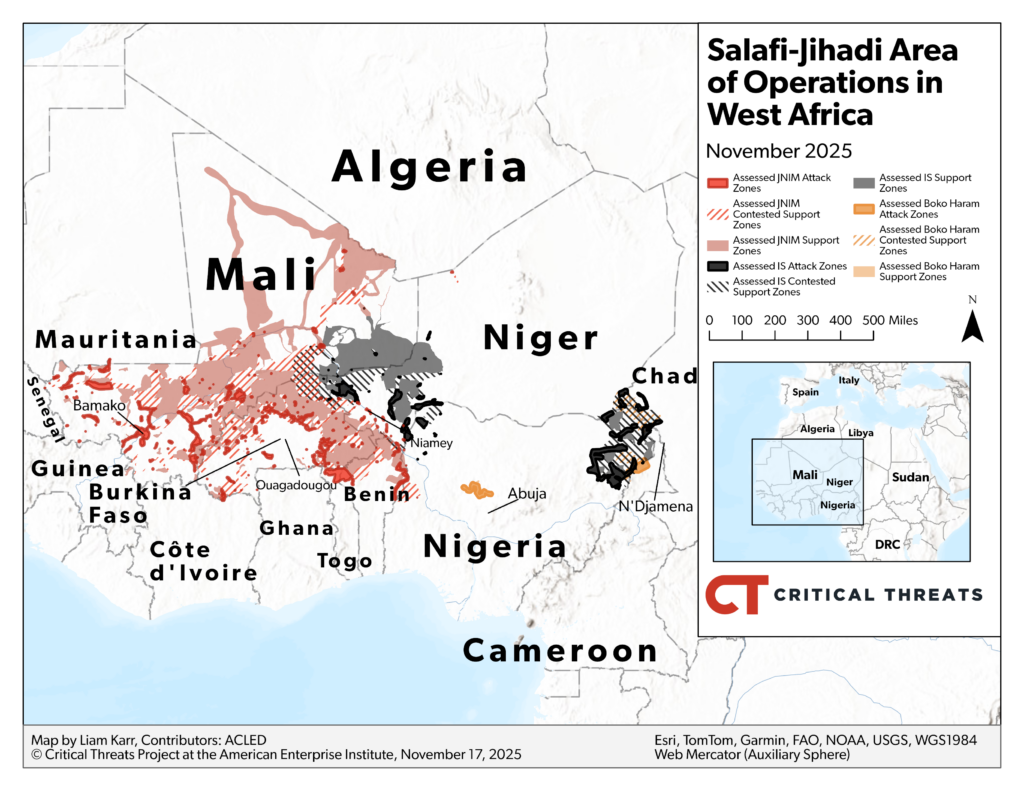
Mainuki was positioned to play a key role in IS efforts to exploit the growing security vacuum in the Sahel, and his death will likely temporarily degrade these efforts. The UN reported in late 2024 that IS explicitly directed ISWAP to increase support for ISSP to boost ISSP operations, and al Mainuki would have led this effort as head of the al Furqan office.[10] IS did this by strengthening its presence in northwestern Nigeria through the ISSP-linked Lakurawa faction, which both the UN and the Armed Conflict Location & Event Data group reported in 2024 was increasingly functioning as a supply corridor and bridge between ISSP and ISWAP.[11] Al Mainuki’s death will likely temporarily degrade or disrupt these networks, but decapitation strikes have repeatedly been shown to have only a short-term impact, especially among heavily bureaucratic organizations like IS, which can replace eliminated leaders.[12]
Figure 2. Salafi-Jihadi Area of Operations in West Africa
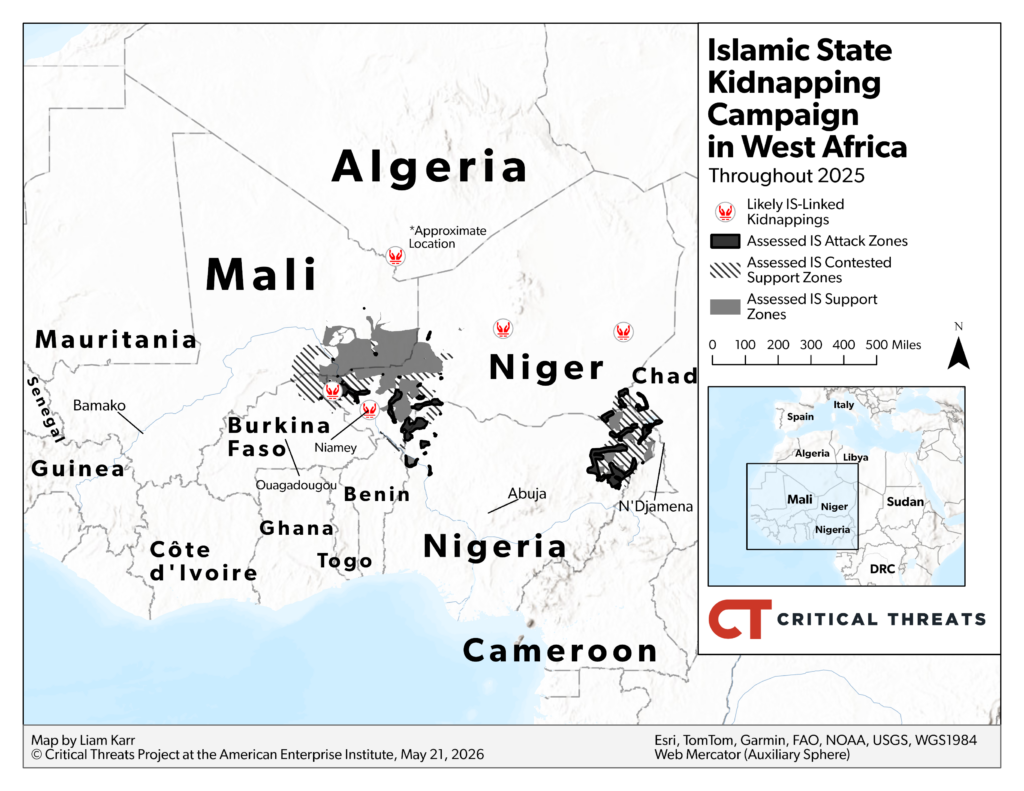
Al Mainuki’s efforts likely enabled major IS operations across West Africa in recent years. Lakurawa operationalized its support zones and began carrying out attacks in response to heightened counterinsurgency pressure in 2025, creating a new hot spot in the West Africa Salafi-jihadi picture.[13] IS also began a kidnap-for-ransom campaign targeting foreigners in the Sahel in 2025.[14] IS worked with local bandits to kidnap US missionary Kevin Rideout, whom ISSP is still holding hostage, from the Nigerien capital of Niamey in October 2025.[15] US officials claimed that al Mainuki was directly linked to this campaign and Rideout’s kidnapping.[16] IS also attacked the Niamey international airport and adjacent air base in January 2026, which was the first major attack in the vicinity of the capital. CTP assessed at the time that the attack likely involved collaboration between ISWAP and ISSP, due in part to the use of attack drones and drone tactics that had previously only been demonstrated by ISWAP, which itself gained these capabilities through trainers dispatched from the Middle East.[17]
Figure 3. Islamic State Kidnapping Campaign in West Africa
Al Mainuki may have also been involved in IS efforts to establish cells in North Africa and Spain in recent years. IS had established links between southern Europe and West Africa via North Africa and the Sahel as late as 2023, and Moroccan and Spanish police have since thwarted numerous IS cells. These disrupted networks included some attack cells, which Moroccan authorities said were part of a concerted IS effort to “recruit, arm, and direct sympathizers to carry out attacks in Morocco.”[18] Authorities have linked several of these disrupted cells to ISSP and IS provinces “south of the Sahara,” which most plausibly implies ISWAP.[19] Al Mainuki was positioned to oversee this campaign, given his roles and connections within IS’s West Africa network, and he had already been part of previous IS efforts to link operations across North and West Africa when he dispatched fighters from Lake Chad to Libya at the behest of IS central leadership in 2016.[20]
Figure 4. Disrupted IS Cells Linked to Africa
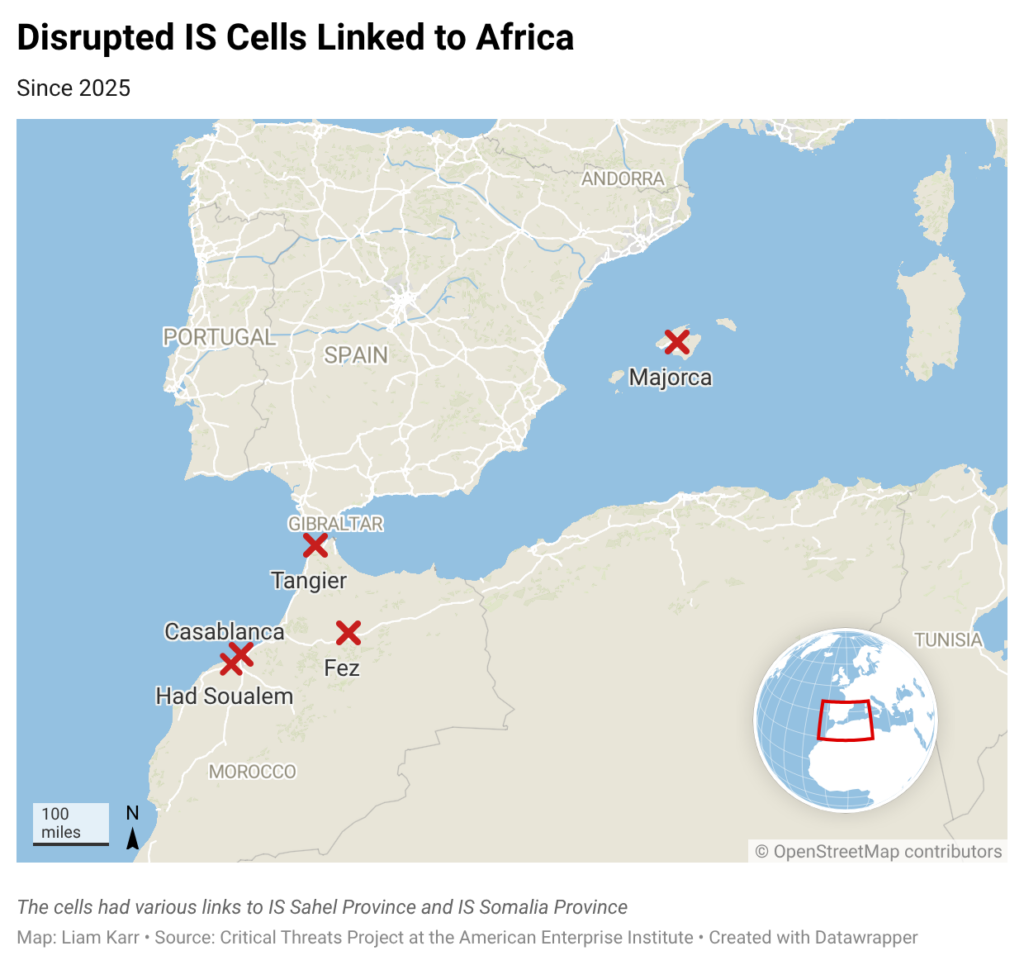
US counterterrorism operations across Africa since 2025 highlight the growing role of African figures in key IS leadership positions and the continued resilience of IS’s global network. The focal point of US counterterrorism operations in Africa in 2025 was northern Somalia, where AFRICOM supported a locally led offensive against IS Somalia Province (ISS). The group had become a key node in the global IS network for leadership, funding, logistics, and foreign fighters.[21] Former ISS emir Abdulqadir Mumin had also become a major leader within IS, with UN member states divided on whether he is currently the head of the GDP or overall IS caliph.[22] CTP and numerous analysts have said that Mumin is more likely to be the GDP head, as an African caliph would pose a risk to IS’s symbolic and theological legitimacy.[23]
Figure 5. The Islamic State Somalia Province’s Global Financing Network
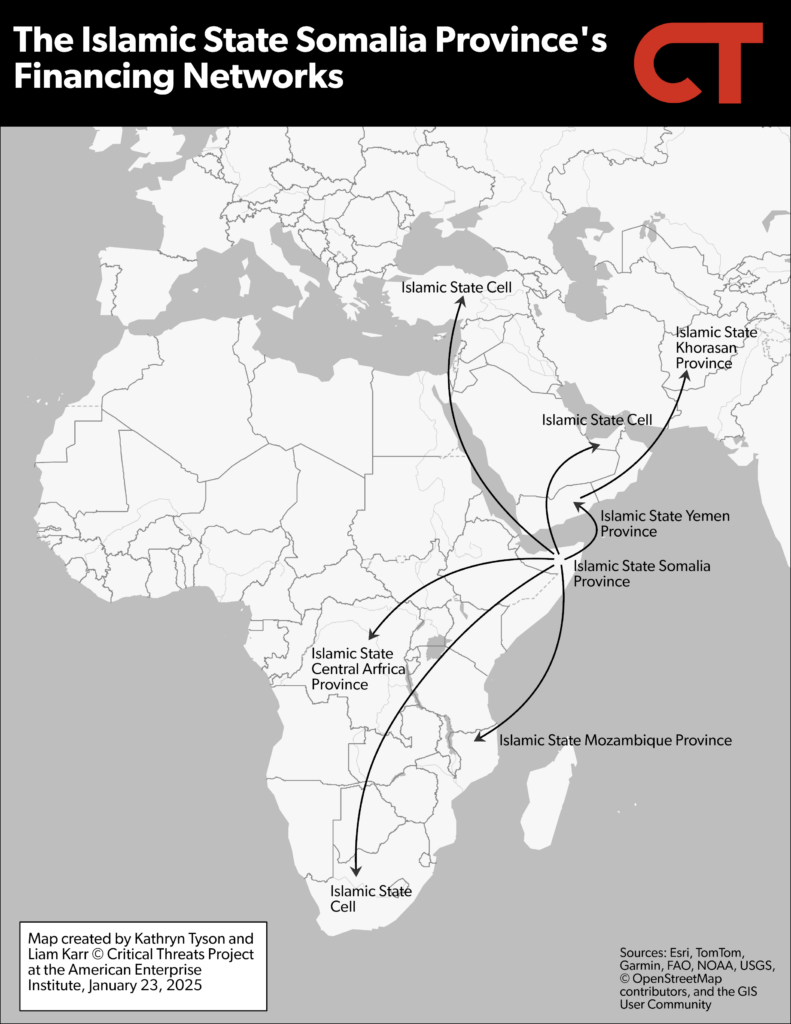
The degradation of ISS may have led IS to shift more leadership functions to ISWAP, a tactic the group could replicate with ISWAP now under increased pressure. US-backed counterterrorism operations in northern Somalia severely degraded ISS, resulted in the capture of the ISS finance head, and forced Mumin into hiding.[24] US officials claimed that al Mainuki may have assumed more responsibility within the GDP, due to counterterrorism operations degrading ISS’s ability to continue serving as a primary hub.[25] Mumin or al Mainuki would be the first Africans to head the GDP, as the position was previously occupied by ISIS leaders in Iraq and Syria.[26]
Sudan
Several Rapid Support Forces (RSF) commanders have defected to the Sudanese Armed Forces (SAF) since April 2026. Generals Al Nour Ahmed Adam (Gubba), Ali Rizqallah (Savanna), and two other RSF commanders, along with forces loyal to them, have recently defected.[27] Gubba was a top RSF commander in western Sudan’s North Darfur state, including during the siege of state capital el Fasher, and he was a leading option for the North Darfur governorship in the RSF’s parallel government but ultimately did not receive the position.[28] Savanna commanded forces on multiple axes in central Sudan’s Kordofan region and had previously led forces in Darfur, including during the siege of el Fasher and battles to secure key supply lines from Libya.[29] Savanna was also reportedly a key recruiter for the RSF.[30] Another defector led forces in Bara, the northern axis front line in Kordofan.[31]
Infighting between the RSF leadership and the generals spurred the defections. The RSF’s decision to appoint another candidate to the North Darfur state governorship angered Gubba, who then withdrew his forces from their area of responsibility against RSF orders, according to the Egyptian news outlet MadaMasr.[32] Savanna had operational disputes with the RSF leadership, including over recent command reorganizations, according to MadaMasr.[33]
The RSF’s targeting of an influential tribal leader with close ties to both generals furthered their split with the RSF. Gubba and Savanna are part of the same tribe as Musa Hilal, a leader of the Mahamid clan, which is a subgroup in RSF leader Mohamed Hamdan Dagalo’s (Hemedti’s) Rizeigat tribe.[34] Hilal initially stayed neutral in the Sudanese civil war despite his tribal ties with Hemedti, as Hilal distrusted the RSF due to previous RSF efforts to subsume his militia.[35] Hilal then declared his allegiance to the SAF in April 2024.[36] The RSF eventually retaliated by assaulting Hilal’s home base in February 2026, forcing him to flee to SAF-controlled territory.[37] Multiple sources have reported that the RSF’s targeting of Hilal influenced the generals’ decision to defect, as they both previously fought under Hilal.[38] MadaMasr reported that Gubba had even helped Hilal flee North Darfur, causing the RSF to issue an order to detain Gubba.[39]
The recent defections are the most high-profile ones since a prominent militia commander in eastern Sudan joined the SAF in late 2024. Abu Agla Keikal and his militia, the Sudan Shield Forces (SSF), helped the RSF capture Wad Madani—the state capital of Gezira—in December 2023.[40] Keikal reportedly defected with his fighters from the RSF due to distrust between himself and the RSF leadership.[41] The SSF has since played a key role in the SAF’s successful offensive to push the RSF out of eastern Sudan—including Wad Madani—in early 2025 and ongoing efforts to halt an RSF offensive in southeastern Sudan’s Blue Nile state.[42]
Defections are a key part of the SAF’s wartime strategy, which has eschewed peace talks in favor of a military victory. The SAF is using defections to fracture the RSF and bolster its own ranks. Africa Intelligence reported that Sudanese intelligence services had identified Gubba and Savanna as defection targets due to infighting between them and the RSF’s leadership and the RSF’s targeting of Hilal.[43] The SAF finalized the defections by offering amnesty and helping at least Gubba retreat to SAF territory.[44] Burhan met with Gubba twice shortly after his defection, and the SAF has since named Gubba and Savanna as generals and had them speak publicly about their defection and intention to fight the RSF.[45] MadaMasr reported that some of Gubba’s forces have already linked up with the Joint Forces militia allied with the SAF in the final SAF-aligned pocket in Darfur on the Chadian border.[46] The SAF rapidly integrated the SSF into combat operations after Keikal defected.[47] The SAF head and leader of the Sudanese government Abdel Fattah al Burhan has said that the “doors are open” to surrendering RSF fighters and that the SAF can achieve a victory through the RSF’s surrender, rather than battlefield dominance.[48]
The SAF has continued to signal that it is pursuing a military victory over the RSF, rather than peace talks. Burhan appointed a hard-line general as the SAF chief of staff on April 2 and later demoted his longtime deputy, who had previously engaged in peace talks with the RSF.[49] Burhan reaffirmed in speeches on April 29 and May 8 that the SAF will not engage in peace processes until it achieves its military objectives.[50]
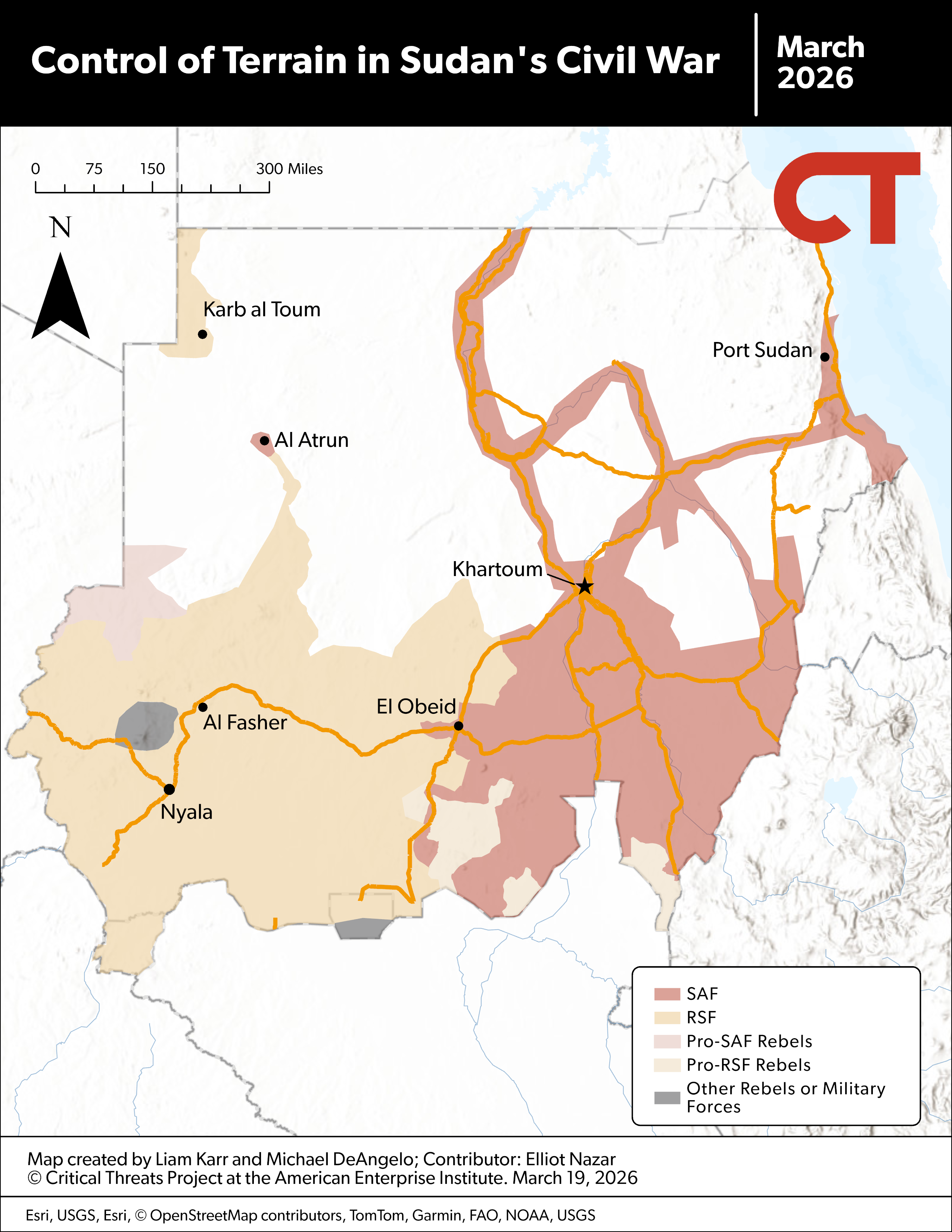
The loss of the two generals could degrade the RSF’s combat effectiveness in the parts of Darfur and Kordofan where these commanders were based. Gubba commanded a significant and battle-hardened force in North Darfur near the final SAF-aligned pocket in Darfur and reportedly defected with hundreds of vehicles.[51] Savanna played a key role in securing RSF supply lines from Libya to Darfur.[52] The RSF and SAF have reportedly mobilized for large-scale clashes near the Chadian and Libyan borders in North Darfur in the past few weeks.[53] Savanna was also responsible for a large contingent of RSF fighters on the western axis in Kordofan.[54] Neither side has been able to make a major breakthrough in Kordofan in nearly a year.
Figure 6. Control of Terrain in Sudan’s Civil War
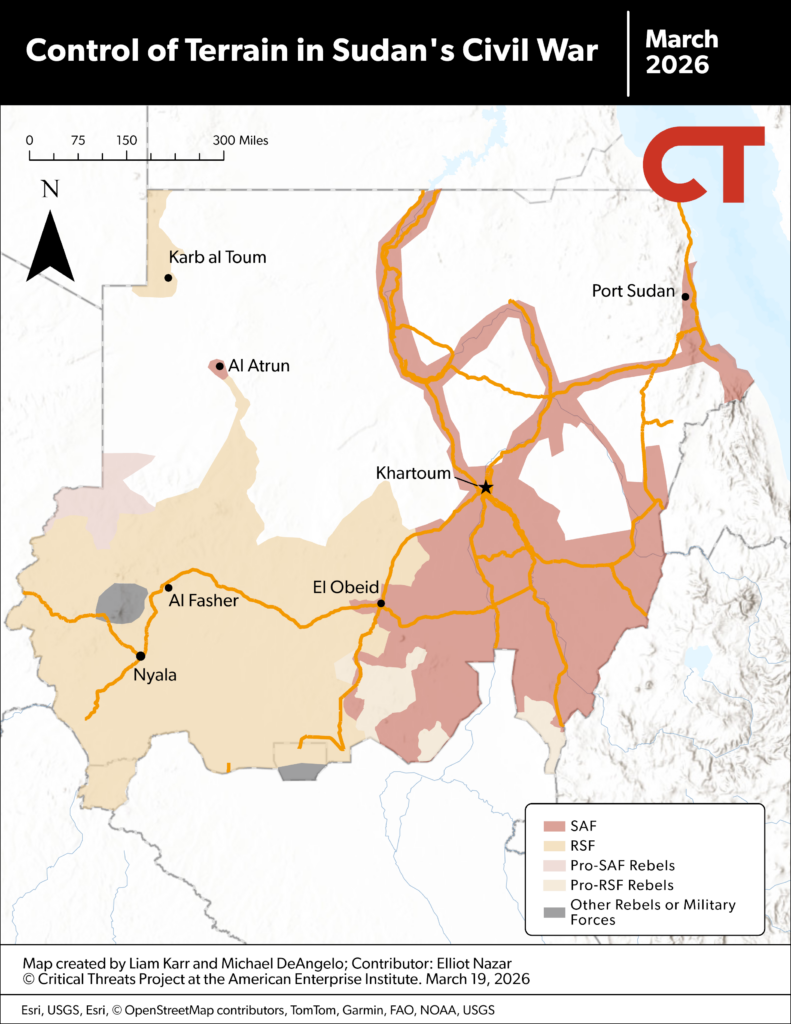
The defections highlight the fragmented nature of both the RSF’s and SAF’s battlefield coalitions. The RSF’s core units draw from an array of Darfuri tribes and subgroups, which are not always aligned with Hemedti and his close associates in the RSF’s leadership.[55] The division within the Rizeigat tribe between Hemedti’s Mahariya clan and Hilal’s Mahamid clan exemplifies this trend.[56] Gubba and Savanna previously had played key roles in reducing tensions and mobilizing the Mahamid and other Darfuri tribes to join the RSF’s coalition.[57]
There are also significant ethnic tensions between the Arab and non-Arab components of the RSF’s coalition. The Arab Rizeigat people were key actors in the Janjaweed militias that carried out the Darfur genocide against non-Arab African groups in the early 2000s, but some of these non-Arab groups are now part of the RSF’s coalition.[58] These dynamics caused tension during the RSF’s siege of el Fasher, a primarily non-Arab city. The open-source news outlet Sudan War Monitor reported that the RSF prevented certain non-Arab fighters from taking part in its takeover of the city, as it was conducting targeted mass killings of non-Arab civilians that a United Nations commission said display “the defining characteristics of genocide.”[59] The RSF has also faced tensions with the allied Sudan People’s Liberation Movement–North (SPLM-N) al Hilu faction, which is a non-Arab African militia that is RSF’s primary partner in Kordofan and Blue Nile. The RSF and SPLM-N al Hilu clashed in early 2026, after SPLM-N al Hilu refused to target primarily non-Arab Nuba population centers in Kordofan.[60]
The inclusion of former RSF commanders in the SAF’s command structure could cause discord in the SAF’s coalition. Africa Intelligence reported that Minni Minnawi, the SAF-appointed North Darfur governor and leader of the primarily non-Arab Darfuri Joint Forces, disapproves of Gubba’s integration into the SAF and appointment to an administrative role in North Darfur.[61] Gubba’s role in the RSF’s siege of el Fasher is reportedly a key point of contention with Minnawi.[62]
This divide threatens the SAF’s force generation structure, as it depends heavily on militias. The SAF has relied on allied militias in essentially every key battle of the Sudanese civil war, including the capture of Khartoum in early 2025.[63] The SSF has contributed thousands of fighters to that breakthrough offensive and other frontline efforts.[64] The Joint Forces have led the SAF’s Darfur defense, including during the RSF’s siege of el Fasher.[65] The SAF has also employed Islamist militias that numerous Sudanese and international actors have accused of trying to reinstate Islamist influence over the Sudanese government.[66]
The SAF has repeatedly had command and control challenges with these allied militias. The SAF has been unable to subordinate the strongest Islamist militias under its command structure.[67] The United States has responded by sanctioning multiple Sudanese Islamist groups.[68] Other militias, such as the SSF, have conducted reprisal mass killings that the SAF has not addressed.[69]