
Key Takeaways:
- Ethiopia. Read CTP’s latest special edition, “Ethiopia Prepares for War,” forecasting imminent conflict in northern Ethiopia.
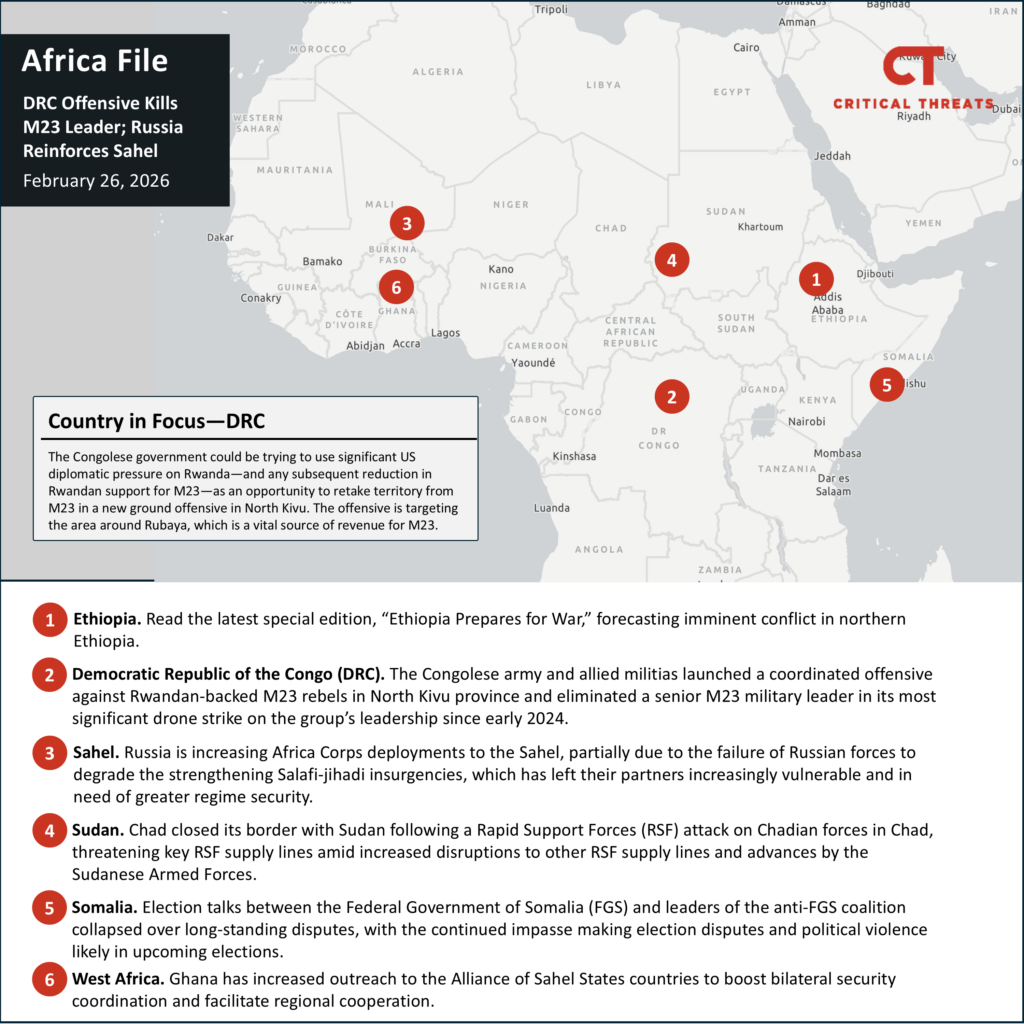
- Democratic Republic of the Congo. The Congolese army and allied militias launched a coordinated offensive against Rwandan-backed M23 rebels in North Kivu province and eliminated a senior M23 military leader in its most significant drone strike on the group’s leadership since early 2024. The Congolese government could be trying to use significant US diplomatic pressure on Rwanda—and any subsequent reduction in Rwandan support for M23—as an opportunity to retake territory from M23 in its ground offensive in North Kivu.
- Sahel. Russia is increasing Africa Corps deployments to the Sahel, partially due to the failure of Russian forces to degrade the strengthening Salafi-jihadi insurgencies, which has left their partners increasingly vulnerable and in need of greater regime security.
- Sudan. Chad closed its border with Sudan following a Rapid Support Forces (RSF) attack on Chadian forces in Chad, threatening key RSF supply lines amid increased disruptions to other RSF supply lines and advances by the Sudanese Armed Forces.
- Somalia. Election talks between the Federal Government of Somalia (FGS) and leaders of the anti-FGS coalition collapsed over long-standing disputes, with the continued impasse making election disputes and political violence likely in upcoming elections. The elections could also attract foreign interference as rival Red Sea coalitions vie for influence in Somalia.
- West Africa. Ghana has increased outreach to the Alliance of Sahel States countries to boost bilateral security coordination and facilitate regional cooperation, although these efforts have not mended bitter regional divides involving Burkina Faso, Côte d’Ivoire, Benin, and Niger.
Figure 1. Africa File, February 26, 2026
Democratic Republic of the Congo
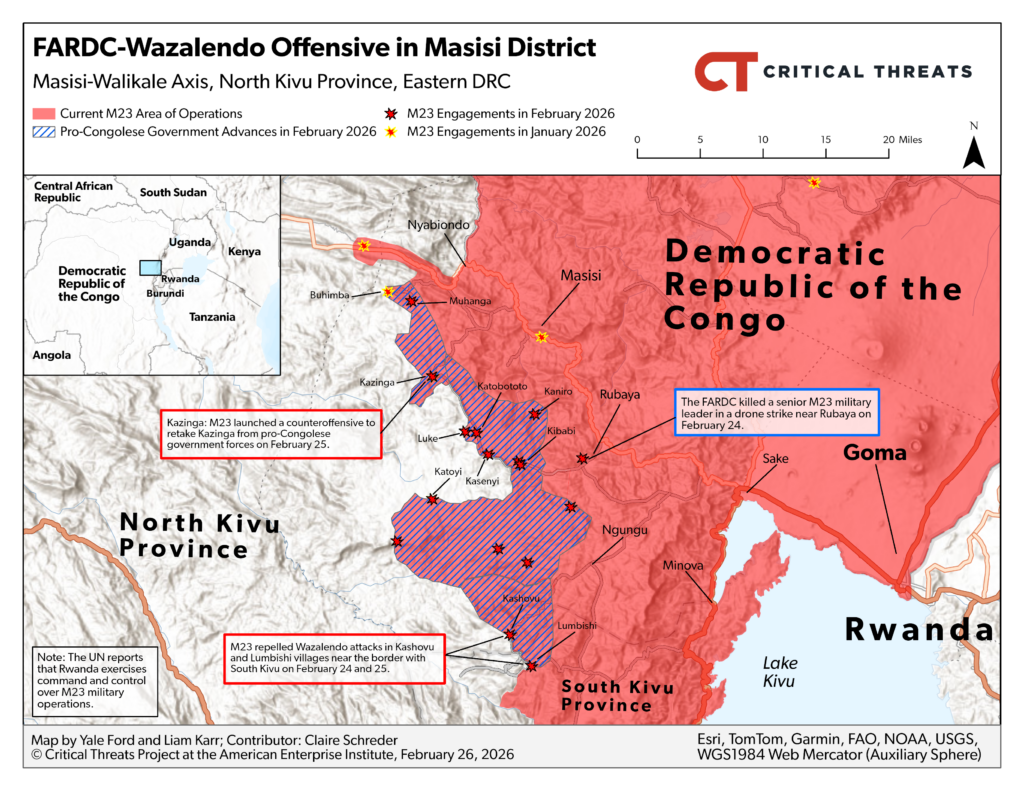
The Congolese army (FARDC) killed a senior M23 military leader in a drone strike amid an ongoing offensive against Rwandan-backed M23 rebels in Masisi district in North Kivu in the eastern Democratic Republic of the Congo (DRC). The FARDC killed Willy Ngoma, a veteran M23 member and the group’s military spokesman, in a strike on February 24 that targeted either an M23 military convoy near Rubaya town or a house on a hill above the town that leaders had used for meetings for several weeks.[1] Initial reports indicate that the strike wounded several high-ranking M23 cadres but did not hit Sultani Makenga, M23’s operational commander, who had reportedly left the area before the attack.[2] M23 did not immediately release a statement on Ngoma’s death. The FARDC said in a now-deleted post on social media that it had killed Ngoma, who it called a “terrorist,” and that it was determined to “dismantle all terrorist networks” in the east.[3] Ngoma is the most senior M23 figure to be killed in an air attack since the FARDC eliminated M23’s military intelligence chief in January 2024.[4]
The FARDC is providing air support to an ongoing ground offensive against M23 that it launched on several axes in Masisi district around February 20.[5] The FARDC has reportedly conducted multiple drone attacks on M23 positions in the Rubaya area since February 23.[6] CTP reported on February 23 and 25 that the FARDC and pro-Congolese government Wazalendo militia fighters launched a coordinated offensive and have dislodged M23 from several positions on at least three lines of advance toward Masisi town, Rubaya, and Ngungu, which is near the border with South Kivu, in the last week.[7] Wazalendo fighters made advances in an area roughly five to 10 miles west of Rubaya and have put pressure on the group north of the town in a possible attempt to encircle it.[8] An M23-aligned independent journalist reported on February 22 that the FARDC deployed new units to spearhead the offensive using an army airfield in eastern Walikale district.[9] These could be FARDC special forces that are already active in a separate offensive against M23-aligned rebels in South Kivu province. Locals in South Kivu have reported the participation of these “owl units,” which specialize in reconnaissance and offensive operations in difficult terrain at night.[10]
Figure 2. FARDC-Wazalendo Masisi Offensive
The Congolese government may be aiming to capture Rubaya to cut off a vital source of revenue for M23. Rubaya is a major M23-controlled mining hub, estimated to produce 15 to 20 percent of the global coltan supply.[11] M23 had captured the site in April 2024, and the UN assessed later that year that M23 was earning more than $800,000 monthly from levies collected from the mine.[12] The UN and other organizations assessed in mid-2025 that M23 tightened control over mineral networks by consolidating control over the cross-border Rubaya–Goma–Rwanda transit corridor, which has reportedly increased the security and efficiency of mining operations.[13] M23 imposed new mining taxes in 2025, and Reuters estimated that a 15 percent tax M23 imposed on tantalum production in early 2025 could equate to nearly half a million dollars in monthly revenue.[14] The Congolese government has tried to limit M23’s revenue streams and weaken its legitimacy by imposing a de facto financial embargo on areas under the group’s control, increasing Rubaya’s importance as a key source of income.
M23 launched a counteroffensive in Masisi and could retaliate with drone attacks on an FARDC military base for Ngoma’s death in the short-to-medium term. M23 has conducted counterattacks and pushed Wazalendo fighters back from several villages on the Ngungu axis since February 22.[15] M23 reportedly reinforced its positions around Rubaya and repositioned an artillery unit to block the advance and bomb positions that Wazalendos have captured.[16] M23 launched counterattacks to retake Kasenyi, a key logistic node on routes to southern Masisi and to Rubaya from the west, and recaptured Kaniro—about 12 miles to the north of the town—on February 25.[17] M23 also launched counterattacks to retake positions around Kazinga in an area about 20 miles west of Masisi town on February 25.[18]
M23 could retaliate against an FARDC airbase in central DRC using one-way attack (OWA) drones and try to deter further air operations against the group in the coming weeks. FARDC air assets based at the Kisangani airport in the central DRC likely conducted the Rubaya strike. Kisangani is the headquarters of the FARDC’s third defense zone, and its airport has been a major air and logistic hub for the FARDC and Congolese-employed foreign military contractors—including Algerian drone operators—since mid-2025, according to the UN.[19] Kisangani houses a large part of the FARDC’s air arsenal, which has been integral to an ongoing FARDC air interdiction campaign to deny M23 lines of advance to the DRC interior and degrade its supply lines in North and South Kivu.[20] Unconfirmed reports suggested that the FARDC recently received Chinese-made Wing Loong medium-altitude long-endurance (MALE) drones that it had purchased in early 2025.[21]
M23 claimed its first major drone attack on Kisangani using long-range Turkish-made OWAs in early February.[22] FARDC air defenses thwarted the attack.[23] Kisangani lies nearly 350 miles from the front line—further than the documented range of the Turkish drones—and M23 said that the attack was a “warning” and framed it as evidence of its expanded operational reach.[24] The French outlet Le Monde cited a “well-informed observer” on February 5 who said that “foreign trainers” have been present in Goma and at M23’s main military base in recent weeks, likely to help with drone operations.[25] The M23 spokesman, Lawrence Kanyuka, said in a statement in early February that the “use of drones and mercenaries is neither exclusive to nor the sole prerogative” of the Congolese government.[26] Kanyuka denounced the FARDC’s ongoing offensive and said that the Congolese government had unleashed a “total war across all front lines” on February 24.[27]
The FARDC-Wazalendo offensive violates an already-struggling effort to secure a permanent ceasefire. The Congolese government and M23 signed three nonbinding agreements that had ceasefire provisions in April, July, and November 2025. They also signed an agreement to establish a ceasefire verification and monitoring mechanism in October, followed by a terms of reference agreement to begin preparations on implementing it on the ground in early February.[28] The mechanism has two parts—a political body made up of an equal number of representatives each from the DRC and M23 that adjudicates violations, and a field monitoring team led by a Zambian general with the International Conference on the Great Lakes Region (ICGLR). The UN has committed to provide logistic support to the mechanism, including with reconnaissance flights to map the front lines, and potentially deploy a small peacekeeping force on the ground.[29] An advance team from the UN and the ICGLR deployed to Uvira and is conducting a mission to assess conditions on the ground for ceasefire monitoring efforts from February 23 to February 27.[30] The two sides have yet to sign a memorandum of understanding that would formally establish the mechanism’s political body, however.[31] M23 has accused the Congolese government of delaying the signing of this agreement.[32]
Both sides had already accused each of ceasefire violations in the last few weeks. DRC President Félix Tshisekedi had agreed in principle to a ceasefire with M23 that Angolan President João Lourenço proposed would take effect on February 18, following an ad hoc meeting that Lourenço hosted in Angola that included the two presidents and the African Union mediators, Togolese President Faure Gnassingbé and former Nigerian head of state Olusegun Obasanjo, on February 9.[33] Angola did not formally consult all parties before announcing the ceasefire.[34] M23 had said on multiple occasions that it did not recognize the Angolan-proposed ceasefire and reiterated its position that it is solely committed to the Doha process, which has effectively been stalled due to deep mutual distrust and the lack of a permanent ceasefire after M23 launched a major offensive to capture Uvira in late 2025. The two sides then mutually accused each other of attacking their positions in violation of a ceasefire in statements on February 19 and 20, shortly before the FARDC-Wazalendo launched the Masisi offensive.[35]
The Congolese government could be trying to use significant US diplomatic pressure on Rwanda—and any subsequent reduction in Rwandan support for M23—as an opportunity to retake territory from M23 in North Kivu. Rwanda may have relaxed its support for M23 and withdrawn some troops from the eastern DRC due to US diplomatic pressure in recent months. Unconfirmed reports from pro-Congolese government media outlets said that an RDF unit that was active in southern Masisi and based about five miles south of Rubaya had withdrawn from the area around February 16.[36] Rwanda has been under US scrutiny for supporting M23’s late 2025 offensive on Uvira town in South Kivu and violating its commitments to the Washington Peace Accords. The Trump administration has reportedly been considering a sanctions package on several high-ranking RDF, Rwandan intelligence, and mining officials.[37] Rwanda and M23 acknowledged their ties publicly for the first time in late January, possible to further manage US diplomatic pressure.[38]
Rwanda temporarily reduced its force deployment in the eastern DRC the last time it faced major international pressure, after helping M23 take Goma in a large-scale offensive in January 2025. The United States and European Union sanctioned a gold refinery in Rwanda and senior M23 and Rwandan officials in February and March 2025, respectively.[39] The RDF then reduced its deployment from at least 6,000 troops to an estimated 1,000 to 1,500 by April 2025, according to the UN.[40] The UN reported in late 2025 that RDF numbers increased again to between 6,000 and 7,000 and that its support remained “critical” to M23 military operations across North and South Kivu.[41]
The FARDC and allied forces have already been waging a separate offensive against M23 and an M23-aligned militia in South Kivu for control of key terrain in the Fizi highlands since late January. The FARDC launched an offensive in the highlands around Minembwe town in Fizi in late January and have intensified ground and air attacks to recapture several areas around the town, which is a stronghold for Twirwaneho, an M23-aligned militia group that claims to protect ethnic Banyamulenge civilians.[42] The highlands around Minembwe control access on several axes to key towns in the lowlands along Lake Tanganyika and potential lines of advance toward the DRC’s economic engine in the southern DRC. The fighting has caused more than 200,000 civilians to flee the Minembwe area since early February.[43]
Figure 3. M23 and Allies Activity in South Kivu
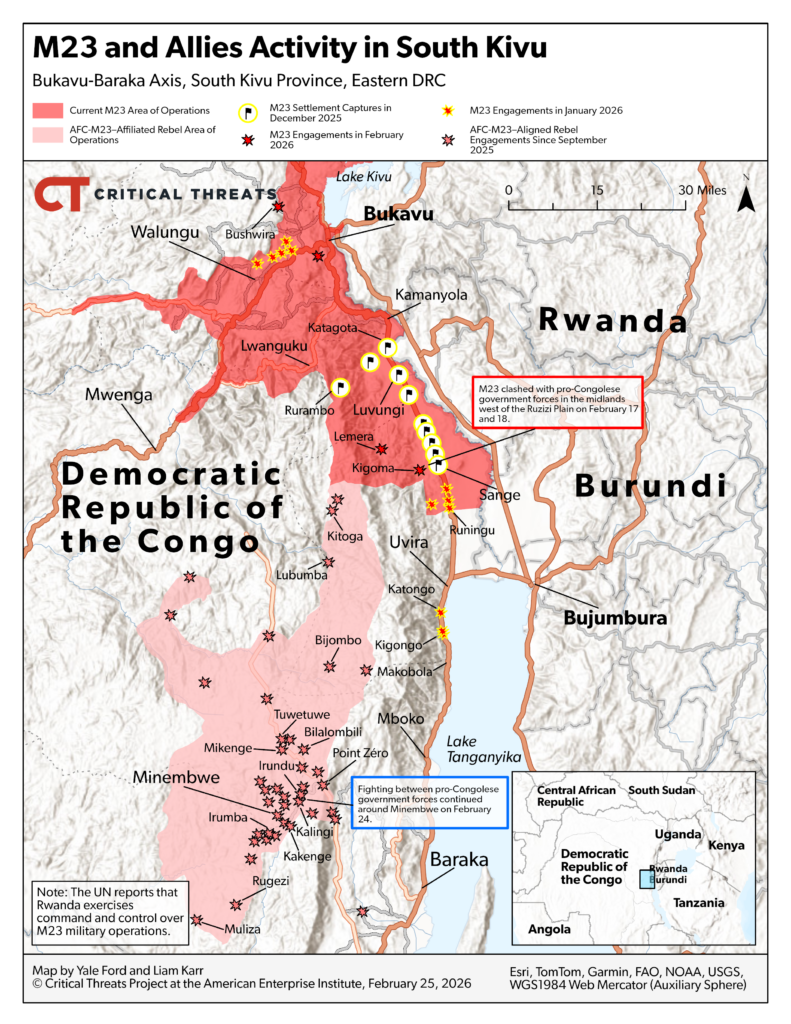
The FARDC is reportedly receiving significant external support in South Kivu. Contractors linked to Erik Prince, a US private security contractor and informal adviser of US President Donald Trump, are reportedly supporting FARDC forces that are fighting Twirwaneho in the highlands.[44] The Burundian army (FDNB)—the FARDC’s most important ally in South Kivu—reportedly began redeploying troops en masse to South Kivu via Lake Tanganyika in late December and early January.[45] French media cited local and military sources on February 25 who said that 5,000 FDNB troops are fighting alongside the FARDC and Wazalendo in South Kivu.[46] M23-aligned journalist Steve Wembi reported in early January that Tshisekedi’s national security adviser was expected to travel to Tanzania in January to discuss the possible deployment of Tanzanian troops to South Kivu.[47] M23 and pro-M23 sources have since claimed that Tanzanian troops are fighting in the DRC coalition.[48] A pro-M23 investigative outlet claimed that Angola deployed assets to support the FARDC, including fighter jets and around 50 troops to Fizi district, to reinforce the FARDC in mid-February.[49] The Angolan president had reportedly denied Tshisekedi’s formal request for military assistance and agreed to mediate a potential national dialogue prior to M23’s withdrawal from Uvira.[50]
Sahel
Russia is increasing Africa Corps deployments to the Sahel. A thousand new Africa Corps soldiers are expected to arrive in Mali in the coming months, increasing Russian forces in the country to 3,500 troops according to French investigative outlet Jeune Afrique. Mali will reportedly pay $35 million monthly to maintain this quantity of Africa Corps forces.[51] The deployment has reportedly been in the works since Malian junta leader Assimi Goïta traveled to Russia in June 2025.
Russia has also recently boosted defense cooperation with Burkina Faso and Niger, including possible plans to increase Africa Corps’ presence in Niger. Nigerien junta leader General Abdourahamane Tiani and Defense Minister General Salifou Modi met with Russian Minister of Defense and de facto Africa Corps head Yunus-bek Yevkurov in Niamey on January 27, 2026, and discussed increasing Africa Corps’s involvement in counterterrorism operations.[52] Tiani praised the role of Russian forces in repelling an IS attack on the Niamey airport on January 28, which was IS’s first major attack on a hardened position near Niamey. Burkina Faso’s Foreign Minister Karamoko Jean-Marie Traoré visited Moscow from February 12 to 14 to sign several bilateral cooperation agreements strengthening military and military-technical cooperation.[53]
Russian forces have failed to degrade the strengthening Salafi-jihadi insurgencies in the Sahel, leaving their partners vulnerable and in increasing need of regime security support. Mali and Niger’s capitals have come under direct threat in the years since Russian forces first arrived in the Sahel. Jama’at Nusrat al Islam wa al Muslimeen (JNIM) has imposed a blockade on Bamako since September 2025, launching major attacks on fuel convoys in Mali’s southern and western regions.[54] The blockade has hurt Mali’s economy—at least 60 percent of Mali’s total trade passes along the Northern Bamako–Dakar Corridor—and heightened tensions between the junta, citizens, and the fuel sector.[55] JNIM also attacked the main military air base and a gendarmerie base in Bamako in 2024, its first attacks in the capital since 2015.[56] The militants killed 60 people at the gendarmerie school alone according to French outlet Le Monde, with the total casualty count over 70 by most estimates.[57]
The IS attack on the Niamey international airport and Air Base 201 highlights the deteriorating security situation around the Nigerien capital. The attackers burned several Nigerien aircraft critical to intelligence, surveillance, and reconnaissance operations, and logistics, weakening Nigerien counterinsurgency capabilities.[58] Local sources reported that the attack killed three Russian soldiers, 24 Nigerien soldiers, and wounded 18 others.[59] The airport is roughly five miles from the city of Niamey and six miles from the Nigerien Presidential Palace.[60]
The deteriorating security around the capitals increases the risk of popular discontent and coups, increasing these regimes reliance on Russian regime security. Malian citizens have expressed frustration over continued fuel shortages, rolling blackouts, and general instability around Bamako and especially in other cities around the country.[61] Mali also announced a new fuel rationing program on January 23, which locals have criticized for its potential inhibitions on their jobs and livelihoods.[62] The non-jihadist Nigerien rebel group the Patriotic Movement for Freedom and Justice attacked the Djibelilla-Agadem oil field on February 10, 2026, illustrating the anti-junta militia’s growing capabilities.[63] The militants allegedly destroyed three Nigerien army vehicles, caused significant damage to oil infrastructure, and killed at least 24 Nigerien security personnel.[64]
Africa Corps is a key part of the Kremlin’s “regime survival package.”[65] This strategy involves leveraging formal state power and unconventional military units—such as the Africa Corps and Russian intelligence—to offer local elites military support, allyship in international bodies, and information campaigns to boost the elites’ domestic support.[66] Russia increases its influence over target governments and isolates them from the West as a result, insulating coup regimes from efforts to encourage a return to civilian rule.
Sudan
Chad closed its border with Sudan following the second Rapid Support Forces (RSF) attack on Chadian forces in Chad since mid-January, threatening key RSF supply lines. The RSF conducted drone strikes and a ground assault on Sudanese Armed Forces (SAF)-aligned Joint Forces militia positions in Tine—a North Darfur town on the Chadian border—on February 21.[67] The RSF seized Tine, causing Joint Forces’ units to flee into Chad.[68] The RSF then attacked a Chadian military base near Tine in Chad, killing five Chadian soldiers and destroying several military vehicles.[69] The Joint Forces launched a counterattack, pushing the RSF out of Chad and retaking Tine.[70] The RSF has intensified efforts to capture Tine and nearby localities, which compose the last SAF-aligned pocket in western Sudan, since late 2025.
Chad has since closed border crossings that are vital to RSF supply lines. Chad’s Ministry of Information announced on February 23 that it had closed its border with Sudan, citing threats from incursions by Sudan’s warring parties to Chad’s stability and territorial integrity.[71] The closure affects all trade and travel except pre-approved humanitarian crossings.[72] Chad’s military has reportedly deployed troops to enforce the border closure.[73] The RSF has relied on supply lines through Chad for weapons and equipment throughout the civil war.[74]
RSF supply lines through Chad have become even more important since January 2026, when external pressure closed alternative supply lines. Egypt, Saudi Arabia, and Somalia have restricted Emirati flights through their airspace, which has impacted both the United Arab Emirates’ northern and southern supply routes to the RSF.[75] Egyptian pressure on eastern Libyan authorities additionally resulted in the temporary closure of al Kufra Airport on January 19, which is a key supply transit point for the RSF.[76] RSF supply convoys transit from Amdjarass International Airport in eastern Chad through Chad–Sudan border crossings into RSF-controlled western Sudan.[77]
Figure 4. Emirati-Linked Weapons Shipments in the Horn of Africa
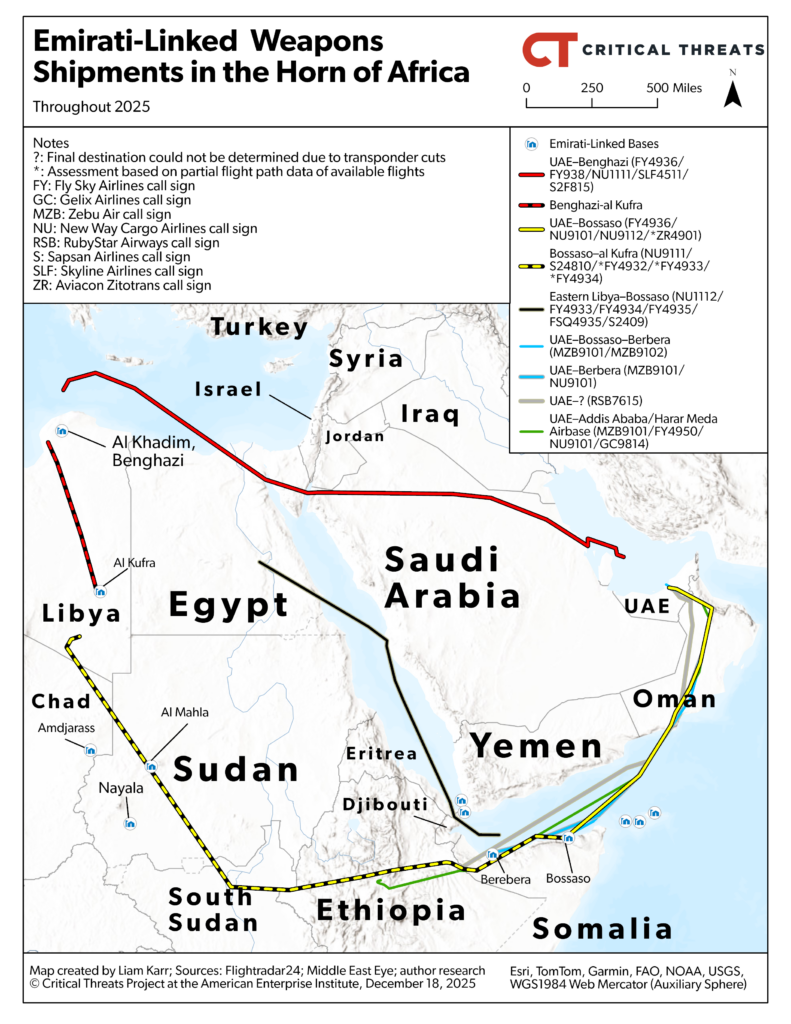
The RSF’s supply line challenges come amid recent setbacks for the RSF in central Sudan. The SAF partially broke the RSF’s sieges of Dilling and Kadugli—key towns on the main highway leading south from el Obeid, the SAF’s central Sudan headquarters—in late January and early February.[78] The SAF’s gains open another potential axis from which the SAF could attempt to advance toward RSF-controlled western Sudan.[79] The SAF has begun setting conditions for a westward offensive, conducting successful drone strikes on RSF air defense systems west of el Obeid in mid-February.[80]
Somalia
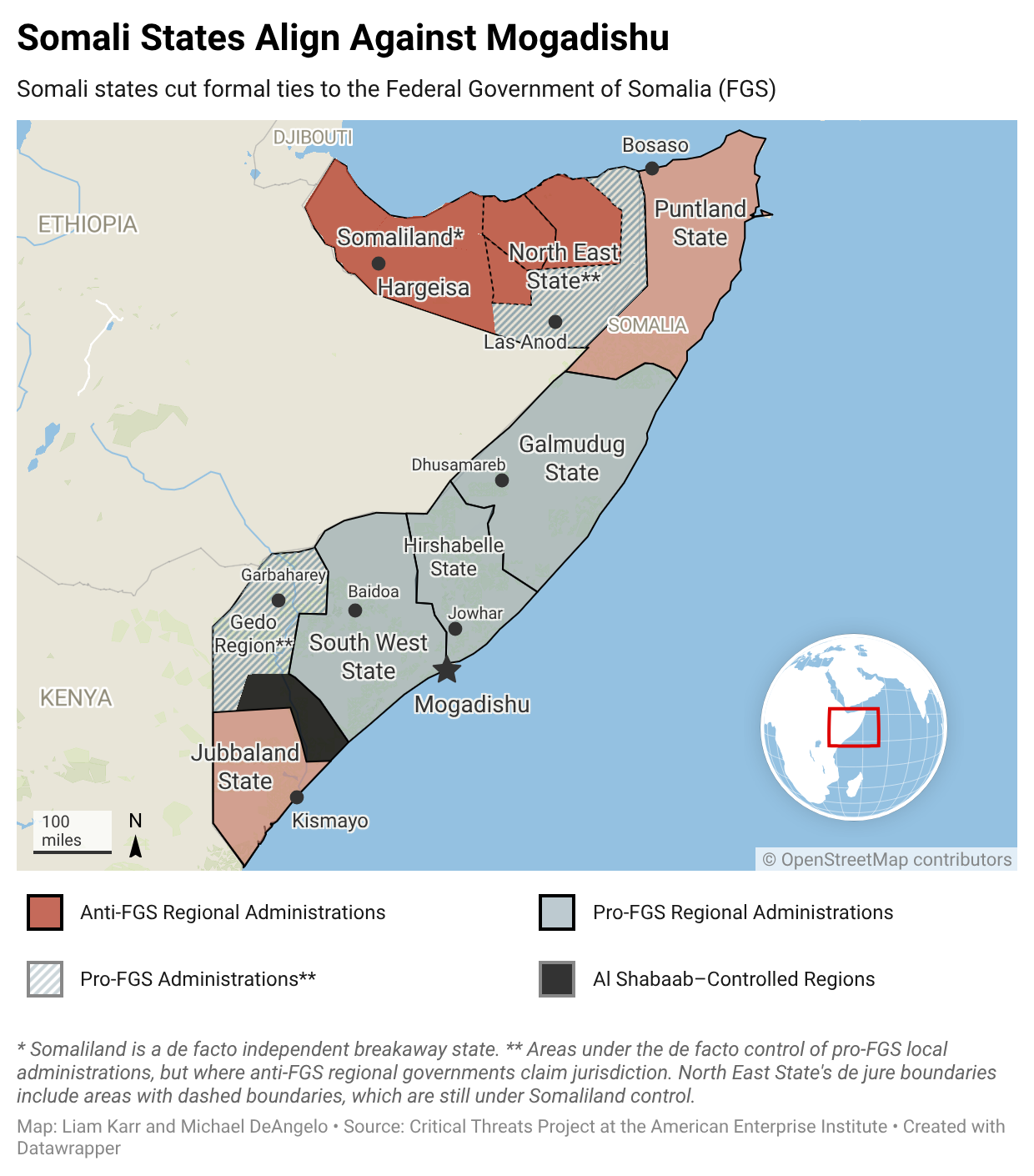
Talks between the Federal Government of Somalia (FGS) and leaders of the anti-FGS coalition to plan upcoming elections collapsed over long-standing constitutional and electoral disputes. Somali President Hassan Sheikh Mohamud began talks with Somali Future Council leaders, including Jubbaland state President Ahmed Mohamed Islam (Madobe) and Puntland state President Said Abdullahi Deni, in Mogadishu—the Somali capital—on February 19.[81] The talks focused on the FGS’s planned implementation of a direct election system for upcoming local, state, and federal elections in 2026, including planned federal presidential elections.[82] Deni, Madobe, and Somali opposition figures formed the Somali Future Council in October 2025 in opposition to the direct election system, as the new system would overturn the current clan-based quota parliamentary system, known as the “4.5 formula.”[83] Clan elders select parliamentary representatives who then select the federal and state presidents in the 4.5 formula, which ensures state and affiliated clan influence in the process.[84] The Somali Future Council wants the FGS to abandon its implementation of the direct election system without nationwide consensus on a constitutional and elections roadmap.[85]
The FGS reaffirmed its intention to implement the direct election system in all upcoming elections, which the Somali Future Council rejected.[86] Somali State Minister for Foreign Affairs Ali Balcad stated that implementation of the new system is nonnegotiable and that only logistical compromises are on the table.[87] The Somali Future Council reaffirmed its demand for indirect elections and a consensus-based constitutional process while accusing the FGS of negotiating in bad faith.[88] Madobe departed Mogadishu on February 23.[89]
The continued impasse makes election disputes and political violence between the FGS and Somali Future Council likely in upcoming elections. Political violence over elections has broken out several times since 2020. FGS forces with clan loyalties to then-Somali President Mohamed Abdullahi Mohamed (Farmaajo) clashed with FGS forces with clan loyalties to opposition leaders in Mogadishu during a delay to the federal presidential election in April 2021.[90] FGS forces clashed with Jubbaland forces in 2020, 2024, and 2025, with the disputes since 2024 occurring because Jubbaland held state presidential elections against FGS orders.[91] The FGS has refused to recognize Madobe as having won a third term.[92] Puntland disputed the FGS’s plan to hold local elections in disputed areas that Puntland claims on February 24, forcing the FGS to revise its election timetable and areas of administration.[93]
The Somali Future Council has established its own roadmap for the upcoming elections that rejects the FGS’s implementation of direct elections, which could lead the coalition to delay or boycott elections and hold parallel elections. The Somali Future Council has said since December 2025 that it would establish its own election processes unless the FGS reaches a consensus with the opposition on an elections roadmap.[94] A Somali Future Council member declared in mid-December that coalition would consider forming a parallel government if the FGS continued to implement the direct election system, matching a previous report.[95]
Figure 5. Somali States Align Against Mogadishu
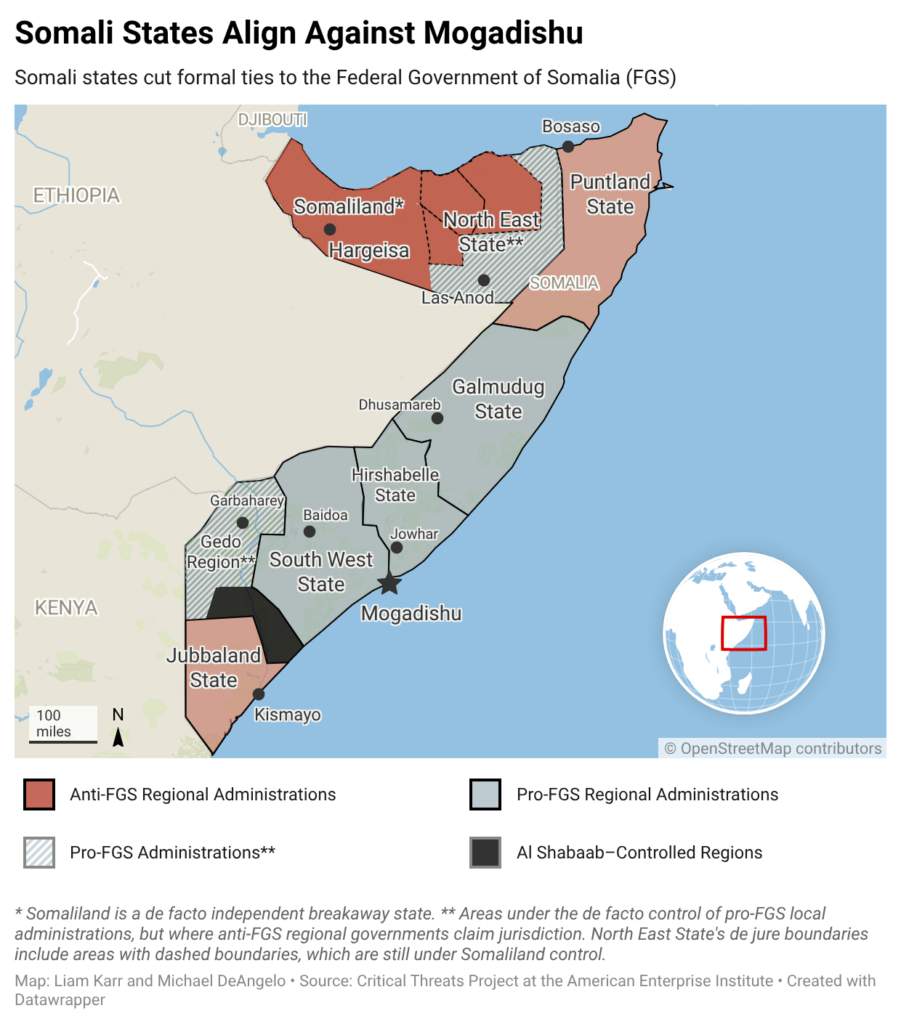
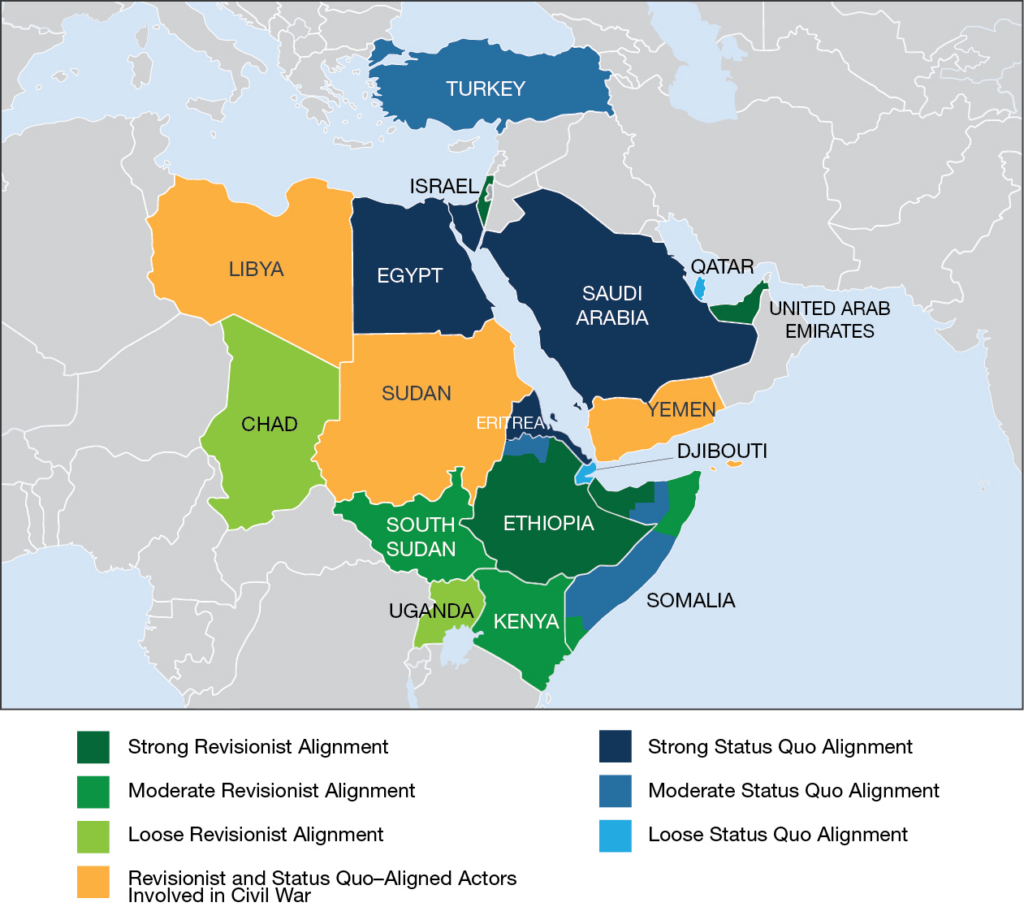
The elections could also attract foreign interference as rival Red Sea coalitions vie for influence in Somalia. The FGS canceled bilateral agreements with the United Arab Emirates (UAE) in January 2026 following Israel’s recognition of Somaliland as an independent state, which Israeli officials claimed the UAE facilitated.[96] The UAE retains strong ties with Jubbaland, Puntland, and Somaliland, however.[97] Ethiopia—a close Emirati ally—also has economic and military ties with Jubbaland, Puntland, and Somaliland.[98] Saudi Arabia and Egypt have bolstered relations with the FGS since the FGS downgraded its ties with their competitor, the UAE. Saudi Arabia and Somalia signed a defense pact on February 19, and Egypt, Saudi Arabia, and Somalia are reportedly finalizing a trilateral pact.[99] Egypt deployed over 1,000 troops to Somalia as part of the African Union Support and Stabilization Mission in Somalia in mid-February.[100]
Figure 6. Emerging Coalitions in the Red Sea Arena
West Africa
Ghana has increased outreach to the Alliance of Sahel States (AES) countries to boost bilateral security coordination and facilitate cooperation with the Economic Community of West African States (ECOWAS). Ghanian Foreign Minister Samuel Ablakwa met with his Burkinabe counterpart Karamoko Traoré and Burkinabe Prime Minister Rimtalba Ouédraogo to sign seven bilateral agreements aimed at enhancing security cooperation and deepening relations between the two countries from February 21 and 23.[101] The accords outlined a framework for cross-border cooperation, the creation of a joint commission to reaffirm the border demarcation, a mutual commitment to counter narcotics trafficking, and a pact formalizing cooperation on disaster prevention and humanitarian crisis management.[102] The agreements also included mutual recognition of national driver licenses and harmonizing transport regulations to facilitate regional commerce.[103] Ablakwa’s official working visit followed a deadly Salafi-jihadi attack in northern Burkina Faso on February 14 that killed at least seven Ghanian traders.[104]
Ghana’s rapprochement with Burkina Faso states are Ghana’s latest efforts to strengthen ties with the AES and mediate between AES and ECOWAS. Ghanian President John Dramani Mahama appointed retired Lieutenant Colonel Larry Gbevlo-Lartey as envoy to the AES, the first such role in an ECOWAS country, shortly after his election in January 2025.[105] Mahama visited Burkina Faso, Mali, and Niger a few months later in early March 2025.[106] Mahama hosted representatives from Burkina Faso and Mali for a high-level consultative conference on regional cooperation and security between January 29 and 30.[107] Liberian President Joseph Boakai and ECOWAS Chairman and Sierra Leonean President Julius Maada Bio also attended the January conference.[108]
Senegal and Togo have also tried to grow ties with the AES and mediate with ECOWAS. ECOWAS tasked the Senegalese and Togolese presidents to negotiate with the juntas as part of reunification efforts shortly after the AES first established a separate confederation in 2024, and both presidents have maintained open communication channels with the juntas.[109] Togolese Foreign Minister Robert Dussey said in early 2025 that Togo was even “considering joining the AES” to strengthen regional cooperation and offer sea access to the landlocked Sahel countries.[110] AES representatives met with Togolese leadership to discuss regional economic integration and trade reforms in October 2025.[111] Togo then extradited former Burkinabe junta leader Paul-Henri Sandaogo Damiba to Burkina Faso at the request of the Burkinabe government in January.[112]
Ghana’s outreach has not mended bitter regional divides involving Burkina Faso and Côte d’Ivoire and Benin and Niger. President Mahama opted not to invited representatives from Côte d’Ivoire and Benin, which are in a diplomatic dispute with Burkina Faso and Niger, respectively, to the January conference.[113]Burkinabe junta leader Ibrahim Traoré has maintained an adversarial posture toward Côte d’Ivoire and accused Côte d’Ivoire of plotting several coup attempts to overthrow him.[114] Burkinabe militias have also conducted repeated incursions across the Ivoirian border since 2025.[115] Benin and Niger have not had formal diplomatic relations since the Nigerien junta took power in 2023, after which Benin promoted ECOWAS sanctions against Niger and shut down their mutual border.[116] The Niger-Benin relationship has continued to erode due to disputes over border closures and access to a China-backed oil pipeline that carries crude oil from Niger.[117] Anonymous Beninese and Nigerien sources claimed that Niger had advanced knowledge of the thwarted coup plot in Benin in December 2025, and Niger accused Benin of being involved in the IS attack on the Niamey airport in January 2026.[118]