
This past month, the TDF clashed with the ENDF, Israel’s recognition of Somaliland has triggered mass demonstrations, and the suppression of opposition parties marked Uganda’s elections.
Ethiopia: The TDF clashes with the ENDF along the Tigray-Amhara border
During the last week of January, the Tigray People’s Liberation Front (TPLF)-led Tigray Defense Forces (TDF) launched coordinated operations to regain disputed territories along the Tigray-Amhara border. These developments marked the most significant confrontation between the TDF and the Ethiopian National Defense Force (ENDF) since the northern Ethiopia conflict ended in November 2022.
In western Tigray, clashes erupted on 26 January in the disputed Tselemt area after the TDF crossed the Tekeze River to seize control of the territory. Fighting between the TDF and ENDF continued on 28 and 29 January. In southern Tigray, TDF troops captured the disputed Alamata and Korem towns on 29 January after the ENDF withdrew its command post. In central Tigray, the ENDF carried out multiple drone strikes targeting vehicles in the Central Tigray zone on 30 January, reportedly killing at least one person. The TDF also fought the Tigray Peace Forces (TPF), an armed group of former TDF members seeking to remove the TPLF from the region. These clashes occurred in Wajirat, in the South Eastern Tigray zone, and Megale woreda in the neighboring Afar region on 29 January. The clashes continued in Afar on 30 January. Since the TPF’s formation in 2025, the group has clashed with the TDF eight times, in both the Tigray and Afar regions.
Though the Tigray interim administration said TDF troops had withdrawn from Tselemt on 1 February, the TPLF is using these armed clashes as a bargaining chip to renegotiate control of the disputed territories in western Tigray with the federal government.
Niger: Islamic State Sahel Province attacks Niamey airport and military base
On 29 January, the Islamic State Sahel Province (ISSP) attacked Niamey’s international airport and adjacent military airbase, resulting in the reported death of 20 ISSP militants, the injury and arrest of 11 others, and the injury of four Nigerien soldiers. ISSP also inflicted substantial damage to the Nigerien Air Force’s infrastructure and several aircraft. While the Islamic State’s (IS) Nashir newsletter attributes the attack on the Niamey airport to ISSP, a video from Amaq — another IS media outlet — shows IS militants speaking Kanuri, a language more commonly used in the Lake Chad basin. This may indicate that fighters from Islamic State West Africa Province (ISWAP) were deployed in support of this high-impact attack. Violence by Islamist groups is rare in Niamey. The only other incident in the past year involved the high-profile kidnapping of an American pilot on 21 October 2025 in the Plateau neighborhood.
The surrounding Tillaberi region continues to be the area of concentrated operations for ISSP, especially in the northwestern administrative departments. However, the Niamey airport attack aligns with a broader ISSP campaign to project violence into more densely populated and strategic locations. ISSP has already continued such activity in February, including an attack on a National Guard camp in the departmental capital of Ayorou. The Niamey attack raises concerns about ISSP’s expanding reach to urban areas, cross-regional collaboration with other IS affiliates, and evolving tactical capabilities.
See our latest expert comment, Reported drone use in the Niamey airport attack is the first-ever by ISSP in Niger — Comment from Ladd Serwat, and more of ACLED’s coverage on Niger.
Somalia: Israel’s recognition of Somaliland triggers mass demonstrations
Israel’s decision to recognize Somaliland as an independent country on 26 December, becoming the first country to do so, triggered a wave of demonstrations across Somalia and in Somaliland. Since then, ACLED records 110 demonstrations directly linked to the recognition. Only seven demonstrations — all in Somaliland — supported the move, while the remainder across Somalia, including within Somaliland, opposed it. Al-Shabaab organized 61 protests in territories under its control.
Israel’s decision has had wider geopolitical implications beyond Somaliland, reshaping regional alliances. On 12 January, Somalia’s Council of Ministers canceled port operation and security agreements with the United Arab Emirates, which maintains close relations with the Somaliland government. The council accused Abu Dhabi of facilitating Israel’s recognition of Somaliland and “undermining Somalia’s sovereignty, unity, and political independence.” 1UAE forces subsequently withdrew from bases in Puntland.2 Although widely supported domestically, this decision triggered six protests opposing the government’s move in states that maintain strained relations with the Somali government — four in Somaliland itself and one each in Puntland and Jubaland.
The heightened political tensions between the Somaliland and Somali governments came amid increasingly deadly fighting against al-Shabaab in the country’s south. From 21 to 24 January, large-scale clashes between al-Shabaab and government forces were reported in Kudhaa in Lower Juba, leading to some of the deadliest clashes since September 2023 that reportedly killed over 80 soldiers and 208 militants. Government forces regained control of Kudhaa on 21 January with the support of international forces’ airstrikes.
South Sudan: Deadly fighting escalates as the 2018 peace agreement falters
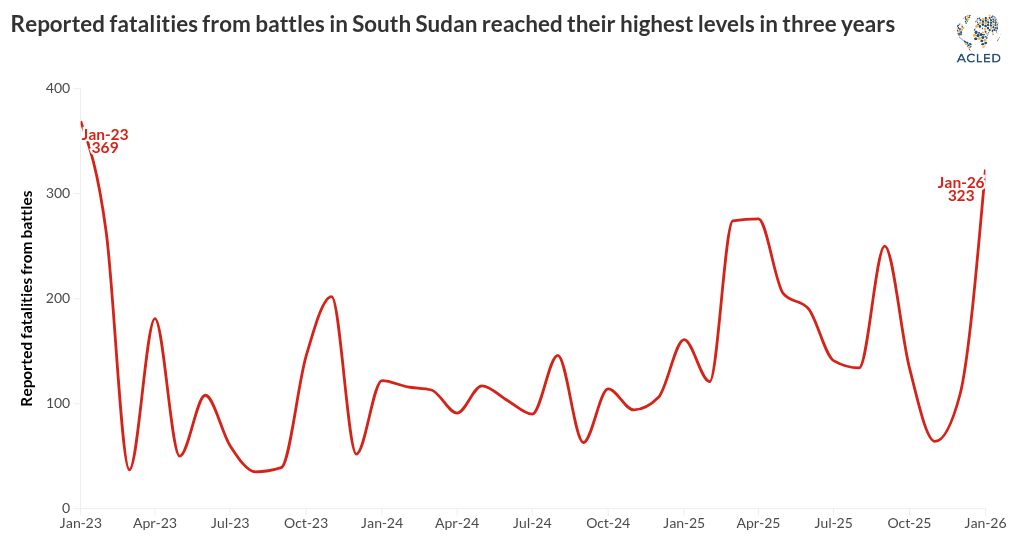
In January, the Sudan People’s Liberation Movement/Army-In Opposition (SPLM/A-IO) and allied Nuer-majority militias — especially the White Army — seized towns and government positions, forcing the South Sudanese army — formally known as the South Sudan People’s Defense Forces (SSPDF) — to retreat. The deadliest day of fighting last month took place on 2 January, when SPLM/A-IO and allied Nuer militants clashed with the SSPDF and took control of Yuai, the Uror County headquarters in Jonglei State, leaving at least 70 people reportedly killed, including both SSPDF fighters and civilians. Opposition commanders also issued threats to march on the capital, Juba, which is defended by the SSPDF and thousands of Ugandan troops.
Compared to December, fighting between government and opposition forces increased across Eastern Equatoria, Jonglei, Unity, Upper Nile, and Warrap states, with sustained clashes in Central Equatoria. The escalation follows a series of unilateral decisions by President Salva Kiir ahead of the country’s first-ever elections scheduled for December. Opposition actors view these moves as deliberate violations of the 2018 Revitalized Agreement on the Resolution of the Conflict in South Sudan, which are pushing armed opposition groups back to the battlefield. As a result, January became the deadliest month for battle-related violence in nearly three years since clashes involving Murle youth militias broke out in January 2023.
Sudan: The SAF breaks long-running sieges in South Kordofan
On 26 January, the Sudanese Armed Forces (SAF) broke the siege of Dilling, South Kordofan’s second-largest city. The Rapid Support Forces (RSF) and the Sudan People’s Liberation Movement-North (SPLM-N), led by Abdel Aziz al-Hilu, had imposed a blockade on Dilling since the early stages of the conflict. Since then, its only relief was a brief period from 24 February to 12 April 2025, when the SAF reopened the strategic road connecting Dilling with the state capital, Kadugli. Following the Dilling breakthrough in January, the SAF also broke the siege of Kadugli on 3 February after regaining control of routes it lost in April 2025. The end of the sieges of Dilling and Kadugli constitutes a significant breakthrough for the SAF, after the fall of West Kordofan’s Babanusa in December. The SAF and its allies may now seek to connect these cities with North Kordofan before pushing toward West Kordofan.
Mass atrocities have not ceased as the SAF continues to push through Kordofan, following its territorial consolidation in central Sudan. Between 15 and 17 January, the SAF and its ally, the Darfur Joint Forces, attacked civilians in several locations across North and South Kordofan after accusing them of supporting the RSF, reportedly killing at least 240 people.
Uganda: Security forces suppress opposition parties during the general elections
Uganda’s general elections on 15 January resulted in incumbent President Yoweri Museveni securing his seventh term in office and prevailing over seven presidential challengers. Leading up to the election, security forces frequently suppressed opposition campaigning, particularly rallies held by the National Unity Platform (NUP) under the leadership of presidential hopeful Kyagulanyi Ssentamu — widely known as Bobi Wine. Security forces routinely used tear gas, roadblocks, arrests, and violence to break up NUP rallies in at least 20 districts nationwide across the campaign period, underscoring the party’s broad geographic reach.
In January, this violence was most concentrated in Wakiso district, where Bobi Wine previously served as a member of parliament for Kyadondo County East and continues to maintain a strong support base.3 There, police violently disrupted NUP gatherings, and clashes occurred between rival political party supporters. Bobi Wine went into hiding following the election, while military and Special Forces Command personnel raided his residence in Magere, Wakiso district, resulting in the hospitalization of his wife, Barbie Kyagulanyi.