
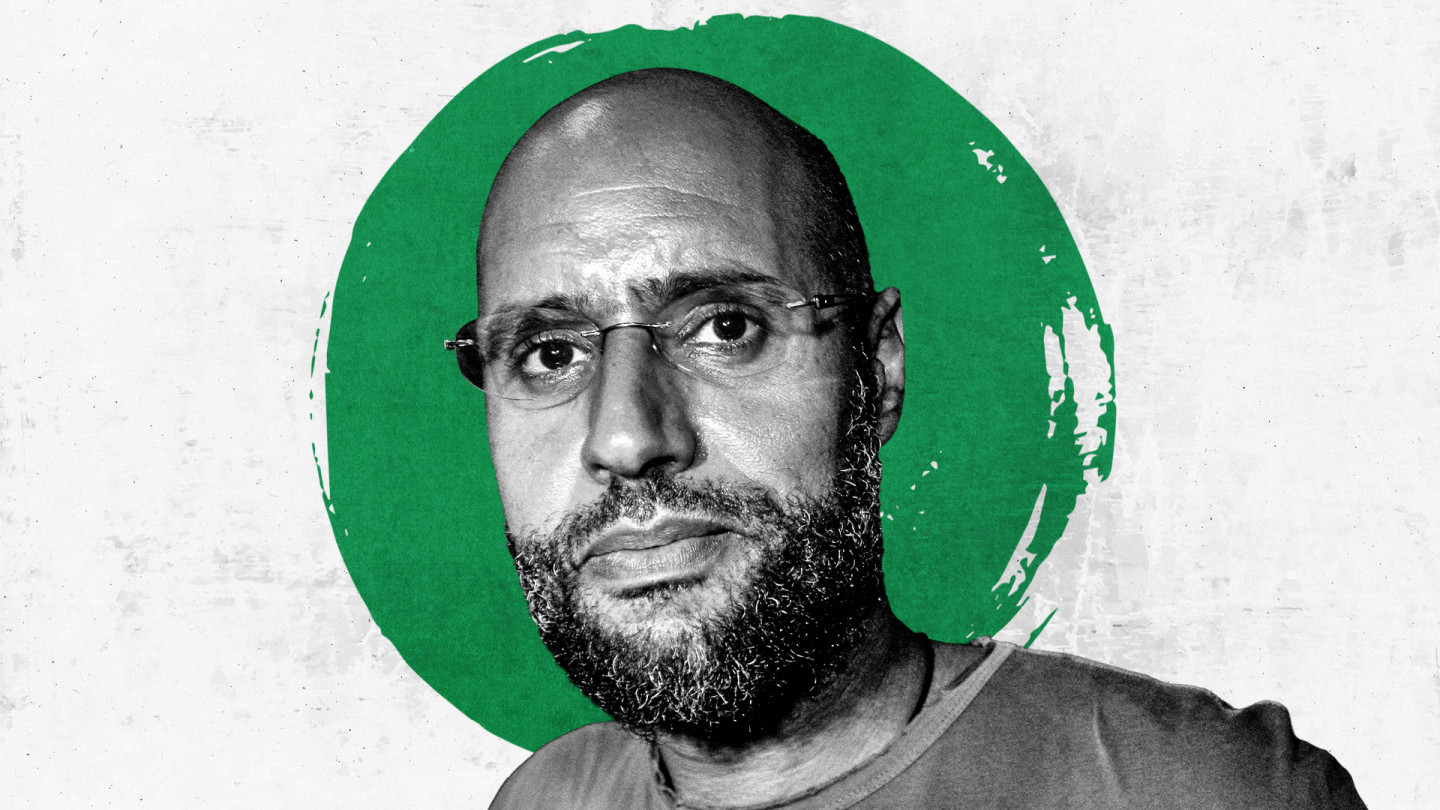
The killing of Saif al-Islam Gaddafi will further entrench Libya’s fractured status quo, deepening the conviction that the ‘New Libya’ is a failed experiment
As thousands descended on the mountainous Muammar Gaddafi stronghold of Bani Walid to pay their final farewells to Saif al-Islam Gaddafi, the atmosphere signalled a grim turning point for Libya’s ‘Green’ movement.
One of the only figures who could unify former regime-aligned security and political elites and other pro-Gaddafi communities, Saif al-Islam’s killing by four masked men on 3 February has forced both his supporters and foes to assess the implications.
Those who encountered Saif in the weeks before his death told The New Arab that he seemed surprisingly relaxed, projecting an air of confidence that seemed at odds with the high-stakes conflict surrounding his political ambitions.
In these final meetings, he often spoke of the Libyan desert as a space of freedom, a sentiment that underscored a profound, and ultimately fatal, reliance on local protection.
The entrance to Bani Walid, south of Tripoli, serves as a physical archive of the 15 years since Muammar Gaddafi’s demise, symbolising a gathering point for those nostalgic for the former regime after years of post-revolution violence and division.
A massive billboard greets those entering from the north – a grim gallery featuring the late Muammar Gaddafi alongside Saddam Hussein, flanked by images of Saif’s late brothers, Gaddafi’s defence minister Abu-Bakr Yunis Jabr, and various local figures who died defending the city in 2011.
Reports from the city indicate that Saif al-Islam’s own image is now being added to this pantheon, a gesture that underscores the city’s refusal to adopt the post-revolutionary national narrative.
This local iconography highlights a political environment where the 2011 revolution is viewed not as a beginning, but as an interruption.
It was within this climate of entrenched loyalty that the lead-up to the murder in Zintan took place, marked by a shift that was more subtle than a “death trap,” but equally lethal.
Over the last two weeks, a coordinated campaign of incitement emerged from a very few, specific individuals within Zintan – local power brokers and well-known influencers who began questioning his presence.
While such voices were not necessarily representative of the town’s general sentiment, Facebook acted as a massive amplifier, making a few ripples of discontent look like a tidal wave of local rejection.
Simultaneously, Tripoli-based influencers – linked to the capital’s political elite – began cross-posting these narratives, framing Saif al-Islam not as a guest under protection, but as a liability to the town’s future and a hurdle to the national elections.
There were no open calls for his blood, but the message was clear: the “unconditional” protection he had enjoyed should end. By the time the masked gunmen arrived, the digital groundwork had already isolated him, turning his relaxed security into a fatal vulnerability.
The ultimate question of “who” and “why” leads directly to those who found Saif al-Islam’s presence on the political chessboard most threatening. The security breach in Zintan – a town that successfully rebuffed every attempt to seize him for over a decade – was far too precise to be accidental. Indeed, almost every major domestic political player stood to benefit from his disappearance.
In 2021, the presidential elections were aborted at the last minute primarily because Saif al-Islam appeared poised to win after the courts cleared his candidacy – a latent popularity later confirmed by the massive crowds at his funeral.
By erasing the most viable alternative to the current transitional elite, these factions have cleared the path for a controlled electoral process that potentially could exclude the “Greens”, as his supporters are known, entirely.
His killing, therefore, ensures that the current power-sharing stalemate remains undisturbed, foreclosing any populist return that could upend the elite’s grip on state resources.
In the immediate aftermath, Libya’s Prosecutor General took charge, dispatching a team of experts to the scene. The head of Saif al-Islam’s political team, Abdulla Othman, expressed confidence in the official investigation, claiming the results were expected “within days”.
Saadi Gaddafi, Saif’s younger brother, echoed this sentiment, posting on X from exile in Turkey that the family is “awaiting the results” and “trusts the Libyan judiciary”.
However, when judged against the judiciary’s dismal record regarding previous assassinations and forced disappearances, optimism feels more like a diplomatic necessity than a grounded expectation. Within Saif’s camp, many believe foreign involvement is plausible. One legal expert in Bani Walid told TNA that some foreign powers may have had “every incentive to get rid of him”.
Libya’s entrenched political landscape
In 2021, Saif al-Islam registered as a presidential candidate, but elections were blocked by Libyan authorities days before they were due to begin on 24 December due to disputes over rules and regulations.
Weeks before, then British Ambassador Caroline Hurndall pointedly stressed that Saif remained an ICC fugitive who must “face the charges,” while then US Envoy Richard Norland later blamed “contradictory candidacies” – a clear reference to Saif – for derailing the vote.
This was not reflective of a universal consensus, however, with France and Italy thought to have been amenable to privately working with Saif al-Islam had he been elected.
As recently as last November, sources close to the Elysée and a “Greens” interlocutor confirmed that Paris and Rome viewed the “Green” constituency as a potential pillar of stability. This quiet European pragmatism stood in sharp contrast to London and Washington’s public rigidity, suggesting that Saif could have become a viable partner for at least some European powers.
His killing is compounded by a pre-existing legal vacuum that now threatens to swallow any hope of accountability. The escalating dispute between the Constitutional Chamber in Tripoli and the newly active Supreme Constitutional Court in Benghazi has left the Libyan judiciary in a state of terminal divorce.
With two rival supreme courts now issuing irreconcilable rulings on the legitimacy of state institutions, the official investigation into Saif’s death is born into a state of ‘constitutional schizophrenia’.
Even if the Prosecutor General’s findings were to be entirely objective, this judicial split ensures that the ‘Green’ camp will view any outcome with inherent suspicion. Without a unified judicial anchor to provide a verdict that all sides can respect, this assassination will inevitably be absorbed into the same cycle of impunity that has defined Libya’s post-2011 landscape.
The timing also extends far beyond a local vendetta, serving as a calculated blow to the fragile architecture of the UN’s latest “Structured Dialogue.” Launched by UNSMIL to bridge the widening constitutional divide, this multi-track process – spanning governance, security, and reconciliation – was intended to build a national consensus that has eluded Libya for years.
Saif al-Islam’s killing could effectively sabotage the “National Reconciliation and Human Rights Track,” which concluded its session on 29 January 2026, with a desperate plea for “judicial unity. It may also directly challenge the international community’s roadmap, signalling that, regardless of UN efforts, a domestic “veto” against a ‘Green’ constituency remains absolute.
Since 2017, when then-envoy UN Ghassan Salamé first integrated the Green movement by calling for the inclusion of those “ostracised” from the political process, the UN has consistently argued that no peace is sustainable without them.
By removing Saif, the perpetrators have potentially paralysed the reconciliation process for years to come, rendering the “inclusive” label a hollow promise – not because the UN lacks the will, but because the local players have the guns.
The unprecedented, sprawling turnout at Saif al-Islam’s funeral serves as a stark confirmation that the resurgence of ‘Green’ sentiment is more than a nostalgic echo; it is a damning indictment of the failure of post-revolution Libya to produce a viable alternative.
For a vast segment of the population, the promise of 2011 has collapsed into a bitter memory of disorder and deprivation. The vacuum left by the old state has not been filled by democracy, but rather by a predatory elite that thrives on a permanent state of transition.
In the end, killing Saif al-Islam may have cleared the political field, but it has at the same time only deepened the conviction for many that the ‘New Libya’ is a failed experiment.